

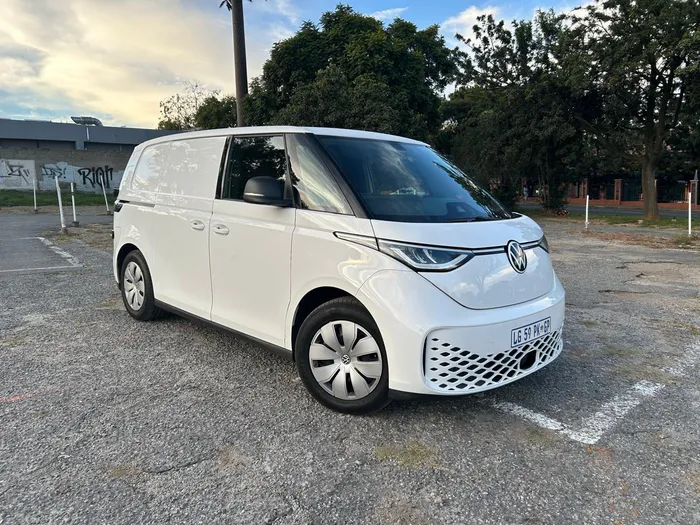
The front of the VW ID Buzz Cargo attracts a lot of attention.
Image: Jaco van der Merwe
I first saw the electric Volkswagen ID Buzz at the Frankfurt Motor Show in 2019 and was immediately enamoured by it.
I think it was partly because I’m a little older and grew up with Kombis, and also because my aunt and her husband had an older split-window two-tone camper-van set up that they travelled the country with, and I thought they were the coolest people ever.
The ID Buzz is not available in South Africa yet, and following a pilot test scheme with DHL Express in Joburg, Cape Town and Durban, selected media have been given an opportunity to drive it.
In Europe, they’re available in a variety of people movers and specifications with some very retro colour schemes, but the ID Buzz Cargo we had on test was vanilla white, as most standard delivery vans are.
Exterior
From the two front doors back, it’s standard VW delivery van fare with sliding doors on either side with large split rear doors, all of it to easily load goods and parcels. There is a rear spoiler, though, to break the monotony.
It’s from the front that it really attracts attention.
It has an almost futuristic combination with a retro look about it, with slim LED headlights connected with a lightbar split by a prominent VW badge.
Everything VW did wrong when they reintroduced the updated Beetle, they have managed to get right here.
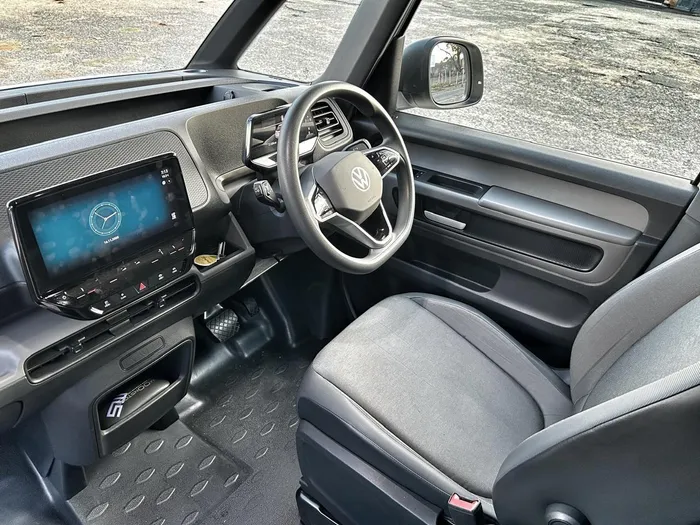
As a delivery van the interior of the VW ID Buzz Cargo is function over form.
Image: Jaco van der Merwe
Interior
Because it’s a delivery van, the area behind the bulkhead is cavernous with a 3.9 cubic metre cargo area, and the cockpit rather sparse. There’s no Apple CarPlay or Android Auto, but there is Bluetooth.
The driver gets a 5.3-inch instrument binnacle, and there's a 12.9-inch infotainment system.
The steering wheel houses the usual array of buttons, and there are physical dials and buttons for volume and climate control.
I did find it unusual that at 4.712 metres long and with no way to see behind you with the rear view mirror, there was not a reverse camera, only rear parking sensors.
Reverse parking using the side mirrors was a bit of a chore, but then again, I’m not a professional delivery driver who has backed into thousands of delivery bays.
Power
It’s powered by an 82kWh battery, which sends 150kW and 310Nm to a rear-mounted electric motor. VW says it will get to 100km/h in 10.3 seconds, and no matter how hard you try, it won’t go faster than 145km/h.
Fully charged, you should get between 350-400 kilometres of range and with a fast DC charger, take half an hour to get to 80 percent.
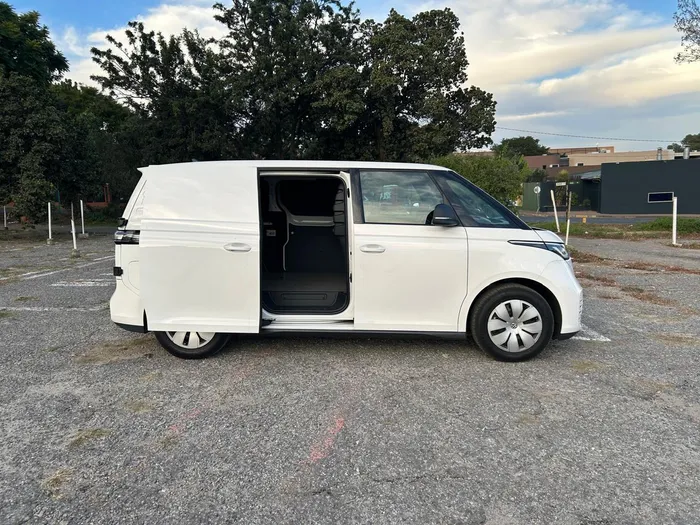
The VW ID Buzz Cargo It’s powered by an 82kWh battery producing 150kW and 310Nm.
Image: Jaco van der Merwe
Driving
The ID Buzz Cargo has a keyless start, and you’re surrounded by ample storage spaces.
The big glass windscreen and windows provide very good front and side views, but it takes a while to get used to manoeuvring it because of its size and limited rear visibility.
With its instant torque, it hustles along quickly and once up to speed, it’s a breeze in traffic.
Given that it’s a panel van, I found the drive to be very comfortable, and I would love to get behind the wheel of the passenger version, which should be even better.
Verdict
Volkswagen Group Africa has, over the past few years, brought in the eGolf, ID.3 hatchback and ID.4 SUV to test the waters.
Considering the capital needed to import, sell, service and maintain, coupled with our ambivalent feelings towards BEVs, it’s understandable that the manufacturer has put the Battery Electric Vehicle ID range on the back burner for now.
For its intended purpose, the ID Buzz Cargo makes perfect sense as a fleet vehicle.
However, until there are decent incentives and they’re not excessively taxed, you can’t blame them for taking a step back.