

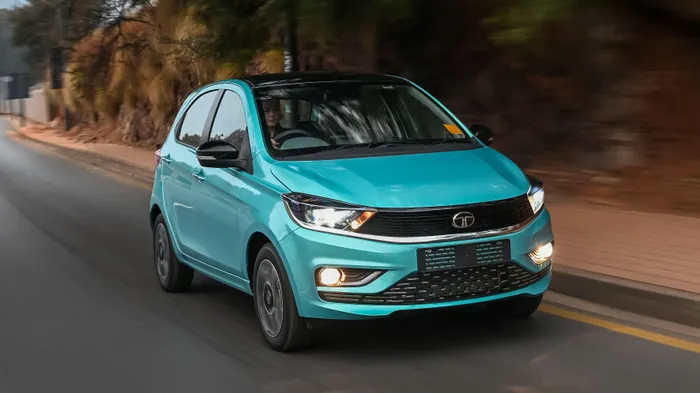
The Tata Tiago is one of South Africa's most affordable cars.
Image: Supplied
If we judged cars purely by what they looked like “on paper”, or I guess we’d have to say “on a screen” these days, as it’s no longer 1986, then the new Tata Tiago could easily be deemed as the best car in its class.
The thing is, that’s not a very big class, because there really aren’t many cars priced around the R200,000 mark anymore.
Spearheading the Indian brand’s local reboot at the entry end of the market, the Tiago costs R184,900, while the more ‘luxurious’ XT manual that we sampled recently, sells for R209,000, and those willing to brave the AMT automated gearbox will part with R224,900 for that version.
Its competitors include the Toyota Vitz and Suzuki Celerio twins as well as the Renault Kwid and Suzuki S-Presso.
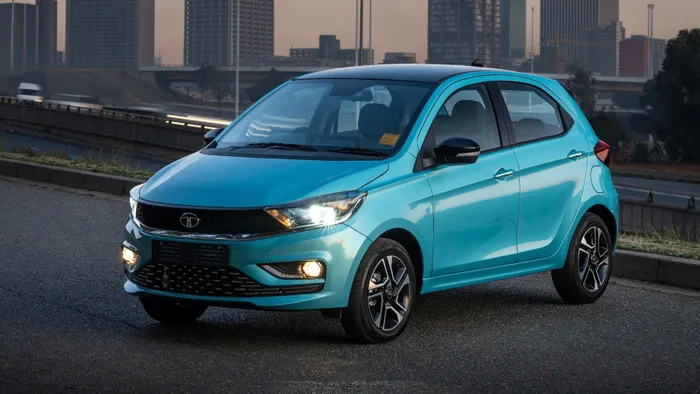
Its clean lines are mostly easy on the eye.
Image: Supplied
At 3,767mm in length, the Tata Tiago is somewhat larger than its rivals, fitting somewhere between a Suzuki Celerio and Swift. It is also, in our most humble opinion, the best looking car among this herd. Although it’s hardly a headturner, its lines are neat and handsome and it manages to appear more like a proper hatchback than a budget city car.
ALSO READ: These are the best (and worst) new cars you can buy for less than R200,000
Power comes from a 1.2-litre normally aspirated Revotron petrol engine with three cylinders, which pairs with a five-speed manual or automated manual (AMT) transmission. We haven’t driven the latter, but this gearbox type usually lacks the smoothness associated with a conventional auto.
The Tiago is relatively well-equipped.
The base version ships with a 3.5-inch infotainment system with two speakers, as well as aircon, remote central locking, park distance control and electric windows.
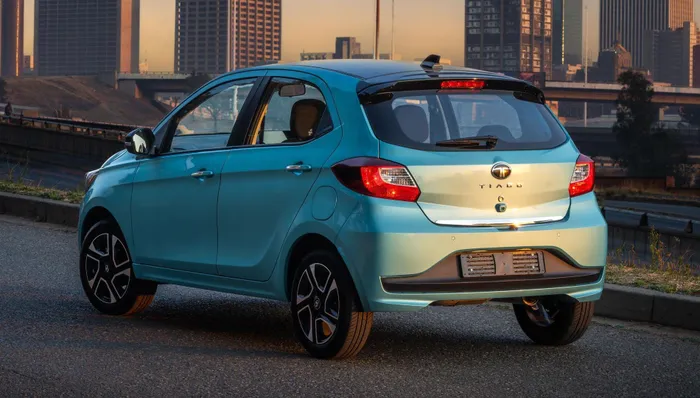
Power comes from a 1.2-litre engine.
Image: Supplied
The XT gains a larger 7.0-inch touchscreen with reverse camera, multi-function steering wheel, two extra speakers, HillHold and ESP stability control.
While its four-star Global NCAP rating is impressive, it is a pity that only two airbags are fitted, whereas rivals such as the Celerio now offer six. Though an airbag count of two is not unusual in the entry class, the Tiago could have been the undisputed safety champion of its class, but now its side-impact protection could be a concern.
Interior functionality is a mixed bag.
Cabin space is reasonably decent, and I could fit my average-sized frame behind my driving position without too much of a squeeze.
The 242 litre boot has a deep loading area and is as commodious as you could expect at this level, but accessing it is a pain as you literally have to insert the key into a keyhole on the tailgate and twist. The parcel shelf also lacks strings, making the loading and unloading process a bit of a chore. One of the plastic panels in the boot also came loose during my test drive.
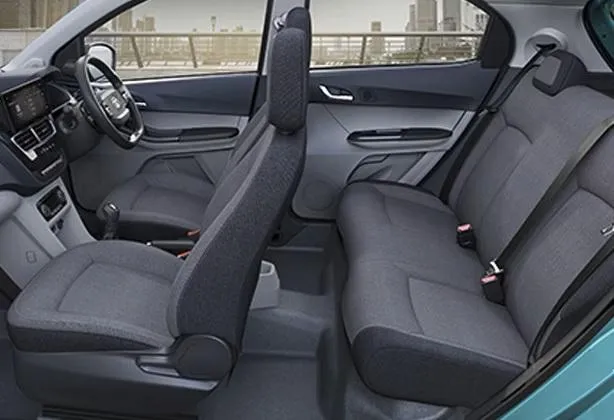
Cabin quality is a mixed bag.
Image: Supplied
The cockpit area has a pleasant and mostly user-friendly design, but many of the plastic surfaces feel cheap, even by budget car standards. That’s probably not a dealbreaker, but I did wonder why Tata saw it necessary to fit a ‘digital steering wheel’, which, on startup, illuminates the badge from behind a sheet of gloss black plastic that looks almost like a screen.
Are we not just being different for the sake of it here?
I mean, a volume knob would have been nice.
On the road, the Tiago feels willing enough, but the fact that it has a more powerful engine than its main rivals is cancelled out to a degree by its increased weight and size - with the Tata tipping the scales at 980kg.
Fuel consumption amounted to 6.4 litres per 100km in a mixture of driving conditions, which is reasonably good for a vehicle of its size and weight.
I didn’t completely enjoy the driving experience as the clutch feels spongy and the gearbox is a bit notchy. You eventually get used to it, but it’s not the epitome of smooth.
Thankfully the ride quality is. This is something Tata has almost always gotten right and for an entry-level car the Tiago does absorb bumps in the road rather well.
Compared to many of its ‘city car’ rivals, the Tata Tiago has a more substantial look and feel, almost elevating it to the class above.
However, there are a few quality and ergonomic bugbears that detract from the package. It’s well worth a test drive, but be sure to spend some good time with it before signing on the dotted line.
IOL Motoring