

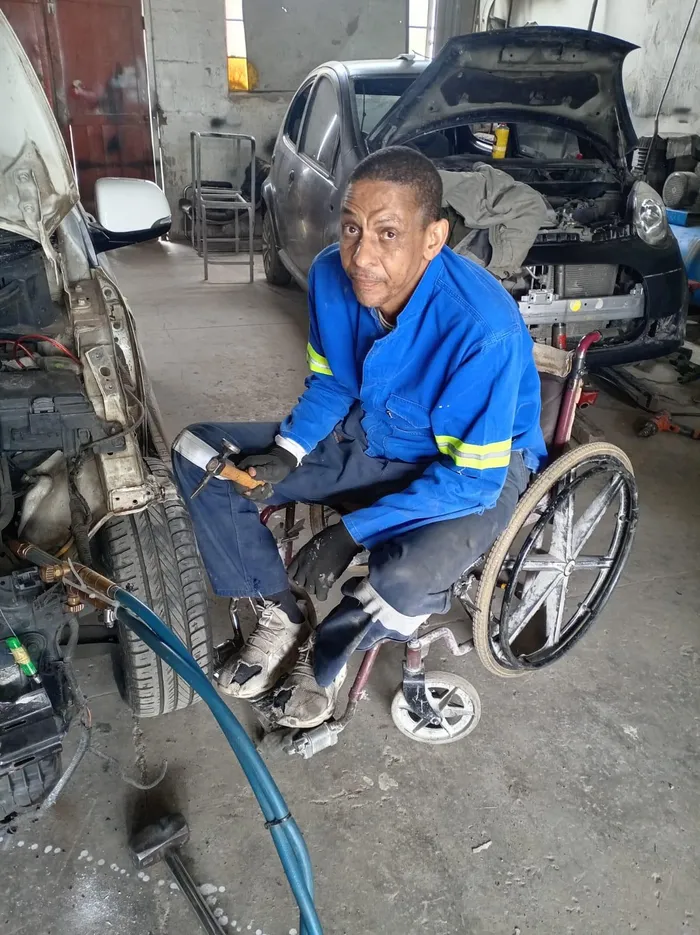
Mike Munro, a paraplegic, requires funding to expand his car-repairing business.
Image: Bongani Hans
Some emerging business owners in Pietermaritzburg, in KwaZulu-Natal, claim they do not know anything about the Industrial Development Corporation of South Africa (IDC), which was established to help their businesses grow.
A visit to various businesses in the area, including those that create aluminum doors and windows, repair cars, cover sofas, and repair car seats, revealed widespread unawareness of available funding opportunities.
Despite small businesses claiming ignorance of the IDC, the entity said it promotes its funding activities through regional offices and partnerships, but acknowledged the need to enhance visibility and engagement with young black entrepreneurs, "especially via digital channels and awareness campaigns".
IDC spokesperson Tshepo Ramodibe said it was untrue that the IDC had strayed from its developmental mandate.
"Over the past three years, IDC has facilitated R41 billion for Black Industrialists, R58.2 billion for Black-owned and Black-empowered businesses, R18.1 billion for women-owned businesses, and R2.6 billion for youth-owned businesses.
"The majority of IDC’s 592 business partners in South Africa are black-owned, underscoring our commitment to transformation and inclusion," said Ramodibe.
Ramodibe said through its unit, the Small Business Finance (SBF), the IDC supports Small and Medium Enterprises, including in townships.
"The SBF provides funding between R1 million and R20 million," he said.
He said through its Khoebo Innovation Promotion Programme, IDC drives grassroots innovation through grants, quasi-equity loans, and incubation support, which he said to date, has seen 19 township applications worth R67 million have been approved for empowering youth and women entrepreneurs.
"In the past five years, IDC has invested R13.7 billion in businesses across key sectors, including agro-processing, automotive, machinery, textiles, wood products, and tourism," said Ramodibe.
The IDC was established in 1940 through the Industrial Development Corporation Act. It is an entity of the Department of Trade, Industry, and Competition.
According to its website, the IDC’s purpose is to provide funding to small industries owned by previously disadvantaged black people in general, women, and youth to grow and create job opportunities
“We support industrial capacity development proactively identifying and funding high-impact projects, creating viable new industries, and using diverse industry expertise to drive growth in priority sectors.
“This is done to facilitate sustainable direct and indirect jobs; promoting entrepreneurial development and growing the SME sector; and transforming communities and growing black industrialists,” read the website.
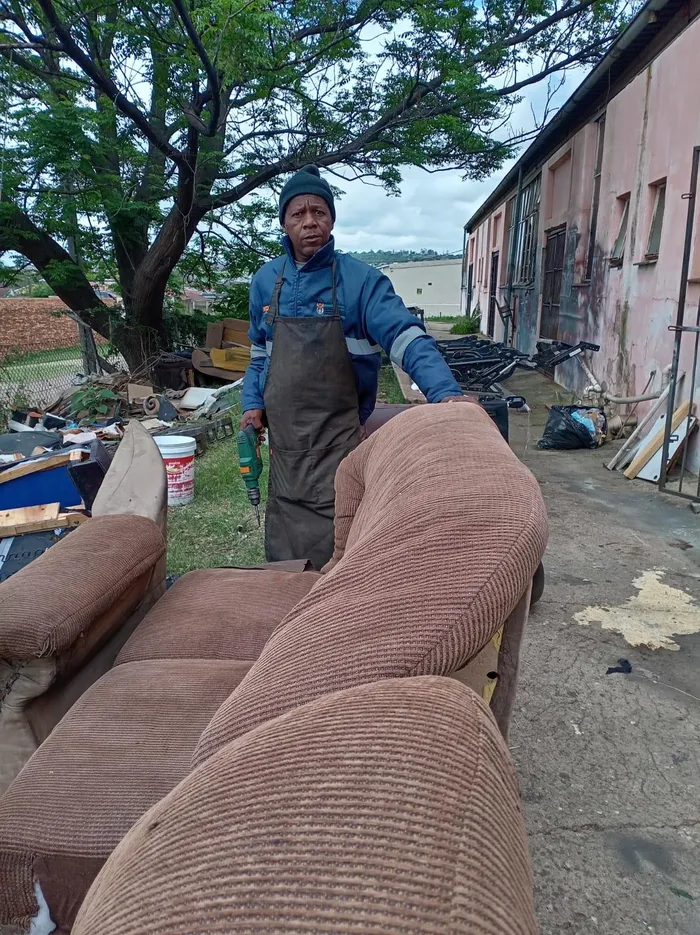
Sandile Khumalo's KTT Upholstery business has been operating for more than 20 years without growth.
Image: Bongani Hans
The National African Federated Chamber of Commerce and Industry (NAFCOC) has raised concerns about the IDC's failure to execute its mandate of supporting township enterprises.
Mike Munro, a paraplegic depending on a wheelchair, has been operating a small car-repairing business in Imbali township outside the city since 2011.
Most businesses operating in Imbali are tuck shops, restaurants, welding, car repairing, brick manufacturing, and clothes sewing.
Although Munro does not know what the IDC is, he said he had tried to phone several public institutions looking for funding, but was unsuccessful.
Munro needs funding to relocate his business to a bigger workshop because the one he is paying R6000 rent a month for at the local industrial centre is too small to accommodate the volume of his customers.
“Even insurance companies do not allow their clients to bring their vehicles to this workshop, which is registered, because I don’t have enough space,” he said.
He said he needs money to buy more tools.
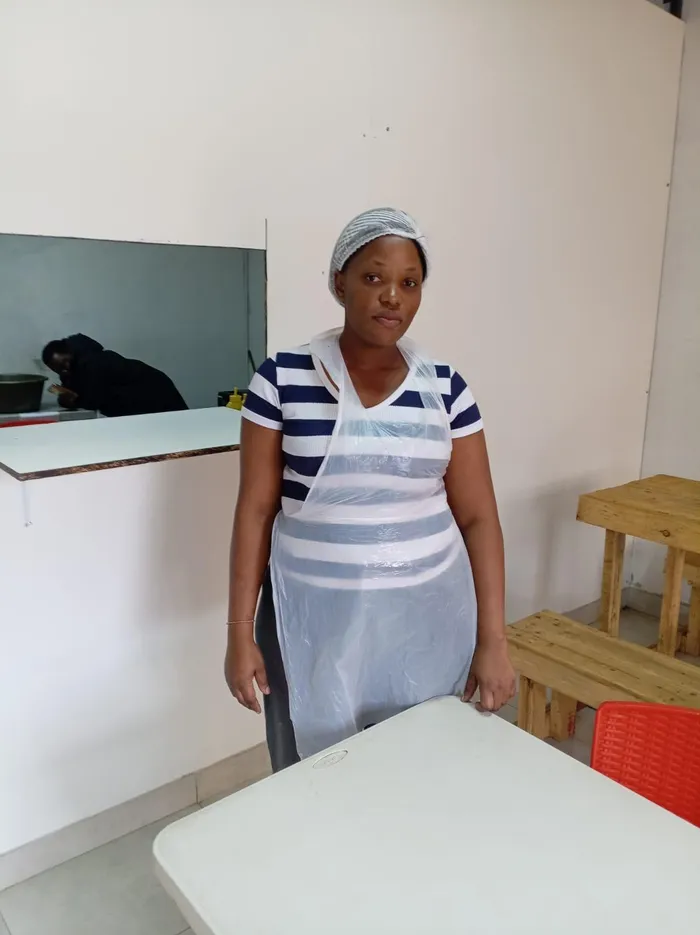
Ziphozonke Mkhize has been struggling for years to keep her restaurant running because she does not have money.
Image: Bongani Hans
Sandile Khumalo, whose KTT Upholstery had been operating for more than 20 years without growth, is also unaware of the IDC’s existence.
He said that, although his business is not growing because of the lack of tools, it helps him to sustain his family.
“I wish I could grow bigger and manufacture sofas, but I don’t have money for that, and I would need a bigger space to operate effectively.
“I need funding so that I can at least buy two sewing machines, which each cost around R11 000, and a sewing table, which costs around R9 000, because having the right tools makes work go faster,” he said.
Xolani Nyembe, who for more than 20 years has been manufacturing aluminum doors and windows, said understanding of how the IDC operates would help him to apply for funding.
Ziphozonke Mkhize is desperate for funding for her restaurant, which for many years has been struggling to survive.
“National Youth Development Agency funded me with R50 000 to start this business, but I need at least R20 000 more so that I can get more equipment, such as a laptop to keep records.
“I also need training to know how to manage the business,” she said.
In a statement released on Monday, NAFCOC complained that for many years, black-owned businesses had been receiving inconsistent funding from the IDC.
It said this undermined black-owned enterprises “while benefitting established or white-dominated firms.”
“We are witnessing a troubling trend where black entrepreneurs face endless red tape, only to see their projects deliberately delayed, collapsed, or arrogantly auctioned at ridiculous prices — often without proper explanation.
“This behaviour is inconsistent with the spirit of transformation and with the IDC’s own mission to promote equitable industrial development and implementation of the black industrialists programme,” said NAFCOC Secretary-General Richard Zulu.
Lesedi Black Business Forum (LBBF) president Tshepo Mazibuko was concerned that while huge industries were shutting down in his Heidelberg hometown in Lesedi Local Municipality, Gauteng, young people are left unemployed because they do not have the means of creating their own employment.
He said British American Tobacco, which was the main employer, reduced its operations.
LBBF held a symposium on Wednesday to discuss the problems created by industrialisation.
“The British American Tobacco used to be the leading employer when it comes to manpower and contracting opportunities, but now they are on the brink of closing down and most of the members have lost their contracts,” said Mazibuko.
He said the forum was trying to find ways to keep big industries in the town.
Mazibuko blames poor government leadership for young people failing to create job opportunities.
“It is appalling that 30 years into this dispensation, the youth are worse off than before.
“That is attributed to the leadership and you could see that we do not have true leadership,” said Mazibuko.
* This story has been updated to include comment from the IDC who, through an error, were not approached for comment in the original published version.
**The error is regretted and we apologise unreservedly for any inconvenience caused.
bongani.hans@inl.co.za