

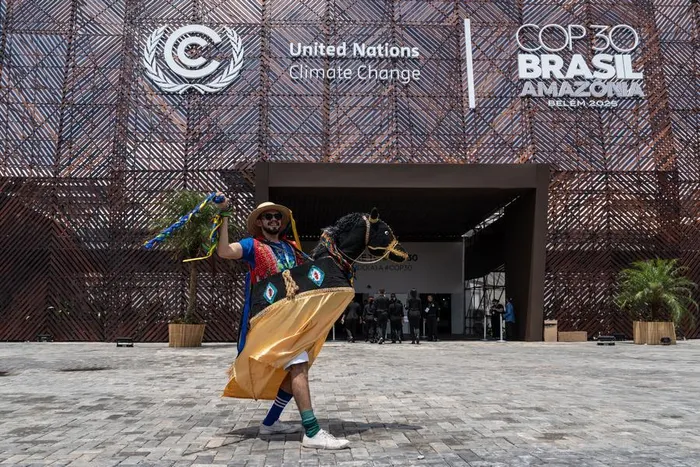
A performer wearing traditional attire poses for a photo in front of the COP30 venue in Belem, Brazil, Nov. 6, 2025.
Image: XINHUA
The climate negotiations at COP30 in Belém have been marked by urgency, geopolitical tension and a focus on the Global South’s leadership in shaping climate ambition. One unexpected controversy arose from Germany’s Chancellor Friedrich Merz, whose comments comparing Brazil to Germany provoked criticism across Brazilian media and political circles.
Germany has long been a key player in global climate diplomacy. Merz’s remarks, however, show how tone and perception can influence international relations. Brazil’s reaction highlights how seriously the Lula administration takes its role not only as host of COP30 but as a leader in climate justice, forest protection, and the interests of developing nations.
German leaders traditionally attend UN climate summits, and Merz followed this precedent with a brief visit to Belém. Returning to Berlin, he told a trade conference that he asked journalists in Brazil if any wanted to stay. According to him, no one raised their hand and all were happy to return to Germany.
In Germany, the comment was framed as an offhand remark contrasting domestic challenges with conditions elsewhere. In Brazil, however, it was seen as disrespectful. Igor Normando, the mayor of Belém, called the statement arrogant and prejudiced. Brazilian media described it as an outrageous comparison and a reflection of a Western bias that underestimates Brazil’s global importance.
President Lula responded with humour, suggesting that Merz should have experienced Belém’s bars, local cuisine, and culture. Lula remarked that Berlin could not provide even a fraction of the quality of life that Belém offers. Behind the humour was a serious point: Brazil expects respect from countries attending COP30.
Germany’s approach to climate diplomacy remains significant but complicated. The country faces internal challenges, including debates over energy transition, pensions, and social cohesion. Merz’s statement came shortly after another controversial remark regarding immigration. For Brazilian audiences, these comments reinforced a sense that some wealthy nations still fail to recognise the leadership and value of the Global South in climate negotiations.
The German government attempted to soften the impact. A spokesperson emphasised Merz’s constructive meeting with President Lula and expressed regret that the chancellor had not seen the Amazon’s natural beauty in person. Despite these assurances, the incident illustrated that diplomacy depends on respect as well as policy.
COP30 is more than a climate conference for Brazil. It is a moment for the Global South to assert its influence. President Lula called this gathering “the COP of truth,” signalling a focus on honest dialogue and meaningful action. Brazil aims to:
Holding the conference in Belém was a deliberate choice. It draws attention to the Amazon, highlights the experiences of communities facing environmental challenges, and encourages visiting leaders to engage with local realities. Merz’s remarks were seen as undermining this effort.
Several major issues are shaping negotiations:
Global targets remain below what is required to meet the Paris Agreement goals. Brazil is advocating for voluntary revisions, pressing countries to act sooner rather than waiting for the next five-year cycle.
Low-income nations require support for adaptation to climate impacts. Without clear finance mechanisms, progress in negotiations may stall.
Brazil is leading efforts for a just and rapid transition from fossil fuels, supported by more than 60 countries. Fossil fuel interests remain influential, making consensus challenging.
The Baku–Belém Roadmap outlines a target of $1.3 trillion annually by 2035. Developed nations must provide high-quality finance, rather than relying on uncertain private sector loans that increase debt for vulnerable countries.
Brazil’s forest protection initiative has received limited funding. Its success depends on support from the international community and the protection of Indigenous peoples’ rights.
The Fund for Responding to Loss and Damage has launched its first call for proposals, but the initial $250 million is insufficient to address the scale of climate disasters affecting the Global South.
For decades, climate negotiations have been marked by a trust gap between developed and developing nations. Merz’s comments were a reminder of the sensitivity surrounding this issue. The Global South is seeking fair treatment, meaningful engagement, and leadership recognition in climate policy. Brazil, as host, is the focal point for these demands.
Brazil’s significance comes from multiple factors:
COP30 is not just about climate agreements. It is a moment for Brazil to assert moral and scientific leadership and to ensure that developing nations have a voice in global climate decision-making.
The controversy over Merz’s remarks illustrates that climate diplomacy is not only about agreements and targets. It is also about respect, recognition, and equitable engagement. Brazil has positioned itself as a central leader in this process through COP30. Its role as host, its advocacy for high-quality finance, and its push for a just transition demonstrate the country’s growing influence in global climate governance.
For COP30 to succeed, developed countries must close the ambition gap, deliver on climate finance, and support a fair transition away from fossil fuels. Brazil has set the tone, and now the international community must rise to meet the challenge. Chancellor Merz’s comments serve as a reminder that diplomatic tone matters as much as policy, and that recognition of the Global South’s leadership is essential for global cooperation.
Written By:
*Dr Iqbal Survé
Past chairman of the BRICS Business Council and co-chairman of the BRICS Media Forum and the BRNN
*Cole Jackson
Lead Associate at BRICS+ Consulting Group
Chinese & South American Specialist
** MORE ARTICLES ON OUR WEBSITE https://bricscg.com/
** Follow https://x.com/brics_daily on X/Twitter for daily BRICS+ updates