

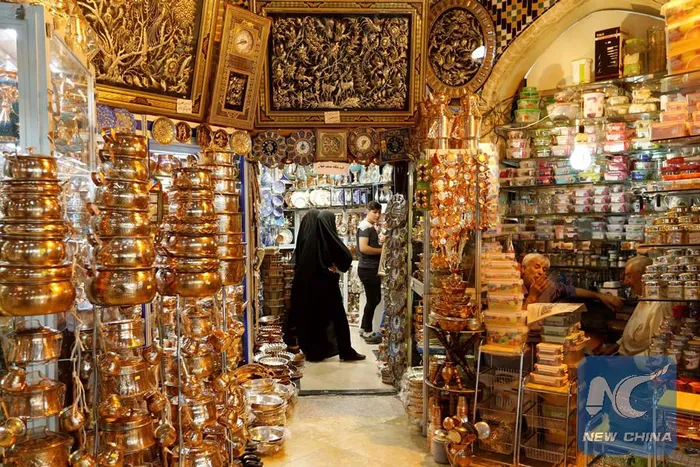
Iranian women shop at Tehran's ancient Grand Bazaar in Tehran on July 28, 2018.
Image: xinhua
Iran’s renewed push into African markets is gathering momentum in ways that say as much about the continent’s strategic value as they do about Tehran’s evolving foreign policy. What began as modest commercial outreach has now become a deliberate effort to rebuild economic bridges, diversify political partnerships and participate more actively in Global South realignments. The recent spike in exports, US$675 million in just the first half of Iran’s current calendar year, signals more than a trade recovery. It reveals a shift in both ambition and opportunity for two regions seeking alternatives to traditional economic corridors.
For Iran, deeper engagement with Africa is partly a response to long-standing economic isolation. Years of sanctions have narrowed its access to global finance, shipping routes and technology transfers, making diversification not simply a strategic choice but a survival mechanism. African markets spanning 1.4 billion people and a fast-expanding consumer base, offer precisely the scale Iran needs to reduce its vulnerability to external pressure.
Africa, meanwhile, is pursuing its own diversification agenda. Many states are working to break historic dependence on former colonial partners, experiment with new financing models, and build value chains that turn raw commodities into higher-value exports. In that context, Iran represents an additional partner. An actor outside the traditional power blocs, capable of supplying industrial inputs, petrochemical products, pharmaceuticals and agricultural technologies at competitive prices.
This convergence of interests explains why Tehran has established specialised committees focused on logistics, air transport, credit lines, agricultural cooperation and other technical enablers of trade. It also explains why an Iran–Africa Summit is already being planned for 2026. Both sides recognise the moment and the potential impact.
The growing Iran–Africa footprint cannot be separated from the wider realignment taking place across the Global South. As emerging economies deepen their production capacity and expand trade routes among themselves, the geography of global commerce is shifting. Iran’s trade expansion mirrors a broader BRICS+ trend, the push for value-added manufacturing, market diversification and more equitable South–South partnerships.
Vietnam’s soaring coffee revenues this year, surpassing the US$8 billion mark years ahead of schedule show how strategic product upgrading and sustainable processing can transform a developing-country export sector. Brazil’s record-breaking agribusiness earnings reflect a similar story of how emerging economies are no longer only suppliers of bulk commodities but increasingly suppliers of processed, high-quality goods with sophisticated supply chains behind them.
Iran fits into this pattern in its own way. While its export basket remains weighted towards energy-linked and industrial products, the principle is the same, greater value capture at home, and wider markets abroad. As BRICS grows, both in membership and economic reach, African governments are calculating where Tehran fits into new trade corridors that bypass older, restrictive systems.
Several African countries already import Brazilian beef and sugar at record levels, source Vietnamese processed coffee, and purchase Iranian petrochemical inputs. What is emerging is not a random scattering of transactions, but a denser web of South–South commercial flows driven by shared development goals and increasingly complementary supply chains.
The implications stretch beyond trade statistics. Iran’s long-term interest in Africa suggests a shift toward more politically autonomous economic alliances. African states, too, are cautiously exploring partnerships that allow them to negotiate on better terms, financially, technologically and diplomatically.
If Iran continues on its current trajectory, its presence in Africa could reshape energy cooperation, technology transfer in agriculture, and infrastructure financing mechanisms that suit the needs of emerging economies rather than the preferences of international lenders. African governments are also aware that competition among Global South suppliers like Brazil, India, China, Türkiye, the Gulf states and now Iran, can work in their favour, lowering costs and widening choices.
What stands out is less the volume of Iran’s trade than the direction of its strategy: outward, diversified and aligned with the restructuring underway in BRICS and the Global South. This movement is not framed as ideological outreach but as practical cooperation. It is commerce anchored in development needs of food security, industrialisation, transport corridors and new markets for finished goods.
The challenge for both sides will be to ensure that the momentum translates into durable partnerships. African countries need guarantees on logistics reliability, fair pricing and financing that does not create new debt traps. Iran, for its part, must continue building institutional structures, such as shipping routes, credit mechanisms and policy coordination platforms that make long-term trade predictable.
If these issues are addressed, the Iran–Africa relationship could become one of the more interesting case studies in South–South cooperation over the next decade. It represents an alternative pathway to global integration, shaped not in the boardrooms of traditional powers but through practical connections between emerging economies seeking resilience and autonomy. The numbers may have sparked the headline, but the real story lies in the political and economic rebalancing quietly taking shape behind them.