

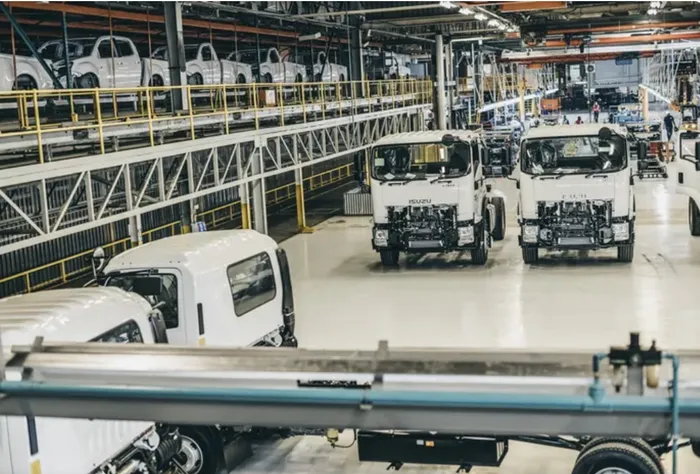
Isuzu Motors South Africa (IMSAf) has created a more efficient manufacturing footprint in South Africa through the consolidation of its truck and bakkie manufacturing plant in Port Elizabeth at a cost of R27million.
Image: INTERNAL
When most people think about Africa's development challenges, vehicles rarely top the list. I’ve learnt however from an Isuzu corporate engagement at the UCT Graduate school of Business that if you dig deeper, a pattern emerges: mobility isn't just about moving people, it's about moving economies. Isuzu South Africa's approach to the African market offers a masterclass in localised industrial strategy and why the automotive sector might be Africa's most underappreciated catalyst for development.
Before Isuzu launches any vehicle in Africa, it undergoes something European and Asian markets never require, a 85,000 kilometers of brutal African road testing. African road conditions, fuel quality, and operating environments are fundamentally different. While South African fuel might contain 10-50 parts per million of sulfur, drive north and you'll find markets where 5,000ppm is standard. A vehicle designed for European roads and fuel will simply fail. This forces a critical choice. Import global models and accept high failure rates, or engineer specifically for African conditions. Isuzu chose the latter, and that decision cascades through everything from suspension systems to engine design to durability specifications.
Mobility is the central driver of economic development. Urbanisation in Africa is projected to grow from 40% to 60% in coming decades, millions moving to cities that need food transported in, construction materials moved around, and distribution networks that function. Without reliable commercial vehicles, that transition collapses. Farmers can't reach markets. Manufacturers can't distribute products. Small businesses can't scale. The difference between a subsistence business and a growing enterprise often comes down to reliable transportation. This is why commercial vehicles matter more than passenger cars in the African development equation. Every bakkie, every truck represents economic activation, not just personal convenience.
South Africa's automotive sector contributes over 5% to GDP and supports more than 150,000 jobs. The real story isn't about competing for European export markets, it's about building manufacturing ecosystems designed for African markets and solving African problems. Isuzu's R1.2 billion investment in South African manufacturing capacity in 2018, followed by a R750 million skills development facility in 2024, signals a different philosophy, that facility is 51% female-owned. A recognition that Africa's industrial future must be built inclusively.
Here's an uncomfortable truth. If every vehicle on the continent converted to electric tomorrow, Africa's electrical grids would collapse.
This is why Isuzu's choose your future approach to powertrain technology makes strategic sense. The portfolio includes Euro 2 to Euro 5 emission standards, compressed natural gas, hybrid vehicles, and electric vehicle development, because different African markets are at vastly different infrastructure stages.
Internal combustion engines aren't disappearing in Africa anytime soon, not because of technological backwardness, but because infrastructure realities demand pragmatic transitions. A Kenyan logistics company can't run electric trucks when reliable charging infrastructure doesn't exist.
What separates strategic automotive investment from assembly operations is value chain depth. Isuzu's engagement with independent power producers, regional supply chain development, and commitment to local engineering isn't philanthropy, it's building the ecosystem that makes manufacturing viable long-term.
Consider cooling system production being developed across African suppliers. Instead of importing complete systems from Asia, component production gets distributed across multiple African countries, each building specific capabilities.
This is value chain integration that creates jobs and builds skills. It's the opposite of screwdriver assembly where nearly complete products get imported, minimally assembled, and labeled "Made in Africa."
The automotive sector's approach offers lessons beyond vehicles. Engineering for local conditions rather than importing foreign solutions. Building deep value chains across countries. Investing in skills development and inclusive ownership. Focusing on total lifecycle value rather than transaction prices.
These principles apply whether building vehicles, manufacturing electronics, or developing industrial equipment. They represent maturation beyond the extractive colonial economic model that still dominates too much of Africa's industrial policy.
As the African Continental Free Trade Area (AfCFTA) accelerates, demand for reliable commercial mobility solutions will intensify. The question is whether African manufacturing capacity will meet that demand, or whether the continent will continue depending on imported solutions designed for different realities.
Isuzu's model suggests a path of deep local investment, engineering for African conditions, and building ecosystems rather than just assembly plants. It's not sexy, it's not fast, and it requires patient capital willing to build for decades. But if Africa is serious about industrialisation that creates jobs and builds skills, this is what the roadmap looks like, one brutally tested, locally engineered, African-ready vehicle at a time.
*Chloe Maluleke
Associate at BRICS+ Consulting Group
Russian & Middle Eastern Specialist
**The Views expressed do not necessarily reflect the views of Independent Media or IOL.
** MORE ARTICLES ON OUR WEBSITE https://bricscg.com/
** Follow @brics_daily on Twitter for daily BRICS+ updates and instagram @brics_daily