

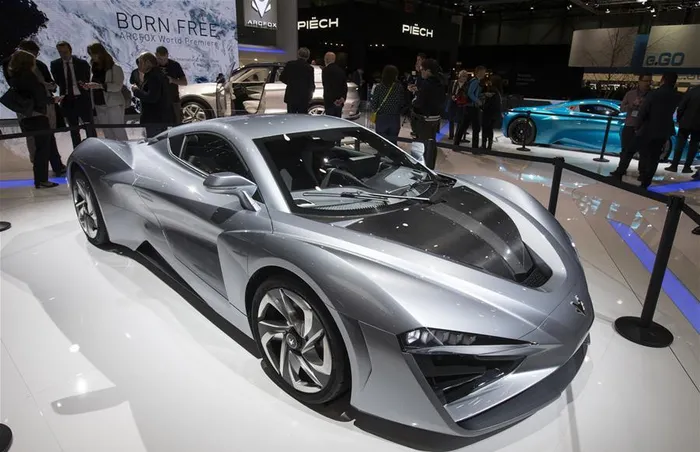
Arcfox-GT electric vehicle at the 89th Geneva International Motor Show in Geneva, Switzerland.
Image: XINHUA
Kia has started assembling the hybrid version of the Kia Telluride at its West Point, Georgia facility, marking the company’s first hybrid model produced in the US. The move reflects rising demand for hybrid vehicles, particularly after federal incentives for fully electric vehicles were withdrawn last year.
The Georgia plant remains the only global production site for the Telluride, a model developed specifically for American consumers. The addition of a hybrid variant is expected to expand its appeal. In 2025, the Telluride ranked as Kia’s third best-selling model in the US, with 123,281 units delivered, behind the K4/Forte sedan and the Kia Sportage.
Despite new import tariffs, Kia’s US sales increased 7% year-on-year to 852,155 vehicles. The automaker also surpassed a major production milestone at its Georgia facility, exceeding five million vehicles manufactured since operations began in 2009.
Sean Yoon, CEO of Kia North America and Kia America, described the dual milestone, five million units produced and the launch of the first US-assembled hybrid, as a demonstration of the company’s long-term investment in domestic manufacturing. Georgia Governor Brian Kemp highlighted the success of the partnership between the state and Kia, noting that since its introduction in 2019, the Telluride has been built exclusively in Georgia and has become one of the brand’s standout models.
The group, parent company of brands such as Jeep and Peugeot, generated annual revenue of $181.07bn, a 2% decline from the previous year. Currency pressures and lower pricing in the first half offset gains in sales volumes and product mix.
Announced on 6 February, the reset produced approximately $26.18bn in second-half charges that were excluded from adjusted operating income.
Although second-half revenue rose 10% year-on-year to $93.47bn, the net loss for that period widened significantly to $23.69bn. North America weighed heavily on performance, contributing $1.11bn in adjusted operating losses during the second half.
Operating cash flow for the full year turned negative at $5.49bn, compared with a positive $1.81bn in 2024. To strengthen its balance sheet, the board suspended the 2026 dividend and authorised the issuance of up to $5.91bn in hybrid bonds.
Upcoming launches include the Jeep Cherokee and Dodge Charger SIXPACK in North America, the Ram Dakota in South America, and the Citroën C5 Aircross BEV, Jeep Compass BEV and Fiat 500 Hybrid in Europe.
Taken together, the contrasting developments at Kia and Stellantis illustrate a sector in transition rather than retreat. Carmakers are increasingly tempering ambition with realism, adjusting production plans and capital allocation to reflect how quickly, or slowly, consumers are embracing electrification. Whether through expanding hybrid output or recalibrating electric vehicle investment, the industry is moving toward a more flexible, demand-led model that prioritises resilience and profitability alongside long-term sustainability goals.
*Cole Jackson
Lead Associate at BRICS+ Consulting Group
Chinese & South America Specialist
**The Views expressed do not necessarily reflect the views of Independent Media or IOL.
** MORE ARTICLES ON OUR WEBSITE https://bricscg.com/
** Follow @brics_daily on Twitter for daily BRICS+ updates and instagram @brics_daily