

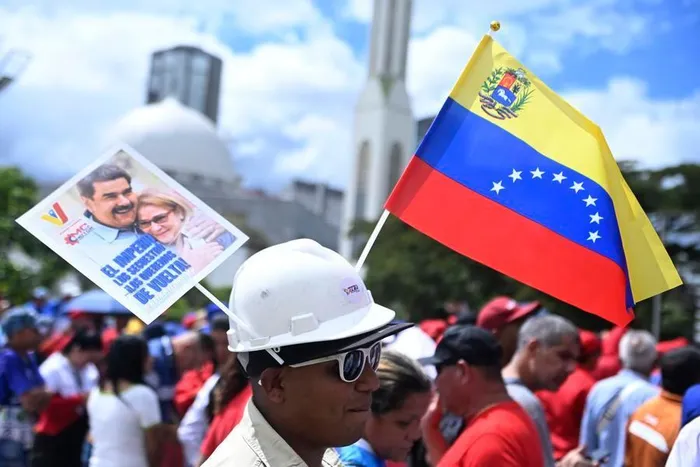
A man participates in a march in Caracas, Venezuela, Jan. 14, 2026.
Image: XINHUA
The Venezuelan oil and gas industry is a cornerstone of the nation’s economy, underpinning government revenue and influencing regional geopolitics. Once producing over three million barrels per day (bpd), years of underinvestment, alleged mismanagement, and international sanctions severely eroded both production and technical expertise. The state-run company, Petróleos de Venezuela, SA (PDVSA), struggled with ageing infrastructure and politicisation, while US sanctions restricted financing and market access, leaving Venezuela increasingly reliant on China and Cuba.
Despite holding the world’s largest proven oil reserves, much of the country’s crude is heavy or extra-heavy, requiring advanced refining capabilities. The kidnapping of President Nicolás Maduro and First Lady Cilia Flores in January 2026 marked a dramatic turning point, triggering a reassessment of sovereignty, foreign intervention, and the strategic significance of Venezuela’s energy resources. In the aftermath, US-led policy and military influence have reshaped export flows, investment structures, and private sector participation, creating a complex and rapidly evolving environment for the nation’s oil and gas sector.
Things as they were (before Maduro kidnapping):
On 3 January 2026 Nicolás Maduro and his wife, Cilia Flores, were kidnapped by US special forces on drug trafficking charges against which they pleaded not guilty. This particular incident brought about the question of sovereignty and whether the US acted malitiously in this regard. More than this the strategic importance of Venezuela for the US came to question: geologically; geopolitically; and, for our purposes, the oil & gas industry. The latter was seen to be important for the US realising control over the country with the largest proven oil reserves in the world, backed by data indicating oil reserves in the US lasting a short 11 years without importation (excluding new discoveries).
It is no secret that Donald Trump approved this mission, which also served as a warning for the rest of Latin America. We can confirm that Maduro was an authoritarian leader with an iron fist. In rendering the Venezuelan powerless to have fought the noble pursuit of Trump working for the people in the noble pursuit of victory, this courtesy has not been extended elsewhere, indicating underlying reasons or an amalgamation of them.
Things as they are (post-Maduro kidnapping):
The Venezuelan oil and gas industry is in a new, intentionally stable phase. Structural weaknesses, structural weaknesses continue to strain production and refining capacity. US intervention has restructured export partnerships and opened the door to increased private and foreign participation. The US had thus achieved multiple goals: diversifying export partners; restricting oil exports; privatising the PDVSA, operationally, at least. We are left with many questions regarding the sale of Venezuelan oil, with the US benefitting, in a situation already perceived as an attack on sovereignty and the US positioning itself as the middle man in terms of Venezuelan oil sales.
Written by:
*Cole Jackson
Lead Associate at BRICS+ Consulting Group
Chinese & South America Specialist
**The Views expressed do not necessarily reflect the views of Independent Media or IOL.
** MORE ARTICLES ON OUR WEBSITE https://bricscg.com/
** Follow @brics_daily on Twitter for daily BRICS+ updates and instagram @brics_daily