

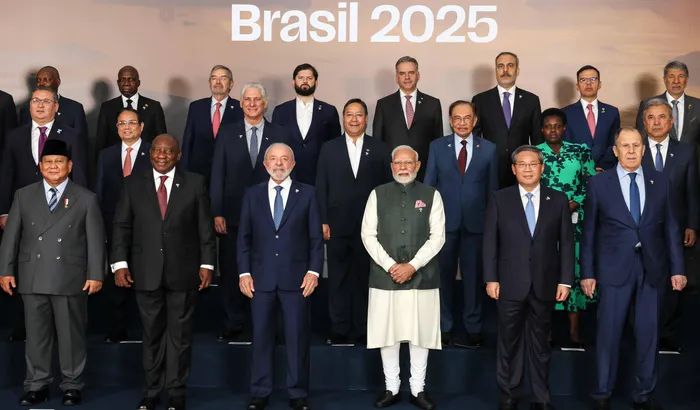
Heads of State and Government from BRICS Member Countries pose for a family photo at the XVII BRICS Summit at the Museum of Modern Arts held in Rio de Janeiro, Brazil on July 7, 2025.
Image: GCIS
Ashraf Patel
Every crisis presents opportunities, the Chinese saying goes.
South Africa’s disinvitation from the G7 in France in 2026 is actually a blessing.
The narrative goes that South Africa’s international relations IR is rooted in multilateralism and non-alignment. This approach supposedly allows it to participate in apex global forums such as the G20, BRICS, and, from time to time, get invited to G7 summits. But as a middle power with limited diplomatic and economic weight, our IR mandarins and policy makers cannot yet demonstrate concrete economic development in all these global engagements.
Realpolitick was at play, given trade wars, as well as France preparing for the France-Africa summit, in Kenya, with the famed FrancAfrique facing multiple challenges in its traditional colonial- cultural sphere.
South Africa hosted the G20 in 2025 at a huge cost to the fiscus. Although there had been good global media coverage for the event, the geopolitical fractures presented many challenges. On balance, South Africa’s G20 process in 2025, and its Communique was a solid one focusing on the SDG agenda, the polycrisis challenges, from AI Inequality to Green industrialisation and social development.
However, a sobering component was that the G20 - unlike the UN is not a decision-making forum, and our diplomatic capital is exhausting. Issues such as the African debt crisis were kept in abeyance or lacked in another panel process. In fact, it is the UN Convention on Tax that is doing the real heavy lifting on global tax policy.
In this context, the abrupt disinvitation by France from the G7 this year came as a surprise, but proved the reality that SA is relatively unimportant in Northern platforms - even though it's generally ‘’toes the line of the globalisation narrative’. Mainstream media and the IR community have been somewhat disingenuous. Very little context has been provided on the actual value of G7 participation, if any. Year on year, the Ramaphosa administration has prioritised global elite forums, WEF, G7, G20, et al.
Since the Ukraine war, the G7 has re-energised, focusing on the growing geopolitical challenges that the West faces from an assertive Russia and a rising China. The non-aligned position adopted by many developing countries in the G20 regarding Russia’s invasion of Ukraine surprised, if not shocked, the West. Yet other conflicts in the Middle East and Africa have not energised them to find the diplomatic weight to find solutions.
G7's failure on Green Just Energy transition and Global conflict management
The divisions within the G7, driven by Trumpism, have seen this premier forum on the wane. The lack of cohesion on sustainable peace or ceasefires in the Middle East and African conflicts lacks consensus. When President Ramaphosa was invited to the G7 meeting in Gleneagles, in the UK, in 2021.
It was the first to enter into a Just Energy Transition Partnership, announced at COP26 with France, Germany, the UK, the US and the EU. More recently, these partners have been joined by others. The total amount committed thus far is about 12 billion US dollars.
But the Trump administration withdrew in 2025. The Just Energy Transition Investment Plan, which South Africa later discovered was not development financing, but green loans repayable. Back to the classical World Bank conditionality model
In net terms, over the past few years, South Africa got nothing from the G7, except COVID nationalism and expensive Green JET loans. Not even IP exceptions allowed under WIPO rules during health emergencies were allowed to be used in the pandemic.
So then, what should be done? Some key recommendations:
1. Reprioritise Africa and Southern Africa, and recalibrate the SADC community
South Africa’s DRC debacle in 2025 has been in the spotlight and has eroded our regional leadership. Yet the mushrooming of wars- from Sudan to the Sahel to Northern Mozambique replicates. It is time for a reboot - and that would need significant economic and diplomatic resources to regain the respect on the African Continent.
SADC faces its moment of truth in 2026, when South Africa is the host. The Tanzanian post-electoral violence was particularly concerning. Botswana, once the ‘shining diamond’ in terms of economic development, is in free fall and barely balancing its budget.
Lesotho, the poorest nation, grapples with Trump tariffs. Mozambique is caught in oil wars, extremism and endemic corruption. South Africa’s GDP in the SADC region is approximately 70% and needs to show leadership. Some suggestions could be:
Hence, SA should focus on G77 and show its supposed ‘middle power prowess.
2. Need for solid engagement at the G77 and NAM.
The current grave geopolitical crisis, the Middle East wars and Trump's Donroe doctrine are the brave new world Africa faces. To its credit, South Africa displayed a good leadership role in the Hague group, advocating for international law. This momentum needs to be carried forward with more diplomatic capital in economic alternatives.
Today, Non-Aligned Movement NAM members Cuba, Venezuela and Iran currently face the full-scale aggression and war mongering by an unhinged Trump administration, ever desperate to extract more resources, minerals and data from the Global South.
Hence, South Africa, as a middle power rooted in liberation movements and multilateralism, should anchor itself with the masses of humanity, where the NAM and G77 reside. Our collective Diplomatic capital should be invested in:
It should be noted that G-77 formulated and led the adoption of the International Development Strategy (IDS), which advocated a commitment to transfer 0.75 per cent of their gross national product of the Global North to developing countries. Today, that commitment is in ashes as geopolitical fractures and nationalism in the North have seen an alarming reduction in Development Aid.
The scholar Franz Fanon's critiqued this type of leadership in Africa, being reduced to the ‘begging bowl syndrome’, where the nation begs to be admitted to elite clubs, even when these don’t benefit the masses.
It was 50 years ago, during the first deregulation wave, that UK Prime Minister Margaret Thatcher famously declared that There is NO Alternative!
Today, the world is multipolar with the Beijing Consensus stating clearly that there must be an alternative as its development state model is proving better at reducing poverty.
Will South Africa be forever caught in muddled rhetoric or boldly anchor itself in the Global South and march onward to progress and be in the leitmotif of history?
* Ashraf Patel is a Senior Research Associate at the Institute for Global Dialogue, UNISA.
** The views expressed do not necessarily reflect the views of IOL, Independent Media or The African.