

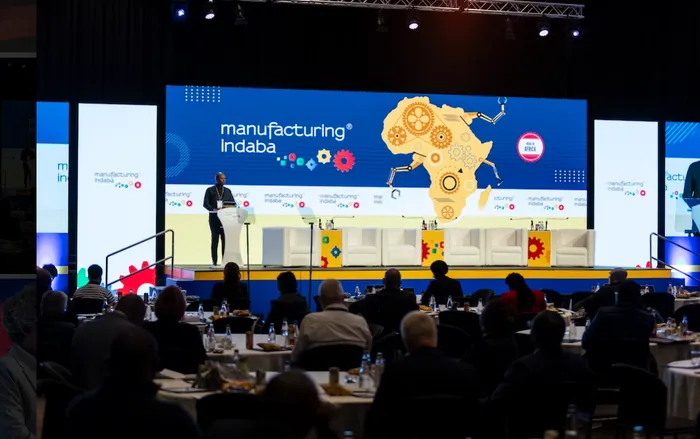
Africa Manufacturing Indaba 2025 (MI25 Day 1-0118)
Image: Africa Mining Indaba Media
When the Manufacturing Indaba opens its doors at the Sandton Convention Centre on 14 July under the theme Made in Africa: Scaling Growth, Shaping Trade, it will do so against a backdrop of numbers that should make every delegate uncomfortable. South Africa holds approximately 37% of the world's manganese ore reserves. Only 2% of it is processed in the country. Africa holds 92% of global platinum reserves, 56% of cobalt, 54% of manganese. The DRC alone accounts for roughly 73% of global mined cobalt production, and yet the continent captures a fraction of what those resources are ultimately worth.
The conference knows this. Every conference before it knew it too. The risk, as always, is that two days of panels on Africa's untapped potential produce another communiqué and very little else. What the 2026 Indaba needs to do differently is resist the gravitational pull of the endpoint like batteries, electric vehicles, full value chain manufacturing, and have an honest conversation about step one.
Because the gap between where Africa is and where it wants to be is not crossed in a single leap. It is crossed in stages and the most underexplored stage, the one that could actually move immediately, generate revenue, build skills, and fund what comes next is partial processing.
The conventional framing of the African industrialisation debate presents two positions: export raw materials as we always have, or build full downstream manufacturing capacity. The first is economically indefensible. The second is, in most cases, a decade away from being realistic at scale. The conversation in between those two positions, partial processing, intermediate products, incremental value capture, is where the practical work lives.
Consider cobalt. The DRC mines roughly 73% of the world's cobalt, but China accounts for approximately 78% of global refined cobalt production. The ore leaves Africa. China processes it into cobalt sulphate and cobalt hydroxide, the intermediate chemical forms required by battery manufacturers and captures the margin. Converting raw cobalt ore into cobalt hydroxide is not a gigafactory. It is a hydrometallurgical processing plant. The capital requirements are substantially lower than full battery manufacturing, the technical threshold is achievable, and the value uplift is significant. Moving from ore to refined intermediate product can represent a price premium of 40–60% per unit of cobalt content depending on market conditions. That margin, captured in Lubumbashi rather than Chengdu, funds the next stage.
Morocco has already demonstrated this logic. It inaugurated its first lithium-ion battery materials manufacturing plant in Jorf Lasfar in June 2025, with a Gotion High Tech gigafactory expected in Kenitra by late 2026 and BTR New Material Group developing cathode-material units in Tangier Tech City. Morocco is not a major mineral producer by African standards. What it had was a government that understood staged progression: attract processing first, build manufacturing around the processing. The minerals corridor feeds into it from Central and Southern Africa.
Botswana is the most cited example of a resource-rich African nation that managed its wealth with intention. The Debswana joint venture with De Beers ensured that a significant portion of diamond revenues flowed back into the national economy, funding infrastructure, healthcare, and education that gave Botswana one of the highest per capita GDPs in Africa. It is a genuine success story of negotiated resource governance.
But Botswana also illustrates the ceiling of a strategy that stops at extraction and revenue-sharing without moving aggressively into processing. Botswana currently cuts and polishes an estimated 10% of its rough diamond production. Diamonds account for 80% of its export revenue and 30% of its GDP. When the global diamond market collapsed, battered by lab-grown alternatives and weak demand, Debswana saw revenues fall by 46% and the economy contracted by 3% in 2024. The concentration risk was catastrophic precisely because the value chain had never been diversified beyond the mine gate.
The cutting and polishing industry that Botswana has been building, its Diamond Hub in Gaborone, its push to process more rough stones locally, is exactly the kind of intermediate step that should have been scaled a decade earlier. A polished diamond commands a price premium of roughly 20–30% over rough. Jewellery manufacturing adds another 200–400% above that. The ambition now is to cut and polish all of Botswana's rough diamond production domestically. That ambition, had it been pursued in 2010, would have built a processing workforce and industrial base capable of cushioning the current demand shock.
The lesson is not that Botswana failed. It is that step one, partial processing, intermediate value capture, cannot be deferred until the political conditions feel perfect.
Three practical questions deserve dedicated attention in Sandton this July.
First: which intermediate processing steps in which minerals are commercially viable at current infrastructure and energy levels? Not theoretically viable at some future grid capacity but viable now, with what exists, in the regions that hold the resources. South Africa has approximately 37% of global manganese reserves and processes only 2% locally. That is not primarily an energy problem or a skills problem. It is a policy and capital mobilisation problem. The session on financing industrialisation needs to produce specific instruments, not general principles.
Second: how does the AfCFTA create the regional market that makes intermediate processing economically rational? The concept of beneficiation at source, processing minerals closer to extraction sites, is gaining traction as a cornerstone of a new approach, and the AfCFTA offers a pathway to scale industrial activity, reduce fragmentation, and enhance regional competitiveness. But this requires regulatory harmonisation that is specific and binding, not aspirational.
Third: what does a reinvestment mechanism look like? The argument for staged beneficiation only holds if the additional revenue captured at each processing stage is formally directed toward funding the next stage of (skills development, infrastructure, technology transfer). Without that structure, partial processing becomes a new equilibrium rather than a genuine stepping stone.
The Manufacturing Indaba has the right people in the room. The question is whether it will give them a concrete agenda or another magnificent overview of a problem Africa has been describing, accurately and eloquently, for thirty years.
The resources are there. The demand is there. The IEA projected in 2025 that demand for lithium will increase fivefold between 2025 and 2040. Demand for cobalt and rare earth elements will grow 50–60%. The window is open. Step one is not a compromise. It is the architecture on which everything else is built.
Written by:
*Chloe Maluleke
Associate at BRICS+ Consulting Group
Russia & Middle East Specialist
**The Views expressed do not necessarily reflect the views of Independent Media or IOL.
** MORE ARTICLES ON OUR WEBSITE https://bricscg.com/
** Follow @brics_daily on Twitter for daily BRICS+ updates and instagram @brics_daily