

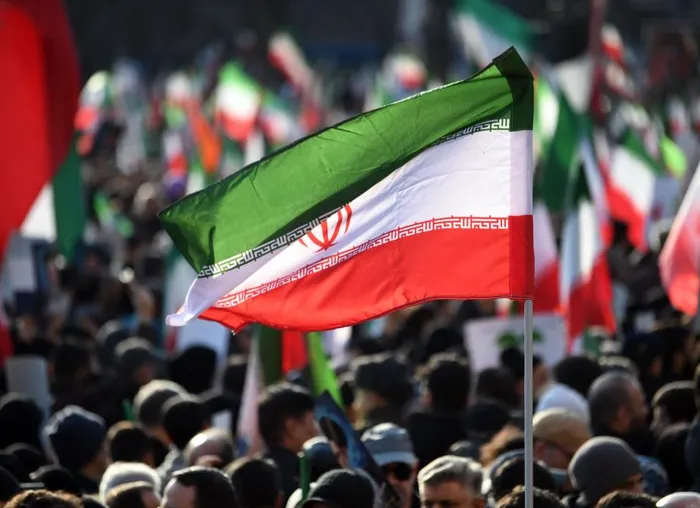
Tens of thousands of pro-government citizens took to the streets across Iran on Monday, responding to calls from Iranian authorities to demonstrate solidarity.
Image: XINHUA
There is a before and an after. Geopolitics rarely offers such clean lines, but the beginning of 2026 has drawn one in ink that will not wash out. The Middle East that existed before Iran mined the Strait of Hormuz is gone. What has replaced it is something older, rawer, and more honest, a world in which control of the arteries of global energy is openly, unapologetically wielded as power. Iran did not just enter the ranks of the world's great strategic players. It rewrote the terms of membership.
For decades, the Strait of Hormuz was treated as a kind of geopolitical commons, a narrow, irreplaceable chokepoint through which 20% of the world's energy flowed, and through which no one nation could plausibly exert a toll. The unspoken arrangement was enforced by American naval supremacy and the mutual interest of Gulf producers in keeping oil moving. That arrangement is finished. Iran mined the strait in March, closed it to shipping, and demonstrated something the international community had long chosen to ignore: geography is destiny, and Iran sits on the most consequential piece of maritime real estate on earth.
The consequences have been seismic and immediate. Brent crude, trading near $70 a barrel before the first American bombs fell on February 28th, surged past $125 in the war's ninth week. The global economy did not merely feel a shock, it absorbed the full weight of what it means when a single nation can functionally shut off a fifth of the world's energy supply. Every airline ticket, every container of goods, every heating bill in every European home is now a referendum on Iran's willingness to negotiate. That is not vulnerability. That is leverage of a magnitude few nations in history have ever possessed and Iran is wielding it with cold, disciplined precision.
The old geopolitical order assumed that American carrier groups guaranteed freedom of navigation. The USS Gerald R. Ford, now preparing to leave the region after months of deployment, represents something more than a homebound ship. Its departure marks a psychological inflection point. The mightiest naval force in human history arrived, struck hard, and the strait remains mined. The message sent to every government on earth is unmistakable: the American security umbrella, stretched across decades of Middle Eastern dominance, has limits. Iran has found them, mapped them, and exploited them for the entire world to see.
Germany's chancellor called it humiliation. He was not wrong, though the word belongs to a broader audience than Washington alone. Every nation that built its energy security on the assumption of open sea lanes must now reckon with the fact that those lanes exist at Iran's discretion. The Strait of Hormuz has acquired a toll, not written in law, but enforced by mines, by fiber-optic drones too small and silent for conventional defences to reliably intercept, and by the blunt geographic reality that no amount of airstrikes has altered the map beneath them.
Russia's offer to broker the removal of Iran's enriched uranium, taken seriously at the highest levels of the Trump administration, is its own testament to Iran's elevated stature. You do not negotiate the disarmament of a country that doesn't matter. The diplomatic choreography now circling Tehran, Putin's phone calls, Trump's overtures, OPEC fracturing with the UAE's departure, all orbit the same gravitational center. A nation that was supposed to be broken by decades of sanctions is instead setting the tempo of global crisis management.
What Iran has achieved is not merely military or economic. It is conceptual. It has proven that a nation with patience, geography, and the will to absorb punishment can force the world to the table entirely on its own terms. The balance of the Middle East has not tilted, it has broken and reformed around a new axis.
Written by:
*Dr Iqbal Survé
Past chairman of the BRICS Business Council and co-chairman of the BRICS Media Forum and the BRNN
*Chloe Maluleke
Associate at BRICS+ Consulting Group
Russia & Middle East Specialist
**The Views expressed do not necessarily reflect the views of Independent Media or IOL.
** MORE ARTICLES ON OUR WEBSITE https://bricscg.com/
** Follow @brics_daily on Twitter for daily BRICS+ updates and instagram @brics_daily