

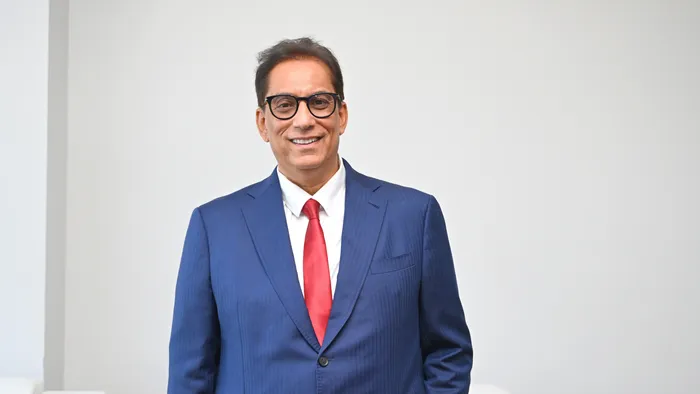
Medical doctor, industrialist and philanthropist Dr Iqbal Survé. Speaking in his keynote address titled “The Future of BRICS in a New World Order,” Dr Survé argued that history does not stand still and that the structures created after the two World Wars and during the Cold War are now being fundamentally restructured.
Image: Supplied
The global order is undergoing one of the most significant transformations in modern history. According to Internationalist and industrialist Dr Iqbal Survé, the world is moving away from decades of unipolar dominance towards a new multipolar system shaped increasingly by emerging economies, particularly those within BRICS.
Speaking in his keynote address at the Friends of BRICS event at the Cape Town Club titled “The Future of BRICS in a New World Order,” Dr Survé argued that history does not stand still and that the structures created after the two World Wars and during the Cold War are now being fundamentally restructured. He explained that world orders are ultimately determined by three critical factors: economic power, control of security systems, and control of the global narrative.
Drawing from both the keynote speech and his extended remarks, Dr Survé emphasised that the rise of China is not accidental, but the result of long-term strategic planning. He noted that for centuries China had been one of the world’s leading economies before losing ground during periods of internal isolation and global industrial transformation. In recent decades, however, Chinese leadership adopted long-term economic and technological planning that enabled the country to re-emerge as a global superpower.
Dr Survé reflected on his personal experiences engaging with Chinese leadership over the past two decades, including interactions with former Chinese presidents and senior officials. He described witnessing firsthand the rapid transformation of China’s economy, education system, and technological capabilities. He argued that China’s growth was achieved not only through industrial expansion, but through massive investment in higher education, innovation, and intellectual property development.
Central to the discussion was the emergence of BRICS as a geopolitical and economic force. Dr Survé explained that BRICS was never intended to be an opposition bloc against the West, but rather “a correction to imbalance” within the global system. He stated that the formation seeks to address the exclusion of the Global South from international financial and political structures that have historically been dominated by Western powers.
He further highlighted that before South Africa joined BRICS, the bloc existed as BRIC, excluding the African continent from one of the world’s most influential emerging formations. Dr Survé explained that South Africa’s inclusion was the result of deliberate advocacy during the presidency of Jacob Zuma, ensuring that Africa would have representation in the organisation.
One of the strongest themes in the address was the issue of narrative sovereignty. Dr Survé argued that global influence is not determined only by military or economic strength, but also by who controls information and perception. He stressed that for too long Africa and the Global South have been spoken about rather than allowed to speak for themselves.
He identified institutions such as the BRICS Media Forum, the Belt and Road News Network, and the World Media Summit as important platforms for reshaping global narratives and strengthening intellectual independence within the Global South. According to Dr Survé, “control of information is control of perception, and control of perception is control of power.”
Economic power and the future of the global financial system also featured prominently in the discussion. Dr Survé argued that the international economy has long revolved around the dominance of the US dollar in trade, commodities, and financial systems. However, BRICS nations are increasingly exploring alternatives such as local currency trade, alternative payment systems, and resource-backed economic cooperation.
In his broader remarks, he warned that emerging economies remain deeply dependent on Western-controlled financial infrastructure. He noted that most international financial flows involving BRICS countries still pass through Western systems, creating vulnerabilities for developing nations. He argued that building alternative systems requires decades of coordination and cannot be achieved overnight.
Dr Survé also discussed shifting geopolitical dynamics, particularly within the United States and Europe. He questioned whether the resurgence of leaders such as Donald Trump reflects temporary political disruption or deeper structural changes within the West. He suggested that the United States is increasingly focused on consolidating influence within the Americas, while Europe faces demographic and economic challenges that may reshape its future relationship with Africa.
Africa’s position in the evolving global order formed a crucial part of the address. Dr Survé insisted that Africa should not approach the new world order as a junior partner, but as a strategic participant with significant leverage. He highlighted the continent’s vast mineral resources, youthful population, expanding markets, and growing digital economies as key advantages.
“Africa is not the future,” he declared. “It is the present.” However, he cautioned that African nations must take ownership of their resources, partnerships, and narratives if they are to benefit fully from the emerging multipolar order.
Concluding his address, Dr Survé described BRICS as an evolving but profoundly important platform representing a shift “from dominance to dialogue, from exclusion to inclusion, and from hierarchy to multipolarity.”
He argued that the new world order is already being built through global partnerships, institutions, and strategic alliances. The key question, he said, is not whether the world will change, but who will shape that change.
Dr Survé expressed confidence that BRICS and the Global South are moving towards a future rooted not in domination, but in dignity, equality, and shared progress.