

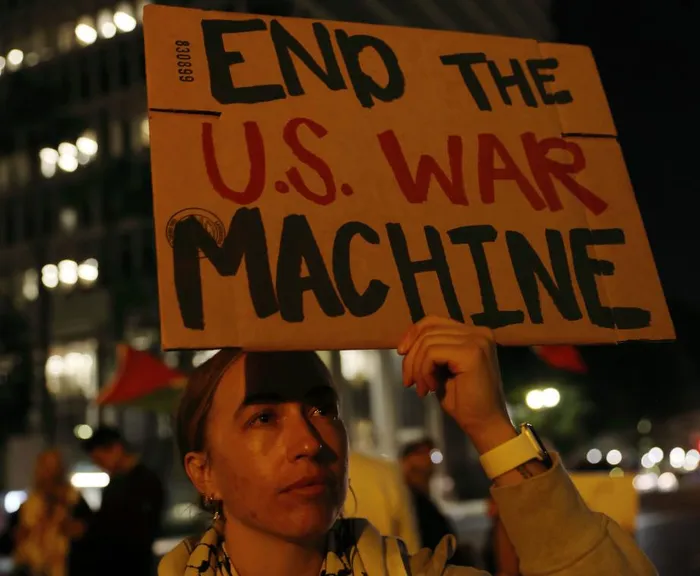
People protest against U.S. military attack on Iran in Los Angeles, the United States, on
Image: XINHUA
There are wars that nations fight with clarity of purpose, with defined enemies, declared goals, and a strategy for what comes after the shooting stops. And then there is the US-Iran war of 2026, a conflict that may go down in history not for its military might, but for its stunning lack of coherence, credibility, and direction.
Since US and Israeli forces launched strikes on Iran in late February 2026, Americans have been treated to a spectacle that would be almost comical if real lives and livelihoods were not at stake. The war began without a congressional declaration, without a formal strategy, and according to multiple intelligence sources, without even a clear and honest justification. At his State of the Union address in February, President Trump claimed Iran had restarted its nuclear program and was developing missiles capable of striking the United States. US intelligence reports, however, suggested Iran posed no such military threat and would need until 2035 to build such missiles (if it chose to do so at all). The administration offered a rotating carousel of rationales for the war like preventing Iranian retaliation on Israel, destroying missile capabilities, seizing oil resources and regime change.
What followed has been a masterclass in strategic incoherence. Trump declared a ceasefire in April, announcing it had been a resounding success and that the "longterm problem" was "close to resolution." Days later, the ceasefire was described as being on "life support." Then came the deadlines, a parade of ultimatums that Washington set and then quietly shelved.
The most recent episode may be the most revealing of all. On Sunday, May 18, Trump warned on Truth Social that Iran had better "get moving, FAST," or "there won't be anything left of them." Twenty-four hours later, he announced on the same platform that he had called off a "scheduled" attack planned for Tuesday, at the personal request of Saudi Arabia's Crown Prince Mohammed bin Salman, Qatar's Emir, and the UAE's President. He framed it as a gesture of respect toward his Gulf allies.
There was just one problem: Gulf country officials, speaking to The Wall Street Journal, said they had no idea the attack had even been planned. And reporting from Axios suggested Trump had not actually made a final decision to strike before announcing its postponement. In short, the president may have publicly credited foreign leaders with talking him out of a war he had not yet decided to fight, using allies who had not made the request he described to provide diplomatic cover for his own hesitation.
This is the kind of story that historians will find extraordinary. A sitting US president, unable or unwilling to define what victory looks like, bouncing between threats of annihilation and last-minute reprieves with the improvisational rhythm of a social media feed. Senate Minority Leader Chuck Schumer captured the absurdity bluntly, accusing Trump of acting "like a toddler playing with a loaded gun."
Congress, to its credit, has begun to push back. The Senate voted 50 to 47 to advance a war powers resolution that would require the president to seek congressional authorisation for continued military operations. Four Republicans broke with their party to support it. The 60-day deadline mandated by the 1973 War Powers Resolution was passed on 1st of May, however the war drags on, justified now by the administration's creative legal argument that the fragile ceasefire "pauses or stops" the 60-day clock. Democrats and even some Republicans have called that interpretation extraordinary.
Meanwhile, the human and economic toll compounds. The Strait of Hormuz (through which roughly 20% of the world's oil passes) has remained largely shut since the conflict began, driving fuel prices to their highest levels in three years. Over a million people have been displaced in Lebanon. Iranian civilians, already brutalised by their own government's crackdown on protesters, now live under American naval blockade.
What has the United States achieved? Iran has not surrendered its nuclear ambitions. The Strait remains a flashpoint. Negotiations are deadlocked over issues that were predictable from day one. And the president is now setting new two-to-three-day deadlines that almost no one believes will be enforced.
History has not been kind to American wars launched on flimsy pretexts, Vietnam and Iraq being the most obvious examples. The Iran war has added a new and unique flavour to that tradition. A conflict managed like a reality television show, where the host keeps threatening to cancel and then changes his mind during the commercial break. Whatever the final outcome, the story of how the United States stumbled into, stumbled through, and failed to stumble out of this war will be studied for a very long time.
Written by:
*Dr Iqbal Survé
Past chairman of the BRICS Business Council and co-chairman of the BRICS Media Forum and the BRNN
*Chloe Maluleke
Associate at BRICS+ Consulting Group
Russia & Middle East Specialist
**The Views expressed do not necessarily reflect the views of Independent Media or IOL.
** MORE ARTICLES ON OUR WEBSITE https://bricscg.com/
** Follow @brics_daily on Twitter for daily BRICS+ updates and instagram @brics_daily