

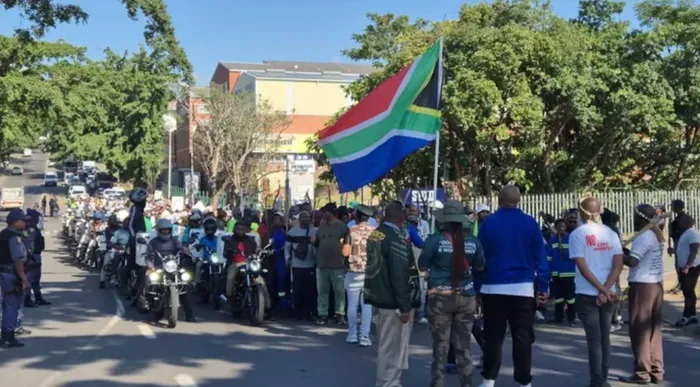
Tensions in eThekwini have escalated into a humanitarian and security concern after refugees, asylum seekers and migrants reportedly fled their communities amid growing threats, intimidation and violence.
Image: Sibonelo Ngcobo/Independent Newspaper.
Ghana's Ministry of Foreign Affairs announced the postponement of a planned evacuation of over 800 Ghanaian nationals from South Africa, citing mandatory passenger screening, multi-institutional coordination, and flight permit requirements as the outstanding conditions blocking departure. The optics were striking. The politics, however, deserve far more scrutiny than they have received.
Ghana's evacuation was announced with considerable fanfare , Foreign Affairs Minister Samuel Okudzeto Ablakwa declared that the welfare and safety of all Ghanaians is a "non-negotiable priority," and Accra framed the entire exercise as a rescue operation from a country gripped by xenophobia. But before accepting that framing uncritically, one question deserves to be asked: is South Africa actually the aggressor here, or is it a sovereign state being caricatured for pursuing the most basic function of government, managing who lives and works within its borders?
South Africa is not a country in a comfortable position to absorb unregulated migration. Since 2024, the country's unemployment rate has exceeded 43 percent, a figure that represents not a statistic but a generation of South Africans locked out of economic participation. New research by the Human Sciences Research Council confirms that anti-immigrant sentiment has risen most sharply among poor and working-class South Africans, driven by the rising cost of living, stubbornly high unemployment, deindustrialisation, and concerns over crime.
This is the material reality that Ghana's evacuation announcement sidesteps entirely. When a country with nearly half its workforce unemployed asks for documented proof that residents are in the country legally, that is not hatred, it is governance. The South African Department of Employment and Labour is currently finalising a National Labour Migration Policy that would prescribe employment quotas for foreign nationals and ring-fence certain sectors wholly or partially for South African citizens. These are policy instruments used by states across the world, from the Gulf Cooperation Council countries to Australia to post-Brexit Britain. No one calls the UAE xenophobic for its kafala system, yet South Africa is held to a standard of open borders that no other country on earth is expected to meet.
The most honest critique of South Africa's current situation is not that its citizens are racist, it is that the Department of Home Affairs cannot even quantify the number of undocumented migrants currently residing in the country. That institutional failure is real, and it has created a vacuum of enforcement that breeds frustration and, in some cases, vigilantism. Civil society organisations have argued that the department's bureaucratic dysfunction affects both South Africans and foreign nationals alike, and that the failure to provide clear documentation pathways creates the very conditions that anti-migrant groups exploit.
This is a governance problem, one that requires investment in Home Affairs capacity, digital border management, and functional asylum processing. What it does not require is for South Africa to accept the label of xenophobe every time it attempts enforcement. The South African government has consistently rejected the characterisation of these events as xenophobia, framing citizen demonstrations as constitutional expression of legitimate socio-economic grievances. That position is not diplomatic evasion, it reflects a meaningful distinction between state-sanctioned persecution and a population expressing anxiety about livelihoods.
Ghana has offered evacuating citizens a welcome home financial package, transportation assistance, a reintegration allowance, free psychosocial support, and entry into a national database for jobs and startup opportunities. It is a generous offer and a politically calculated one. Ghanaian citizens on social media have already pointed out the contradiction: why do nationals who leave South Africa receive government packages that unemployed youth at home cannot access?
The answer is that this is as much about optics and continental positioning as it is about citizen welfare. Ghana under President Mahama is constructing a Pan-Africanist identity at a moment when such branding has diplomatic currency. South Africa has become a convenient foil. But the framing collapses under scrutiny: if the situation in South Africa is so dire, why did only one person reportedly show up at OR Tambo International Airport on the morning of the scheduled departure? Eight hundred people registered. One arrived. That is not the behaviour of a population fleeing persecution, it is the ambivalence of a community weighing a difficult choice.
Every functioning state reserves the right to enforce its immigration laws, protect its labour market, and require documentation of residents. South Africa's economic conditions, unemployment levels, and service delivery challenges make the migration question particularly acute,more so than almost any other upper-middle-income country on the continent. Public distrust of undocumented migrants has climbed from 62.6% in 2021 to 73.1% in 2025, not because South Africans have become more hateful, but because the pressures on public services, housing, and employment have intensified without relief.
South Africa does not owe the continent an open door at the expense of its own citizens. What it owes is a functional, humane, and legally consistent immigration system — one that distinguishes between documented residents who contribute and undocumented migration that strains an already fractured state. Ghana's evacuation, delayed by the very logistical realities of operating within South African legal frameworks, is not a rescue. It is a narrative. And South Africa should not accept a villain's role in a story it did not write.
Written by:
*Dr Iqbal Survé
Past chairman of the BRICS Business Council and co-chairman of the BRICS Media Forum and the BRNN
*Sesona Mdlokovana
Associate at BRICS+ Consulting Group
Africa Specialist
**The Views expressed do not necessarily reflect the views of Independent Media or IOL.
** MORE ARTICLES ON OUR WEBSITE https://bricscg.com/
** Follow @brics_daily on Twitter for daily BRICS+ updates and instagram @brics_daily