

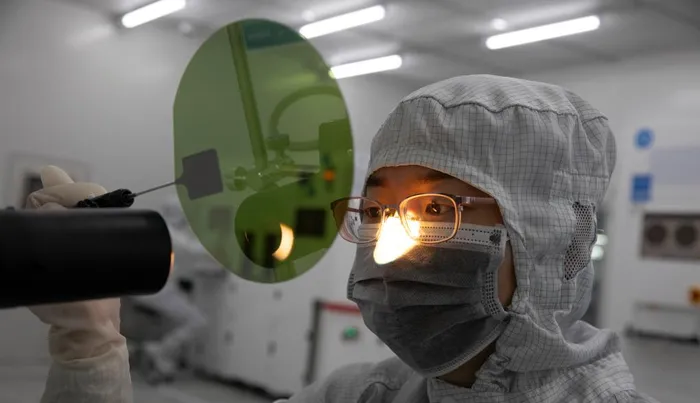
A staff member works at the workshop in the headquarters of TankeBlue Semiconductor Co., Ltd. in Daxing District of Beijing, capital of China
Image: XINHUA
The semiconductor industry has never been a forgiving environment for slow decisions. Engineers are routinely buried under terabytes of yield data, process logs, wafer measurements, and failure analysis reports and every day brings a new problem that requires not just data processing, but genuine expertise and judgment. It is precisely this pressure that makes the conversation around generative AI in semiconductor manufacturing so important, and so easy to get wrong. The wrong conversation frames AI as a replacement. The right one frames it as a co-pilot.
There is a persistent anxiety in technical industries that AI will eventually render skilled engineers redundant and that machines will simply do the analysis faster, cheaper, and without the professional overhead. In semiconductor manufacturing, that anxiety misreads both the technology and the nature of the work.
The reality is more nuanced, and ultimately more optimistic. Generative AI is at its most powerful not when it operates independently, but when it works in close collaboration with the domain experts who understand what the data actually means. AI can surface patterns in a dataset of millions of wafer measurements in seconds. But it takes an experienced engineer to know whether that pattern reflects a genuine process anomaly or a known artefact of a particular measurement tool. Speed without judgement is just noise generated faster.
The model that is emerging in leading semiconductor operations is a hybrid one: AI handles the heavy lifting of data retrieval, visualisation generation, and pattern recognition, while engineers retain control of the analytical narrative, the validation process, and the final decisions. Think of it the way modern cars handle driver assistance, the technology can detect a lane drift and correct it, but the driver still needs to keep their hands on the wheel.
One of the most practically significant developments in this space is the ability to interact with complex analytics platforms using natural language. Tools like Spotfire Copilot™ allow engineers to request visualisations and analyses in plain English "Show yield by lot" or "Convert that to a line chart" and receive results instantly, without needing to write code or navigate complex query interfaces.
This matters enormously in an industry where time to insight is a competitive differentiator. When a process excursion is causing yield loss on a production line, every hour spent building the right visualisation is an hour of production risk. Natural language interfaces compress that window dramatically, letting engineers focus cognitive energy on interpretation rather than configuration.
But the intelligence behind these tools goes deeper than simple command execution. Retrieval-augmented generation (RAG), allows AI systems to pull relevant information from a company's own document library before formulating a response. Process logs, historical failure reports, engineering spec sheets: all of it becomes accessible context that grounds AI outputs in real, domain-specific knowledge rather than generic inference. The result is not just faster answers, but more trustworthy ones, conclusions that can be traced back to evidence and shared with confidence across teams.
None of this works without a culture of critical engagement with AI outputs. The most sophisticated tool in the world becomes a liability if engineers treat its suggestions as verdicts. The value of the hybrid model is precisely that it preserves human scepticism as a structural feature, not an afterthought. AI proposes; humans decide. That principle is not a limitation, it is the entire point.
As these platforms evolve toward agent-based AI, knowledge graphs, and multi-agent orchestration, the engineers who will thrive are not those who defer to AI, but those who have learned to interrogate it well, who know when to accept a suggestion, when to push back, and when the data is telling them something the algorithm has not yet learned to recognise.
The most powerful analytical capability in semiconductor manufacturing is not artificial intelligence alone. It is what happens when artificial intelligence and human expertise decide to think together
Written by:
*Chloe Maluleke
Associate at BRICS+ Consulting Group
Russia & Middle East Specialist
**The Views expressed do not necessarily reflect the views of Independent Media or IOL.
** MORE ARTICLES ON OUR WEBSITE https://bricscg.com/
** Follow @brics_daily on Twitter for daily BRICS+ updates and instagram @brics_daily
.