

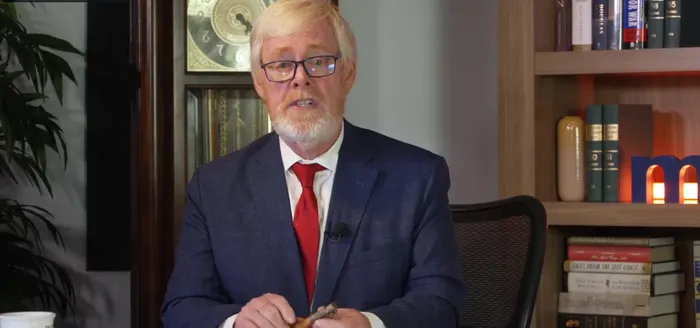
US ambassador-designate to South Africa Brent Bozell III
Image: Screenshot
Brent Bozell III, the United States’ ambassador-designate to South Africa, has previously warned that Washington is deeply concerned about what he describes as Pretoria’s drift toward the People's Republic of China and other global rivals.
Bozell told the US Senate Foreign Relations Committee in October that, if confirmed, he would make it a priority to challenge South Africa’s geopolitical posture.
On 19 December 2025, IOL reported that the United States Senate had formally confirmed Bozell as the US ambassador-designate to South Africa. This move transitions his controversial "priority list" from the campaign of a nominee to the official mandate of a confirmed envoy.
The 53–43 party-line vote on 18 December 2025 came at what diplomats describe as the most dangerous crossroads in bilateral relations since 1994. While Bozell now holds the title of ambassador-designate, he will enter the mission in South Africa, currently engulfed in a diplomatic firestorm following the raid at a US "refugee" facility in Johannesburg and the deportation of Kenyan staff from the centre — incidents Washington has labelled as "unacceptable harassment".
Washington and Pretoria remain at odds over a range of geopolitical issues — from South Africa’s growing alignment with China and Russia to its stance on the Gaza conflict and its legal case against Israel at the International Court of Justice.
While Bozell will likely arrive in Pretoria in the New Year, diplomatic analysts say the delay in President Donald Trump appointing an ambassador to South Africa reflects the strained atmosphere between the two governments, with both sides increasingly framing each other’s actions through the lens of global strategic rivalry.
Bozell said he intended to “communicate our objections to South Africa’s geostrategic drift from non-alignment toward our competitors, including Russia, China and Iran.”
His remarks signal that the potential next US envoy to Pretoria plans a more confrontational approach to South Africa’s growing relationships with Beijing and other partners in the BRICS bloc. China, in particular, has become South Africa’s largest trading partner over the past decade.
Bozell emphasised that he would approach the role with what he called respect for South Africans, while stressing the strategic value of the bilateral relationship.
He noted that South Africa remains the United States’ largest trading partner on the continent and that more than 500 US companies in the country employ hundreds of thousands of South Africans. He also highlighted the responsibility of safeguarding American citizens who travel to or work in South Africa.
“I come before you at a challenging moment for US–South Africa relations,” he told senators.
He linked his concerns about governance and corruption to the broader strain in the relationship.
“When people and businesses in South Africa believe their private property rights are at risk, when rampant corruption and unfair business practices hold back the economy, and when South African politicians greet as friends those who seek to destabilize the world’s peace and security, then common ground between our two countries feels harder to find.”
Bozell, known in Washington for his work in conservative media and politics, said he would use his ambassadorship to promote American business interests in South Africa and advocate for what he called fair trade practices.
Analysts view his comments about “leveling the playing field for US companies” as a reference to China’s strong presence in South African infrastructure, energy and technology sectors.
He argued that South Africa’s growing engagement with countries such as China and Russia complicates cooperation on global security and democratic governance.
“I will communicate our objections to South Africa’s geostrategic drift … and support the President’s call for South Africa to reconsider policies that risk aligning with our adversaries,” he said.
South Africa has consistently defended its foreign policy as non-aligned and rooted in pragmatic economic partnerships. Pretoria maintains that its engagement with China and other BRICS states reflects national interests, not ideological alignment. Officials have also argued that diversified partnerships strengthen economic resilience and sovereignty.
Bozell’s remarks suggest that Washington may adopt a firmer posture, pressing Pretoria to demonstrate greater distance from Beijing in trade, diplomacy and multilateral forums such as the United Nations and the International Court of Justice.
Bozell's tenure could signal a shift from cautious engagement to open competition for influence in one of Africa’s most strategically significant democracies.
Bozell also criticised South Africa’s genocide case against Israel at the International Court of Justice. He told senators that one of his first priorities would be to push Pretoria to abandon the proceedings.
“I would press South Africa to end proceedings against Israel before the International Court of Justice,” he said. He added that he would urge the International Criminal Court prosecutor to discontinue what he called “lawfare,” arguing that Israel’s support for a ceasefire in Gaza and its stated commitment to the rules of war should weigh against the case.
His comments mark one of the strongest US criticisms yet of South Africa’s decision to pursue the ICJ case, a position that has been widely supported across the Global South. Bozell’s stance also signals that Washington’s next diplomatic team intends to directly challenge Pretoria’s global activism around the Gaza conflict.
The South African government has repeatedly defended its case as rooted in international law and consistent with its stance on human rights. Officials argue that the action is not anti-Israel, but reflects Pretoria’s opposition to what it describes as atrocities committed against civilians in Gaza.
Still, Bozell’s framing of the ICJ matter as “lawfare” underscores Washington’s discomfort and highlights how South Africa’s diplomatic positions are increasingly interpreted through the lens of global geopolitical rivalry.
jonisayi.maromo@iol.co.za
IOL News