

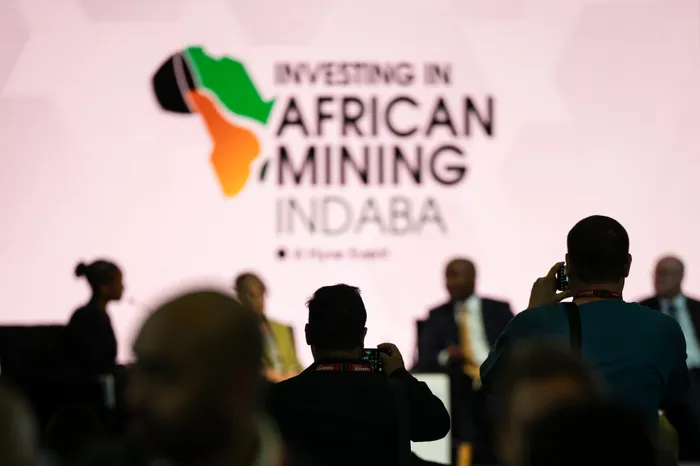
The African Mining Indaba kicked off at the Cape Town International Convention Centre.
Image: Armand Hough / Independent Newspapers
This week, Cape Town once again hosts the African Mining Indaba. Ministers will deliver keynote speeches. Executives will praise partnership and sustainability. South Africa, and Africa more broadly, will be advertised as “open for business” in the global scramble for critical minerals.
It will look like strategy.
It will sound like confidence.
It will feel like progress.
It is none of these.
The African Mining Indaba is not a development forum in which the money of the world gathers to further the interest of the people. It is a place where the finite inheritance of the people of Africa, is converted into short-term cash flow and sold as foresight. We will be told that sovereignty is secure, transformation is underway, and urgency leaves no room for delay. But sovereignty without consent is performance, transformation without power is cosmetic, and urgency without governance is liquidation.
Supporters of the Indaba insist there is no alternative. Capital is mobile. Competition is fierce. Time, they say, is not on South Africa’s side. If we hesitate, others will move faster. If we pause, we will be left behind.
This argument has the rhythm of realism. It lacks the substance.
It rests on a confusion so common it now passes for common sense: that speed equals strategy, that growth equals development, that extraction equals progress. South Africa’s lived experience tells another story, one written not in prospectuses, but in places like Emalahleni, Rustenburg, and Sekhukhune.
For more than a century, governments have changed, flags have changed, and ministers have come and gone. Yet the pattern has remained. Minerals have been extracted, revenues briefly absorbed into the fiscus, and then dispersed, through consumption, debt servicing, and capital flight. What has not emerged is durable productive capacity. What has not followed is reduced inequality. What has not materialised are resilient local economies in mining regions.
When extraction ends, leverage ends with it.When the mine closes, the bill arrives.When the investors leave, communities remain.
What remains are degraded ecosystems, collapsing municipalities, and households abandoned with no transition plan, no exit strategy, no future beyond survival.
The geography of the Mining Indaba is not incidental. Cape Town, polished, distant, insulated, sits far from the coal dust and tailings dams of the mining belts. Distance does political work. Decisions are made far from the harm they cause, by people who will never bear their long-term costs.
This is where sovereignty is not merely performed, but appropriated. The people’s authority is extracted from below and consolidated above, claimed in their name but exercised without their consent. What appears as national sovereignty is, in fact, its conversion: collective ownership narrowed into elite control, democratic mandate reduced to administrative licence.
The strong, as Thucydides observed, “do what they can. The weak suffer what they must”.At the Indaba, this logic is institutionalised. The powerful negotiate contracts, timelines, and exits; the powerless are offered consultation, urged to be patient, and left to carry the consequences.
Mining-affected communities are invited to consult, but not to consent. They are asked to participate, but not to decide. They are present in the language of inclusion, yet absent from the structures of power. They are not at the table. They are on the menu.
When communities resist, when they insist that their inheritance is not for sale, they are framed as obstacles to development, impediments to growth, enemies of progress.
Defenders of the system, including Mineral Resources Minister Gwede Mantashe, often point to Black Economic Empowerment as proof that mining has transformed. Ownership patterns have shifted, they argue; extraction is no longer racially exclusive.
Even if this claim were more robust than it is in reality, it confuses representation with transformation. The faces at the negotiating table may have changed, but the terms of extraction have not. Speed still trumps care. Cost still trumps consequence. Profit still trumps people.
Deracialisation has not disrupted extraction; it has stabilised it. It has made the system more legitimate, more defensible, and therefore harder, not easier, to challenge.
Others warn that stronger community consent rights or binding conditions on mine closures would deter investment. But this objection reveals a preference, not a law. It assumes that certainty for capital must outweigh security for communities, that efficiency must outrank democracy, that the economy must be protected from the people who live in it.
Comparable mining jurisdictions reject this trade-off. Countries such as Canada subject major mining transactions to public-interest review. They impose enforceable conditions on closures and restructurings. They require consent that is meaningful, not merely procedural. These measures do not repel investment (Mining investment in Canada has tripled since 2006); they shape it.
South Africa, by contrast, allows companies to extract, restructure, sell, and exit with minimal public scrutiny. The consequences are visible in places like Kriel, where families were evicted from mine-linked housing with no transition plan, and the social costs were transferred, quietly, efficiently, onto already-bankrupt municipalities.
Which is why the debate cannot end with partnership slogans or ESG panels at the Indaba. It must confront governance. It must confront power. It must confront the rules that decide who carries risk and who walks away.
South Africa urgently needs a mandatory Public-Interest Exit Test for mining companies. Before any mine closure, asset sale, corporate restructuring, or foreign redomiciling is approved, companies should be required to demonstrate, publicly, how workers will be protected, how communities will be housed, how environmental liabilities will be funded, and how historic obligations will be honoured.
Investment should not be allowed to socialise loss and privatise gain.Communities should not be asked to absorb risk so that others can extract reward.Democracy should not end at the mineshaft gate.
Every society knows that you do not build a future by selling your inheritance to cover today’s bills. Families that do so do not become prudent; they become poorer. Nations that do so do not become competitive; they become hollowed out.
South Africa’s family silver includes finite mineral wealth, ecological thresholds, social cohesion, and democratic legitimacy. Liquidating these assets in the name of urgency is either reckless or selfish. Either way, it is not development and is more akin to disposal.
The African Mining Indaba will proceed. Applause will be loud. Confidence will be choreographed and the media will lap it up.
But activity is not accumulation.
Access is not authority.
And selling is not building.
Investors can exit silently. History cannot. The consequences of liquidation accumulate and return, socially, politically, and ecologically.
* Christopher Rutledge is a South African human rights activist and the Executive Director of Mining Affected Communities United in Action Advice Office, and part of a national network representing communities impacted by mining.
** The views expressed do not necessarily reflect the views of IOL or Independent Media.