

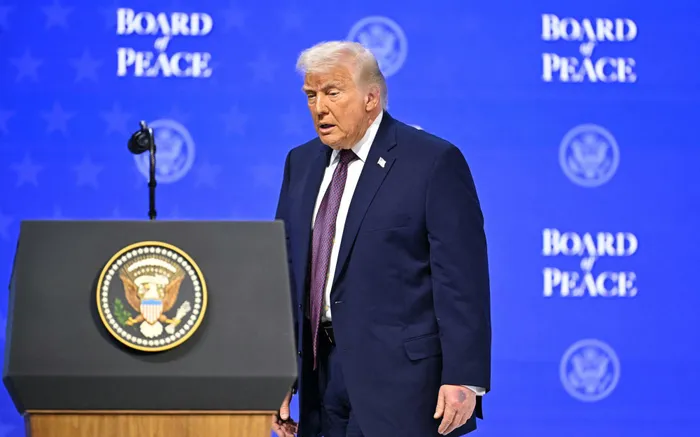
US President Donald Trump Donald Trump, the President of the United States succinctly reflected on the plan to establish the Board of Peace (BP) with 20 points plan to end war, restore peace and redevelop Gaza Strip
Image: Fabrice Coffrini / AFP
In September 2025, Donald Trump, the President of the United States (US), succinctly reflected on the plan to establish the Board of Peace (BP) with 20 points plan to end war, restore peace and redevelop Gaza Strip; however, in November 2025, the United Nations (UN) passed a resolution approving the establishment of BP and it’s attached 20-points plan, however, this BP was approved as ‘New International Transitional Administration’ or body confined to only the war-torn Palestinian territory of Gaza.
After that, in January this year, at the World Economic Forum in Davos, Switzerland, Trump used his populist strategy to lead the signing of BP’s charter at the wrong platform, even though there is no clarity on how BP would relate to and work with the United Nations Security Council (UNSC).
On February 19, 2026, Trump convened, in Washington, the inaugural meeting of the BP, and apparently out of more than fifty-five invited countries to join the board, only twenty-seven signed the pledge, and others chose to attend as observers; however, there is growing concern and heated debate among UN member states that the BP has been systematically formed to assume the legislative mandate of the UNSC as enshrined in the UN’s charter.
As a scholar of international relations and political science, I do not possess a jurisprudential astuteness, however, I want to posit an argument that it was wrong for the UN to approve the establishment of the BP and its 20-point plan to end war and coordinate the re-development of Gaza, because Article 24 of the UN’s charter substantively stipulates that the primary responsibility of the UNSC is to maintain and ensure international peace and security and at least article 25 of the UN’s charter provides a basis for decisions of the UNSC to be binding to all members states of the UN.
It is also problematic for the UN to have passed a resolution on the approval of BP and its plan, without invoking any of the articles of the UN’s charter to legislatively justify that, because according to the charter, it is only the UNSC that can invoke either Article 41 (non-military intervention) or Article 42 (military intervention) to ensure global peace and security.
For example, Article 33 states that, where actions of the parties in disputes or conflict threaten the maintenance of international peace and security, it is the UNSC that is legislatively mandated to seek solutions through mediation, negotiation, judicial settlement, or conflict resolution. The UN Charter does not have a provision for structures such as the so-called ‘new international transitional body’ to operate outside the legal framework. Surprisingly, the Board of Peace’s charter contradicts the contents of the November 2025 resolution that approved the board; the resolution clearly confines the board to Gaza and deems it as a transitional administrative structure, but the charter of the board stipulates that it transcends the borders of Gaza to intervene everywhere globally, and it also characterises the board not as a temporary but as a somewhat permanent structure.
In its charter’s preamble, the BP explicitly undermines the UN and UNSC because it states that the formation of the board was a response to the need for the world to ‘depart from approaches and institutions that have too often failed’. However, the silence of the UN Secretary General, Antonio Guterres, leaves much to be desired; he was supposed to stand firm, clarify the resolution and defend the legitimacy of the UN and its structure UNSC. However, this confirms the narrative that the UN is not impartial and it solely serves the interests of certain countries, especially those that are aligned with the US and the so-called superpowers.
It is glaring that the BP is, to some extent, a replicated structure that intends to assume the responsibilities of the UNSC, with the US holding the same veto powers that Russia, China, the United Kingdom, France, and the US hold within the UNSC. Therefore, there is a need for the UN to convene an urgent assembly to rescind its resolution of November 2025 and assign its legal team to re-examine the establishment, 20-point plan and the charter of the BP, because this matter has a potential to further divide its member states and also weaken the selectively reactive UNSC in its execution of the key mandate of maintaining international peace and security.
The general reaction is that many countries that joined BP lack legitimacy and credibility to deal with peace, mediation, development and security, because they failed to deal with their domestic abuses of human rights, inclusive governance and development. And some of them have contributed to the situation that exists in the conflict-ridden Palestinian territory (Gaza Strip).
On the other hand, countries such as France and Greece refused to join the BP, arguing that its formation serves as a subtle strategy to undermine and replicate the mandate of the UNSC. However, Norway rejected the invitation because it believes that some of the points in the 20-point plan need some discussion and clarification.
One of the concerns is how lasting peace can be restored in Gaza without the inclusion of the Palestinian political leadership in peacebuilding and the redevelopment of the area. The fifteen members of the transitional government or the National Committee in Gaza are imposed on the population and the Palestinian government.
Again, the BP might face some disintegration as the Israeli government has already raised a concern about the inclusion of Turkey and Qatar on the board, because it believes the two countries have been supporting and hosting the leadership of Hamas. Contrary to that, Brazil and Mexico refused to join the BP based on the exclusion of Palestine in the peace processes. The President of Brazil, Lula da Silva, has further accused Trump of trying to establish a ‘new UN’. One may conclude that the BP is formed as an alternative structure from the UNSC not to restore lasting peace in Gaza and the world, but to advance the interests of the US and Israel amidst the international geopolitical tensions and power shifts, and other countries are merely co-opted to support that nefarious agenda led by the white house.
Perhaps now is the time for all countries that rejected BP to swiftly engage with the remaining permanent members of the UN with veto powers to agree on the reform of the UNSC to make it effective, and in order to counter the nefarious agenda of Donald Trump and Benjamin Netanyahu.
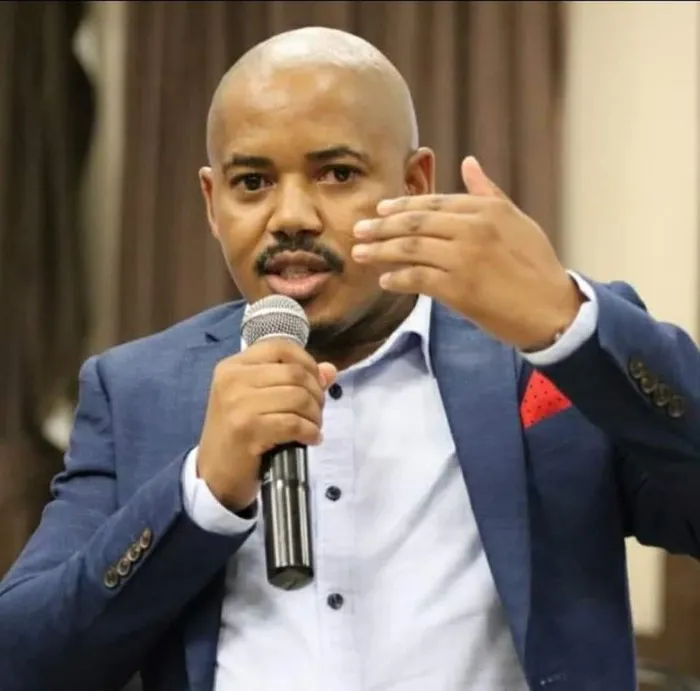
Orapeleng Matshediso
Image: Supplied
* Orapeleng Matshediso is a master’s graduate of Pan African Development Studies and a Research Fellow at the University of Johannesburg (Institute for Pan African Thought and Conversation). The author is also an alumnus of the then Thabo Mbeki African Leadership Institute (TMALI).
** The views expressed do not necessarily reflect the views of IOL or Independent Media.