

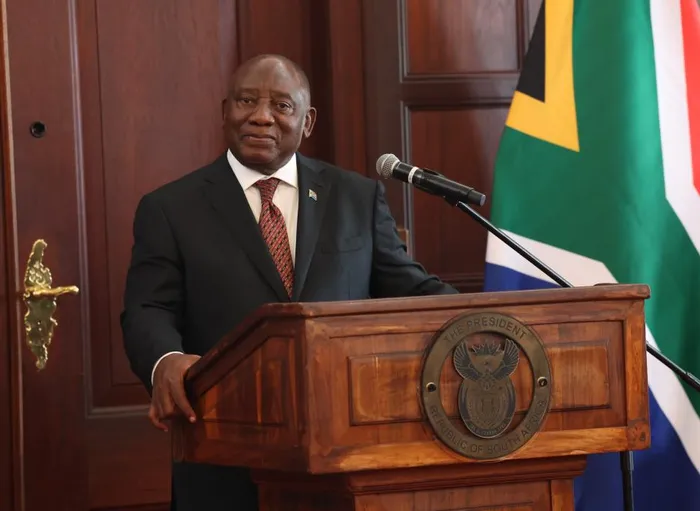
South African President Cyril Ramaphosa speaks while addressing diplomats who had presented letters of credence as new heads of missions accredited to South Africa at the presidential guest house in Pretoria, South Africa
Image: XINHUA
South Africa's foreign policy has been under international scrutiny more often than any other nation on the African continent. This has largely been due to American President Donald Trump’s extended focus on the country. Trump cites a range of factors, arguably stemming from democratic South Africa’s support for Palestine and tensions between itself, the US and Israel regarding its proximity with Iran. The ascension of South Africa to BRICS has long been a point of contention for the West, particularly the US. South Africa, however, rightfully contends its position as a sovereign state free from coercion.
US–South Africa relations have sharply deteriorated in early 2026, reaching their lowest point since 1994 amid escalating tensions with the Trump administration. Washington has focused heavily on South Africa’s land reform policies, particularly the 2024 Expropriation Act, alleging discrimination against white farmers. These claims are strongly rejected by Pretoria, which says the law addresses historical inequality. Frictions have also deepened over South Africa’s foreign policy positions, including its BRICS membership and its legal action against Israel at the International Court of Justice.
The fallout has moved beyond diplomacy into concrete measures, including suspended US aid, a refugee programme prioritising Afrikaners, and the expulsion of South Africa’s ambassador, Ebrahim Rasool. Washington has reviewed South Africa’s African Growth and Opportunity Act (AGOA) trade benefits [extended until December 31, 2026] and criticised its G20 role. Pretoria has responded by rejecting allegations of “white genocide” and defending its policies as sovereign decisions, while accusing the US of misinformation and political pressure.
South Africa has long supported the plight of the Palestinian people in the Middle East. Nelson Mandela himself remarked: “But we know too well that our freedom is incomplete without the freedom of the Palestinians.” South Africa has taken the world to task on this. Linking it to the suffering its own people have suffered during apartheid, South Africa spearheaded the ICJ case against Israel in 2023.
The United States has strongly opposed South Africa’s case against Israel at the ICJ, dismissing it as “meritless,” “without any basis in fact,” and “counterproductive.” In March 2026, Washington formally intervened in the case, filing an 11-page declaration in support of Israel and arguing that the genocide allegations form part of a broader effort to delegitimise the state. US officials and segments of the media have accused Pretoria of effectively acting as a legal proxy for Hamas, a characterisation South Africa firmly rejects.
South Africa’s relationship with Iran is rooted in long-standing political alignment shaped by shared anti-colonial and anti-Western positions and historical ANC–Iran ties. In recent years, this has expanded into limited military and naval cooperation, including defence engagements and Iran’s participation in BRICS+ exercises near Cape Town alongside South Africa, China, and Russia.
Pretoria has maintained diplomatic engagement with Tehran despite US pressure and criticism over Iran’s alleged human rights record, while supporting continued dialogue even amid regional conflict. Although economic cooperation has been discussed, particularly in energy and infrastructure, tangible benefits remain limited, with the partnership viewed by critics as complicating South Africa’s non-aligned stance and increasingly aligning it against Western strategic interests.
The expansion of BRICS has intensified Western geopolitical concern by consolidating a large, non-Western coalition that increasingly challenges the US-led global order. With new members including major energy producers such as Iran, Saudi Arabia, and the UAE, the bloc now represents roughly 40% of global GDP (PPP) and more than 50% of the world’s population, strengthening its economic and demographic weight. Key concerns in the West centre on efforts toward de-dollarisation through alternative payment systems that could reduce reliance on the US dollar and SWIFT, as well as attempts to build parallel institutions like the New Development Bank that compete with G7-led structures.
South Africa’s foreign policy has come under growing international scrutiny due to its positions on Palestine, its engagement with Iran, and its active role in BRICS, all of which have contributed to heightened tensions with the United States and other Western powers. These disputes now span diplomacy, trade, and international legal forums, reflecting broader disagreements over global order, governance, and shifting geopolitical alignments.
Despite this pressure, South Africa continues to present its approach as rooted in liberation values, multilateralism, and independent decision-making in foreign affairs. Its partnerships and policy choices reflect an effort to maintain strategic autonomy in a changing world order, underscoring its commitment to sovereignty, non-coercion, and an independent foreign policy stance
Written by:
*Cole Jackson
Lead Associate at BRICS+ Consulting Group
Chinese & South America Specialist
**The Views expressed do not necessarily reflect the views of Independent Media or IOL.
** MORE ARTICLES ON OUR WEBSITE https://bricscg.com/
** Follow @brics_daily on Twitter for daily BRICS+ updates and instagram @brics_daily