

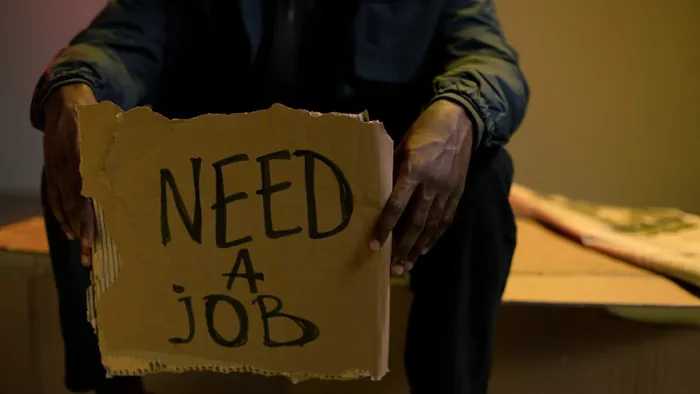
South Africa’s official unemployment rate reached 32.7% in the first quarter of 2026
Image: Ron Lach/Pexels
Is it unstoppable? South Africa’s official unemployment rate reached 32.7% in the first quarter of 2026, according to StatsSA.
Furthermore, the expanded unemployment rate, which includes discouraged job seekers who have stopped looking for work, could rise to 43.7%. This represents an increase of 301,000 unemployed South Africans, bringing the total to 8.1 million.
What can we do? In South Africa, service delivery (mostly its lack) is a constant topic of discussion, not necessarily because services are entirely absent, but because their reach and effectiveness are often inadequate.
As you read this, it is important to recognise that empires do not collapse overnight; they decline gradually into a state of decay. This is an important starting point for this analysis.
South Africa has invested significantly in infrastructure such as roads, stadiums, and more. These assets are either in use, or, regrettably, turning into wasted investments or “white elephants”, as has often been observed.
However, the first point must be clarified: service delivery alone is not enough to maintain our cities and communities. Municipal officials are simply insufficient to meet the scale of need.
They also tend to focus on minor maintenance tasks, many of which I think could be undertaken by the unemployed. Once municipalities acknowledge that they cannot service cities on their own, this perspective can be considered part of the solution, so that we do not witness cities like Pietermaritzburg deteriorating into dumpsites with little attraction beyond government offices. This reflection is not only informed by the state of Pietermaritzburg, but also by observations made while travelling our country.
Across many parts of South Africa, unemployment is visible; you see it. If you drive or walk through our cities, you will encounter men and women who wake up each day and wait by the roadside, hoping to be picked up for a day’s work to earn an income.
A fellow South African stands on the street, waiting for someone to stop and say, “I’m looking for painters”, “looking for grass cutters”, or “I need manpower.” They climb into the back of a bakkie to make a living.
Our cities are not short of manpower to clean streets, repair potholes, and revitalise parks and buildings. These individuals are waiting to be engaged and taken where their labour is needed.
They do not require permanent contracts, but rather opportunities that sustain hope and provide a steady flow of income in exchange for their work.
If we have the manpower, then we must ask:
Why is there so much litter in our streets?
Why are there so many potholes?
Why is grass left uncut?
Why are road markings and signs not visible?
Why does it take months to clean our beaches?
Why is there so much crime?
Yes, crime. A person who wakes up to look for work and finds none will not return home to watch their children go hungry. Out of desperation and responsibility, they will do whatever they can to provide. At worst, they may take what does not belong to them just so their family can eat. This highlights the urgency of engaging the unemployed and ensuring that they can earn an income, even temporarily, while contributing to the upkeep of our cities and infrastructure.
Informal employment and entrepreneurial activity are the backbone of building and maintaining cities. Keep young men and women off the streets by giving them the opportunity to work within their communities.
So, what is the response to the question: how do we keep people off the streets?
Municipalities already allocate funds for service delivery, yet a significant portion goes to contractors who often lack the capacity to deliver at the required scale.
Government should focus on specialised and technical services, while communities themselves are engaged in maintaining their environments for daily wages or salaries. Municipal agents could be deployed with clear targets to recruit individuals for tasks such as cleaning streets, cutting grass, and performing routine maintenance. This approach would not only direct money to those who need it most, but also address capacity constraints.
If given the opportunity, I would introduce a “Pothole Month”, the men on the street waiting for employment are mobilised to repair roads across our cities. Imagine the transformation if such an initiative took place twice a year; yes, potholes would become a rare occurrence. We have the manpower, yet we are not using it.
From an economic perspective, labour is the most valuable factor of production. Once people are engaged, they gain confidence, become entrepreneurial, and eventually create employment for others. In simple terms, people need income to participate in the economy and to begin investing in future opportunities. Paying a worker R200–R300 per day enables them to purchase basic goods from local vendors, thereby injecting money directly into the local economy.
This money circulates quickly, strengthening small businesses. The person on the street is not saving for long-term wealth; they are sustaining immediate consumption. Is this not basic economics: money circulating rapidly rather than being absorbed into contracts that are poorly executed and financially retained?
Municipalities must pay people to work in their own cities. Otherwise, citizens will begin to question the value of their vote and may increasingly turn to grants or crime. This solution is possible, it requires political will, management and far less funding than what is currently lost through inefficient contracting.
Let people work for the services they expect. They will have no desire to neglect or vandalise their environment. Employ people. Inject money into the economy.
*** Pfano Mashau is the director of Durban University of Technology Business School. He writes in his personal capacity.
***The views expressed here do not necessarily represent those of Independent Media or IOL.

Prof Mashau
Image: Supplied