

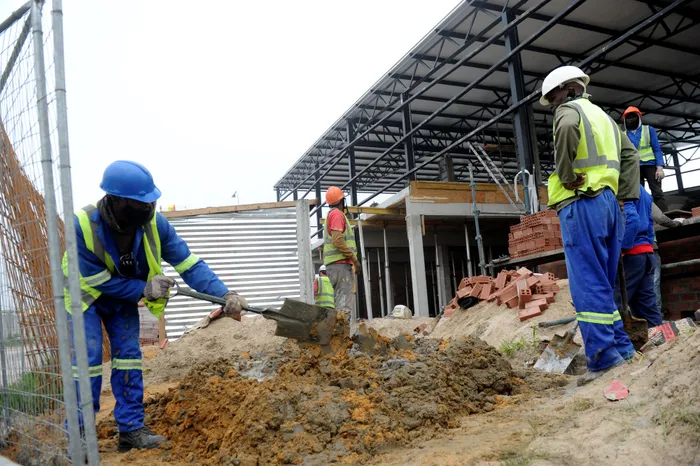
SACAP aims to turn the department, both nationally and provincially, into economic delivery units, ensuring projects are completed on time and within budget while restoring public trust through transparency, performance monitoring, and quarterly public reporting.
Image: Ayanda Ndamane/Independent Newspapers (File)
Public Works and Infrastructure Minister Dean Macpherson has announced the South African Construction Action Plan (SACAP), a new framework to recover delayed construction projects and restore accountability, saying this means the 'days are numbered for underperforming contractors'.
On Wednesday, Macpherson was joined by Director-General of the Department of Public Works and Infrastructure, Sifiso Mdakane, and Deputy Director-General: Construction Project Management, Batho Mokhothu, as he presented SACAP.
“That plan, which we are unveiling today, is called the South African Construction Action Plan, or SACAP. It is a framework of collective and individual accountability, a plan that sets measurable targets, real timelines, and enforceable consequences,” Macpherson said.
SACAP aims to turn the department, both nationally and provincially, into economic delivery units, ensuring projects are completed on time and within budget while restoring public trust through transparency, performance monitoring, and quarterly public reporting.
The plan introduces six key actions, including the blacklisting of defaulting contractors, ring-fencing of project budgets, digital tracking of all construction projects, the establishment of Procurement War Rooms, real-time audit collaboration with the Auditor-General, and the professionalisation of built environment practitioners within the public sector.
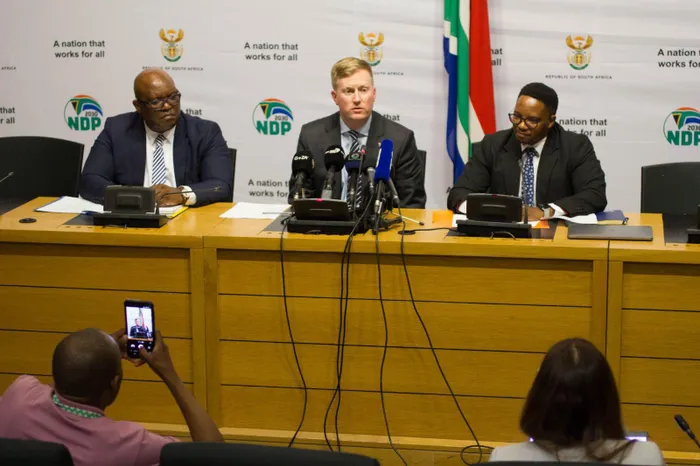
Minister Dean Macpherson (centre) was joined by Director-General of the Department of Public Works and Infrastructure, Sifiso Mdakane (left), and Deputy Director-General: Construction Project Management, Batho Mokhothu (right), as he presented SACAP.
Image: Supplied
“For too long, underperforming contractors have operated with impunity. They fail on one site, only to resurface in another province under a new name or company number. That will come to an end.
“From today, all national and provincial departments will establish Restriction Committees to work with the Construction Industry Development Board in identifying and blacklisting defaulting contractors,” Macpherson said.
“These committees will compile and submit lists of non-performing companies to prevent repeat offenders from securing new state contracts.
“This database will then be used to reference companies and individuals who have been blacklisted. If you have failed the state once, you will not be given a second chance to waste public funds,” Macpherson said.
The minister added that all departments will enforce catch-up plans on stalled or delayed projects, with progress reports submitted quarterly to Members of the Executive Council for Public Works and Infrastructure. These reports will track performance against milestones and costs, and where progress is not made, contracts will be terminated, and consequences will follow.
“Cash-flow mismanagement is one of the biggest reasons projects stall. Budgets are approved but not released on time. Contractors go unpaid for months. Work stops, costs climb and the public bears the consequence.
“To end this cycle, we are advocating for the introduction of strict ring-fencing of project budgets. Our goal is to work with the National Treasury, provincial treasuries and departments to ensure that infrastructure funds are protected and cannot be diverted to other uses,” he said.
“Without accurate information, decision-making becomes slow, and accountability becomes impossible. To change this, by March 2026, every Public Works department, national and provincial, will implement a digitised, integrated Asset Information Management System based on modern Enterprise Resource Planning, or ERP, technology.
“This will enable real-time tracking of every construction project in South Africa: the contractor, the timeline, the budget, and the physical progress.
“For the first time, we will have a unified, live dashboard that shows where projects stand, what risks they face, and what interventions are required,” Macpherson explained.
Later, when questioned about safety concerns and the possible attacks on projects by the construction mafia through the dashboard, the minister explained that since the Construction Summit in Durban last year, more than 850 people have been arrested, resulting in 240 convictions.
“In some instances, according to construction companies, we’ve seen an 80% decline in lost construction hours, so that is remarkable success that we’ve seen in less than a year because of collaboration with SAPS, with our own department, and setting up a hotline for tip-offs.
“Our view now is that failed construction projects, by and large, have very little to do with the construction mafia and more to do with budget issues, and so on.”
Regarding the Procurement War Rooms, he said that every Public Works department will now launch this hub, which brings together supply chain specialists, legal advisors, engineers, and project managers to monitor awards in real time.
“These Procurement War Rooms will identify blockages, speed up evaluations, and ensure that projects move from bid to site without unnecessary delay.”
By June 2026, all built-environment professionals working for or contracted by Public Works departments will also be required to be registered with their statutory councils, such as the Engineering Council of South Africa (ECSA) or the South African Council for the Project and Construction Management Professions (SACPCMP).
“We are also introducing a Professionalisation Programme in partnership with the Council for the Built Environment and the National School of Government, aimed at strengthening ethics, competence, and accountability.
“This will not only raise professional standards but also reduce our over-reliance on external consultants, ensuring that the skills to build the country reside inside the state, not outside of it.”
Macpherson said that there is currently R14 billion in construction projects being designed, planned and constructed across all national and provincial Public Works & Infrastructure departments.
“For too long, we have been starting construction on major projects but have failed to complete them. We are turning the Department of Public Works and Infrastructure into the economic delivery unit of South Africa, one that builds faster, cleaner, and smarter.”
theolin.tembo@inl.co.za