

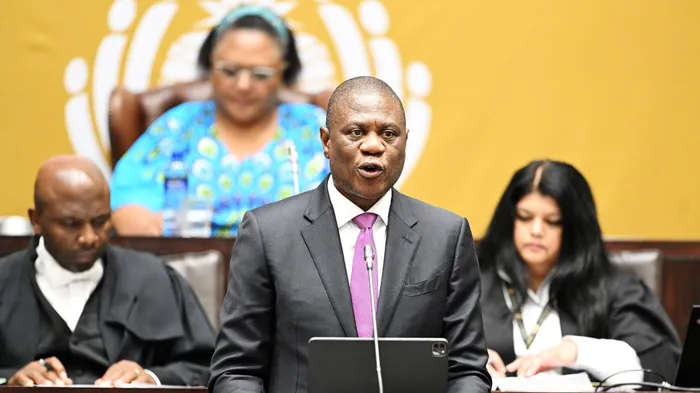
Deputy President Paul Mashatile on Tuesday said that the government is aware of corruption associated with water tanker operations.
Image: Phando Jikelo / Parliament of SA
Deputy President Paul Mashatile on Tuesday addressed the national crisis surrounding water provisioning in South Africa during a session at the National Council of Provinces, highlighting the government's commitment to tackle corruption linked to water tanker operations.
Mashatile said the government is aware of and is responding to corruption and criminality associated with water tanker operations.
Responding during a question-and-answer session in the National Council of Provinces, he said the National Treasury has issued a circular cautioning municipalities against long-term reliance on water tankers, which should only be used as temporary emergency measures.
“As government, we call for increased community participation in protecting critical infrastructure. We also urge communities to report suspicious activities and embrace the culture of whistle blowing to expose criminal networks and corruption within the water sector,” he said.
Mashatile was responding to ANC chief Whip Kenny Mmoeimang, who asked about measures taken against water tankers who are colluding with municipal officials to manipulate the country’s water crisis for their own selfish benefit.
In a follow-up question, DA MP Paul John Swart asked Mashatile about examples where water tanker corruption and collusion was actually stopped.
“Can you give this House just one successful case, where it happened?” said Swart.
In his response, Mashatile said he did not have details of cases, but was aware that there was intervention in municipalities in the North West.
“The problem with water tankers is that when there is a problem of water, municipalities do require to bring water through water tankers.
“As I said in my reply, this was supposed to be treated as an emergency temporary solution, but of course, because of corruption, people vandalise water infrastructure so that municipalities don't have an option but to continue to bring water tankers.”
He said municipalities should be vigilant to make sure that water infrastructure is protected, adding that when water infrastructure was protected, cases of vandalism decline. He said this resulted in municipalities not continuing to rely on water tankers.
Mashatile added that once they have cases of the water tanker providers colluding with municipal officials to manipulate the water crisis, they will provide that information.
In an earlier question, Mmoeimang asked whether the government was considering expanding public-private partnerships and investment to address persistent water and sanitation challenges that were worsened by ageing infrastructure, climate change and limited municipal capacity.
The Deputy President said municipalities were grappling with challenges related to the provision of water and sanitation due to a combination of factors.
“This includes poor governance, lack of technical and administrative capacity, inadequate infrastructure investments, poor maintenance and financial mismanagement. “
Mashatile said the Department of Water and Sanitation reports that there has been a severe decline in the capacity of many municipalities to deliver water to communities.
“I must highlight that the government is taking decisive steps to resolve the systemic issues that continue to hinder reliable provision of water and sanitation services to local communities.
“Through the Water Task Team, we are tackling security challenges by improving infrastructure, reforming institutions and expediting project management in a coordinated approach.”
The department, he said, in March proposed key interventions aimed at addressing the challenges of water provision and continuous disintegration of critical water infrastructure.
Key recommendations included increased investments through financing options and ensuring the financial viability of the sector.
Mashatile said the Department of Water and Sanitation has established a water partnership office housed at the Development Bank of South Africa to help municipalities prepare projects for private sector investment.
mayibongwe.maqhina@inl.co.za