

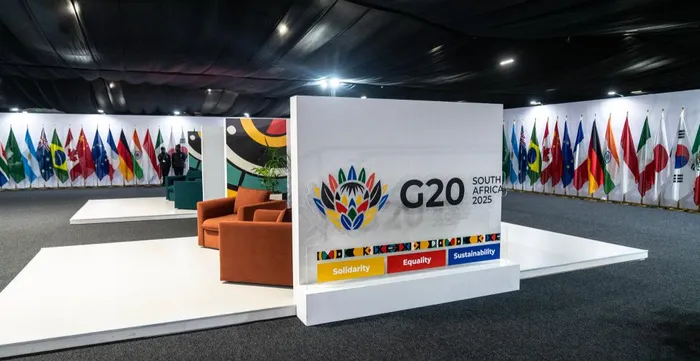
This photo taken on Nov. 17, 2025 shows a scene of the venue for the 20th Group of 20 (G20) Summit in Johannesburg, South Africa. The 20th Group of 20 (G20) Summit was held in Johannesburg from Nov. 22 to 23.
Image: Xinhua
The 2025 G20 Johannesburg Summit marked a historic turning point, the first time the G20 convened on African soil. What might once have been a symbolic novelty has become a deliberate effort to reorient global multilateralism around centres of power, demographics, and the ambitions of the Global South. South Africa’s leadership leveraged the summit to highlight Africa’s priorities and demonstrate that multipolarity can function effectively, even without full participation from traditional powers.
Africa: A Rising Labour Capital
Africa stands at the cusp of demographic and economic transformation. The continent’s population is at roughly 1.5 billion which is nearly a fifth of the world’s total, with a median age of just 19.2 years, making it the youngest region globally. Between 2024 and 2050, the working-age population is projected to almost double, rising from approximately 849 million to 1.56 billion. Africa is expected to supply a large share of global labour growth over this period, with some estimates suggesting up to 85%.
These dynamics create extraordinary labour capital potential. By 2043, Africa’s labour supply is forecast to expand by roughly 23.5 million per year, and the continent’s workforce could surpass that of China by around 2034. Africa is not only growing; it is growing younger and more dynamic. If properly mobilised, this expanding pool of labour is set to become a global engine of production, innovation, and value creation.
The G20 Summit: Matching Structure to Demographics
The Johannesburg summit arrived at precisely the right historical moment. Under President Cyril Ramaphosa, Africa’s G20 presidency sought not mere visibility but structural influence, embedding Africa’s demographic realities into the architecture of global governance.
Through dedicated Task Forces and an ambitious agenda, the summit aimed to align global policy with Africa’s growth potential and youthful workforce.
Africa’s Agenda, Zain Dangor & GBV
Zane Dangor, serving as South Africa’s G20 Sherpa, played a pivotal role in ensuring Africa’s priorities remained at the forefront of deliberations. Dangor’s leadership was critical in steering discussions, building consensus, and keeping the G20 focused on the African agenda. He ensured that issues such as debt relief, industrialisation, food security, and youth employment remained central, while navigating the complex dynamics of a multipolar summit. His diplomatic skill reinforced the message that African leadership is substantive, capable of shaping the global order rather than simply participating in it.
While South Africa successfully hosted the G20 and advanced a robust African agenda, it did so amid pressing domestic challenges. The country continues to grapple with social, economic, and political pressures, highlighted poignantly by the GBV-related protests that took place on the Friday of the G20 weekend. These demonstrations, led by courageous activists and organisations such as Women for Change, brought attention to the urgent need for gender justice, safety, and equality at home. South Africa’s ability to host a global summit while simultaneously acknowledging and respecting the voices of its citizens underscores the complexity of leadership, balancing international responsibilities with domestic accountability, and recognising that progress on the global stage must be matched by meaningful reform and activism at home.
Multipolar Multilateralism and the African Moment
The Johannesburg G20 demonstrated that effective global governance can occur even in the absence of traditional powers, notably the United States. Africa’s growing labour force adds weight to a multipolar order, showing that global cooperation can function based on shared interest rather than unilateral dominance. The summit highlighted that Africa [and the world] has the agency, resources, and human capital to shape international frameworks in ways that reflect its priorities.
Demographic advantage alone does not guarantee prosperity. Africa faces major challenges in converting its population growth into sustainable development. Sub-Saharan Africa must generate millions of jobs annually to match labour supply, yet formal sector growth remains slow. High levels of informality, low productivity, skills mismatches, and structural barriers threaten to limit the impact of the demographic dividend. Without investment in education, infrastructure, industrial capacity, digital connectivity, and green value chains, Africa’s workforce risks underemployment rather than empowerment.
Foreseeable challenges
As the G20 baton passes from South Africa to the United States, questions arise about how the priorities established in Johannesburg will be sustained or reshaped. The US chairmanship may emphasise traditional security and financial concerns over the African-focused agenda championed by South Africa, potentially shifting attention away from debt relief, industrialisation, and youth employment. There is the reality that Africa’s development and multipolar priorities could be diluted or reframed to align with US strategic interests.
However, the momentum generated by South Africa’s leadership, the institutional frameworks established through the Task Forces, and the visibility of African issues on the global stage provide a foundation for continuity. Maintaining collaboration with committed G20 members [,other multilateral organisations] and leveraging the growing influence of the Global South will be crucial to ensuring that Johannesburg’s achievements are not sidelined but integrated into the broader multilateral agenda under the US chair.
Why the G20’s New Mandate Matters for Africa’s Future
The Johannesburg summit recognised Africa’s demographic shift as a global structural trend. By prioritising inclusive growth, industrialisation, food security, and digital transformation, the G20’s Task Forces offered a framework to convert labour capital into tangible economic gains.
The G20 in Johannesburg was more than a summit; it was a statement. Africa matters not only for its resources but for its people: a youthful, growing, and increasingly skilled labour force that could reshape global production, governance, and economic geography. Yet, demographic potential alone is insufficient. Only deliberate policies in skills, infrastructure, industrialisation, governance, and technology can transform potential into prosperity.
Written By:
Cole Jackson
Lead Associate at BRICS+ Consulting Group
Chinese & South American Specialist
** MORE ARTICLES ON OUR WEBSITE https://bricscg.com/
** Follow https://x.com/brics_daily on X/Twitter for daily BRICS+ updates