

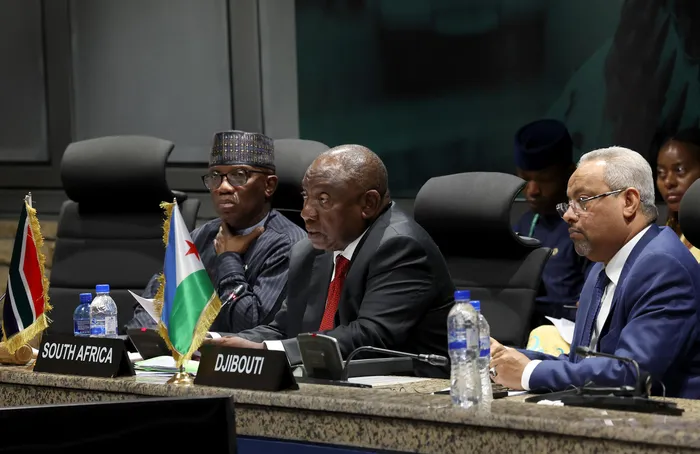
Ramaphosa urges African nations to work collectively to manage their critical minerals.
Image: Kopano Tlape
Amid a strained global order, President Ramaphosa has called on Africa to unite and assert itself, especially regarding the strategic management of its crucial natural resources, which developed economies increasingly depend on. This necessitates a new approach to trade and resource governance.
Ramaphosa was speaking to the media after the 39th Ordinary Session of the African Union Assembly of Heads of State and Government concluded in Addis Ababa, Ethiopia, on Sunday.
Ramaphosa argued that the global structure has shifted, with some suggesting the “rules-based architecture” has effectively collapsed. This necessitates that regional bodies like the African Union (AU) must clearly define how Africa will engage and make interventions in this new world order.
He said key issues requiring consolidated African positions include trade and, crucially, how to manage the continent’s natural resources, specifically minerals, critical minerals, and rare earths, which are vital to more developed economies.
Ramaphosa stressed the need to prevent a “new form of colonialism” where developed economies might “target” these minerals.
“It’s now time for Africa to do business on its own terms and to make sure that the decisions that we engendered at the G20 on how we treat our endowments like particularly critical minerals should be dealt with.
“It should no longer be a case where rock, soil, and dust are exported out of Africa without being beneficiated,” he said.
Ramaphosa said Africa now possesses significant leverage, and it must be used. Crucially, without imposing their will, they need to speak and act collectively as one continent to strategically manage their resources and wealth. This management must prioritise the advantage of Africans, as historically, this has not been the case.
“Other countries outside the African locale have gained a great advantage. Now the geopolitical situation having changed as it is requires us to be smarter and wiser and use the leverage that we have without being arrogant, without seeking to impose ourselves,” Ramaphosa said, adding that it time for Africans to act together.
Meanwhile, when delivering remarks on the Report of the Peace and Security Council (PSC) of the African Union on its activities and the state of peace and security in Africa, Ramaphosa said South Africa is concerned about the prevailing security and humanitarian situation in the eastern Democratic Republic of Congo (DRC), despite several mediation and peace processes.
“We reiterate that the unity, sovereignty and territorial integrity of the DRC must be upheld and respected. We condemn the continued capture of territories by the M23/AFC in the Kivu and Ituri provinces. Such unlawful actions must be corrected decisively,” he said.
In January last year, 14 South African National Defence Force (SANDF) soldiers died in the DRC. They were part of a multinational Southern African Development Community (SADC) force deployed to stabilise the region during clashes between the DRC military and M23 rebels.
During the National Assembly’s urgent debate in February, held under the theme: “The recent casualties incurred by the SANDF in the Democratic Republic of Congo and their implications for the defence force,” DA MP Emma Louise Powell said the conflict is about politics and money and the M23’s advances are not ideological, but they are designed to consolidate control over critical mineral resources and supply lines to Rwanda. She said the United Nations reported that M23 generates $800,000 in taxes on mineral trades monthly.
thobeka.ngema@inl.co.za