

Are political parties capitalising on March and March's anti-immigration stance?
Image: XOLILE MTEMBU
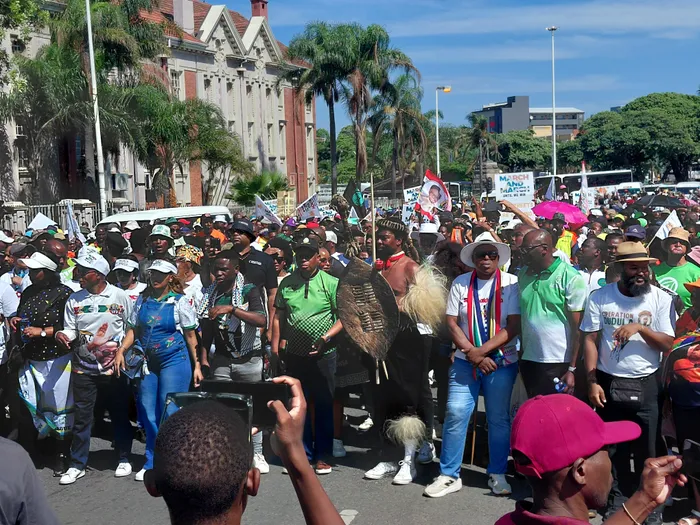
Tensions boiled over in Durban on Wednesday as numerous parties marched alongside group March over illegal immigration in the country.
ActionSA, the Patriotic Alliance (PA), and Inkatha Freedom Party (IFP) were some of the political parties in attendance.
Analysts told IOL that these parties may be using the group for political clout.
The 2026 Local Government Elections (LGE) are looming, and politicians may be scrambling for votes.
March and March was celebrating its first-year anniversary with thousands showing up to support.
However, in October, the SA Human Rights Commission (SAHRC) initiated legal proceedings against "unlawful and discriminatory" actions of groups such as Operation Dudula and March and March, who were blocking non-nationals and undocumented individuals from accessing public healthcare facilities.
"Our Constitution does not allow for vigilante enforcement of immigration laws, nor does it permit anyone to deny medical services to another person based on their nationality," said the SAHRC.
Yet, the Durban High Court rejected the urgent application against the organisations.
March and March leader, Jacinta Ngobese-Zuma addressed the crowds.
"They left their countries to become rude here. Do you remember how white people treat us? They came to visit and ended up saying they discovered us. One day, these foreigners will say the same. Why aren't you angry?
"We want to convey the message that we don't want them here. They should leave. Everyone here should chant as if they are doing it for their future child," she told the crowd.
MK Party's KwaZulu-Natal provincial deputy coordinator, Shirley Willemse, told IOL that the MK Party is not prejudiced against immigrants.
She insisted the movement was not driven by hatred.
"We are not anti-African. We do not despise or dislike our African brothers, but we cannot be sacrificed as South Africans so that they can live."
But her comments quickly took a sharper turn, as she accused the government of failing its own citizens.
"We find ourselves as South African citizens at a crossroads where the government is prioritising our neighbours instead of us as South Africans," she said.
Willemse questioned the future of struggling locals, asking: "Now the question remains, where should South Africans go? Where must they go? Where must our children go?"
She went on to link unemployment, drug abuse, and illegal immigration.
In the march that began at King Dinuzulu Park to Hoy Park, protesters chanted inflammatory statements.
The demonstrators attempted to enter the African National Congress (ANC) provincial office and were stopped.
Political analyst Goodenough Mashego warned that the parties may be playing a dangerous political game.
"I'm not surprised with Action SA being involved," Mashego said. "They are borrowing much of their politics from American right, the right-wing politics, where everything is being blamed on immigration."
ActionSA's leader Herman Mashaba echoed March and March's views.
"Illegal immigration has been destroying the soul of the country. We really appreciate March and March and other political parties and NGOs. Enough is enough. Our people are suffering.
"I don't understand the Government of National Unity (GNU) and the African National Congress (ANC) believe South Africa should be the nanny of the world when we're unable to look after our own people."
Mashego told IOL that he did expect some parties to align with such rhetoric.
"I'm just a little bit disappointed by MK Party, given the fact that they identify themselves as being a pro-African party. The MK Party has every intention of growing...they believe by aligning with it [March and March], they can be able to convert the support into electoral votes."
The street felt like a pressure cooker long before the march began, voices rising, placards lifted, and frustration hanging thick in the air.
Political analyst Dr Lubna Nadvi, a senior lecturer at the University of KwaZulu-Natal (UKZN), situates the tension within a broader national pattern.
"The issue of the presence of foreign nationals in South Africa and immigration has become a very hotly contested debate in South Africa," she said.
In the heat of election season, she suggests, the anger on the streets is not unfolding in isolation but is being shaped and sharpened by political agendas seeking traction.
According to the professor, the stakes are far greater than campaign rhetoric.
"The movement of people from one country to another should not be seen as political fodder to secure votes in an election," she said.
She pointed instead to a framework of laws and rights that exist beyond the immediacy of public outrage.
She said migration is not merely a local grievance, but part of an intricate legal and human system, one that governs who may seek refuge, who may work, and who may belong.
"Every single foreign national leaves the country the jobs, medical care and other opportunities that the members of this organisation hope to secure will not magically materialise."
The reality, she said, is more complex, tied to economic structures, state capacity, and resources that cannot simply be freed up overnight.
Her argument stretches beyond South Africa's borders, drawing an uncomfortable parallel.
As the crowd calls for exclusion, she asks the country to consider its own citizens abroad.
"The debate needs to take into account the broader framework of global migration where for example South Africans also move abroad and go elsewhere to work, study and live.
"It is a mirror held up to a nation in conflict with itself, she said, both a sender and receiver of migrants, both hopeful and defensive."
IOL News