

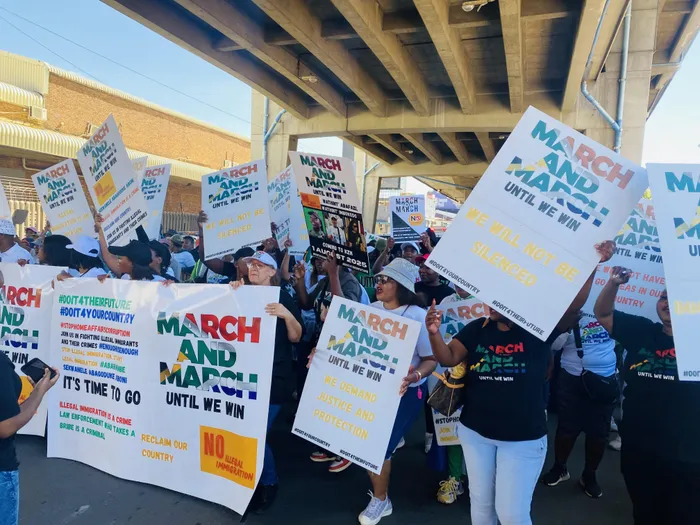
South Africa's anti-illegal protests have continued to expose the South African government's inconsistent approach to the country's immigration problem.
Image: Simon Majadibodu / IOL
As South Africa grapples with mounting immigration challenges, the government’s response has been described as inconsistent, according to immigration expert Dr Shadi Maganoe.
This assertion comes in light of recent anti-migrant protests across the nation, calling for decisive action against illegal immigration.
On Wednesday, while addressing the media, presidential spokesperson Vincent Magwenya insisted: "South Africans are not xenophobic. What we have are pockets of protest which are within our legal framework."
Magwenya went on to underscore the importance of protecting the rights of all individuals, asserting that immigration is a global pressure point.
On Sunday, Ramaphosa paid a visit to Zimbabwean President Emmerson Mnangagwa at his private farm to discuss bilateral interests.
Magwenya revealed that the immigration issue taking shape in South Africa was the centre of discussion between Ramaphosa and his Zimbabwean counterpart.
"To this end, the president is calling for the police to play their role against any individual. The two presidents also agreed to work together to address the issues that are behind these levels of migration that we see across our continent," Magwenya revealed.
Dr Maganoe, a senior lecturer at Wits University, said: "The government’s response has been inconsistent. There have been promises to act, but implementation has been slow and sometimes reactive in the sense that the government reacts to pressure, protests, or crises instead of acting early, consistently, and proactively. In a constitutional democracy, the state must act firmly, but always within the law and with respect for human dignity."
Dr Maganoe's assessment of the government's policy on immigration comes as Minister of International Relations, Ronald Lamola, also distanced the country from the anti-migrant rhetoric in South Africa amid ongoing protests.
He said: "Any action by SA citizens hunting down alleged illegal immigrants erodes the credibility of the country's foreign policy across the globe."
Lamola's tough line stance against South Africans taking matters into their own hands comes as the Hawks in Mpumalanga confirmed the arrest of two Home Affairs officials in Secunda.
The incident also coincides with the Special Investigative Unit's (SIU) interim report, which recently uncovered an astonishing R18 million in corruption within the Department of Home Affairs.
This corruption has been linked to notorious figures like Shepherd Bushiri and Timothy Omotoso, to collusions that allowed them to unlawfully secure permits to operate within South Africa.
"Some applications were made and approved on WhatsApp, which highlights the seriousness of the issue," noted SIU spokesperson Selby Makgotho.
The two employees now join at least 111 Home Affairs officials implicated in the SIU Home Affairs corruption, and the issuing of work permits, visas, and other documents irregularly.
On Tuesday, in the wake of nationwide protests demanding the expulsion of illegal foreigners, Deputy President Paul Mashatile asserted that South Africans are not xenophobic.
On the regional and diplomatic concerns raised by countries such as Nigeria, Kenya, and others on the continent, Dr Maganoe indicated that there is a potential risk that the protests, especially if they become violent, may harm South Africa’s relationships with other countries.
"While public input and long-term reforms are critical, an urgent administrative action is needed to tackle immediate challenges. The recent reports also show that some foreign nationals feel unsafe, and their governments are raising concerns, which can affect both diplomacy and economic relations."
siyabonga.sithole@inl.co.za