

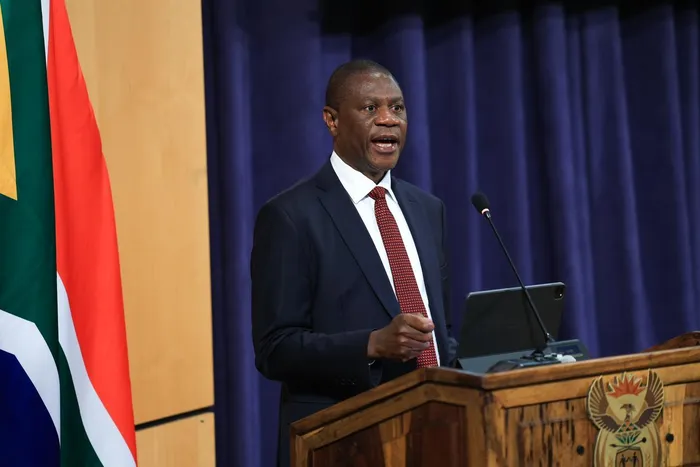
Deputy President Paul Mashatile to brief MPs on municipalities, crime and rural support measures.
Image: SA Government X Account
Deputy President Paul Mashatile will respond to oral questions in the National Assembly in Cape Town on Thursday afternoon on issues including service delivery, rising fuel prices and organised crime.
Mashatile will answer related to his delegated responsibilities at 2pm.
His acting spokesperson, Keith Khoza, said the appearance formed part of the constitutional requirement for Cabinet members to account to Parliament for the exercise of their powers and performance of their duties.
Khoza said Mashatile would address government efforts to implement rapid-response interventions for service delivery and resolve service delivery hotspots to improve governance in municipalities across the country.
“Following the recent announcement on fuel price adjustments, based on local and international factors and effective from 6 May 2026, by the Minister of Mineral and Petroleum Resources (Gwede Mantashe), the deputy president will brief members on government interventions aimed at protecting and improving the long-term sustainability and profitability of small-scale farmers, particularly in rural and underdeveloped provinces, amid ongoing fertiliser and fuel price volatility,” Khoza said.
Fuel prices in South Africa have surged in recent months, driven largely by geopolitical tensions that have destabilised international energy markets and increased local fuel costs.
The increases have placed pressure on businesses, motorists and the taxi industry.
Khoza said Mashatile would also address the rollout of the District Development Model (DDM).
“Members of Parliament will be updated on the effective and well coordination of the different spheres of government, which aim to improve the functioning of municipalities and challenges faced by communities.”
He added that this included efforts to align budgets and investments in healthcare.
Mashatile is also expected to respond to questions on agriculture and land reform, as well as measures implemented by the security cluster to combat organised crime and gang violence in the Western Cape.
Gang-related violence in the province has continued to rise over the past five years.
In March, the Western Cape recorded 1,157 murders between October and December 2025 - an average of about 385 a month, more than 96 a week and at least 13 a day.
Although the figure was 41 lower than during the same period the previous year, it reinforced the province’s status as the country’s epicentre of gang violence.
Presenting the third-quarter crime statistics for the 2025 and 2026 financial year, provincial police commissioner Lieutenant General Thembisile Patekile said the province had recorded decreases across the 17 community-reported crime categories, as well as reductions in contact crimes, but warned that serious violence remained deeply entrenched.
“Murder decreased by 41 cases to 1,157 this quarter. That translates to 15.2 murders per 100,000 people, down from 16 last year,” Patekile said.
“But 1,157 murders in a single quarter is still far too high.”
The Western Cape continues to account for more than 15% of the country’s crime despite having a smaller share of the population.
Several of its police stations remain among the nation’s top 13 murder hotspots, including Mfuleni, Delft, Nyanga, Mitchells Plain and Gugulethu.
simon.majadibodu@iol.co.za
IOL Politics