

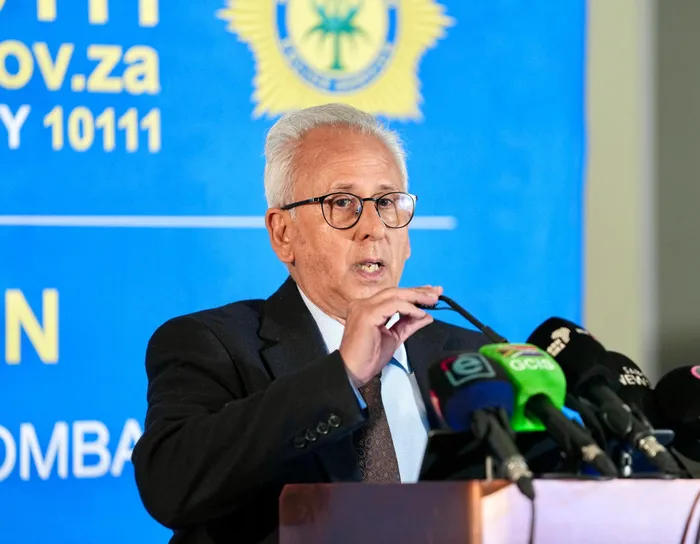
Acting Minister of Police, Firoz Cachalia,
Image: Supplied
Civil society groups have claimed that the recently released crime statistics do not reflect the “daily reality our communities face.”
On Friday, Acting Minister of Police, Firoz Cachalia, together with Deputy Minister Dr Polly Boshielo and senior SAPS leadership - National Commissioner General Masemola and Lt‑Gen Tebello Mosikili, Deputy National Commissioner, presented the quarterly crime statistics. The briefing covered offences recorded during the first two quarters of the current financial year from April 2025 to June 2025 and July 2025 to September 2025, respectively.
In provincial performance, the Western Cape and Northern Cape recorded increases in contact crimes, with rises of 183 and 146 cases, respectively.
Gauteng contributed the highest share of national contact crime, 26.4%, followed by the Western Cape, 18%, KwaZulu-Natal, 17.4% and the Eastern Cape, 10.6%.
The top five stations for contact crime came from only two provinces. These were Mfuleni (Western Cape), Nyanga (Western Cape), Delft (Western Cape), Inanda (KwaZulu-Natal) and Kraaifontein (Western Cape).
All three months of the quarter - July, August and September recorded decreases in murder. Only the Western Cape (up 97) and Northern Cape (up 1) showed increases. On a per capita basis, both the Eastern Cape and Western Cape recorded about 15 murders per 100,000 people.
The top five murder stations were Mfuleni (Western Cape), Kraaifontein (Western Cape), Delft (Western Cape), Gauteng, and Gugulethu (Western Cape).

Acting Police Minister Firoz Cachalia delivers the much-anticipated quarterly crime statistics recorded during the first and second quarters of the current financial year, which spans from April to September 2025.
Image: Itumeleng English/ Independent Newspapers
GOOD secretary-general, Brett Herron, said the stats reveal a province in deep crisis.
“From Delft to Mfuleni to Kraaifontein, entire families and neighbourhoods are being terrorised. Mfuleni has already recorded 156 murders across Q1 and Q2, a staggering 61.4% of last year’s total murders at the station, reached in just six months.
“The broader picture is just as alarming. Last year, the Western Cape recorded a total of 4,467 murders. In only half a year, the province has already reached 2,308 murders, 51.6% of last year’s total. We are only six months in.
“This surge is even more shocking when viewed against the national trend, where the country has recorded a decrease in murders. While South Africa moves forward, the Western Cape is falling further behind,” he said.
Civil group, Fight Against Crime, said that “in the Flats we still dodging bullets like it’s a sport”.
“Gangsters clocking in and out like it’s a normal 9-to-5. Numbers can say whatever they want, but our streets still telling the real story. Stop playing with stats and start playing defence. Communities are tired of PowerPoint policing. During the G20, visiting foreigners were better protected by our own SAPS and SANDF than we were and are,” the group said.
Cape Flats Safety Forum chairperson, Abie Isaacs, said they have noted the delayed crime stats, and that while they are not statisticians, they hold the view that “it does not reflect the daily reality our communities face”.
“We have noted the same police stations have once again ranked high on the national list when it comes to contact crimes. We have further noted that the main weapons used in these crimes are guns.
“We call on the premier to declare the Cape Flats a state of disaster, as it's in his mandate. Version 1 of his safety plan failed. We call on the SANDF to be deployed as a force multiplier, for a probe to be set up to look into gun violence, and we call on political parties not to politicise crime, as we have recently again seen this notion.
“It can no longer be business as usual while we have urban terror on the Cape Flats.”
Premier Alan Winde said that while he is outraged and disturbed by the murder rates in the province and across the country, “we can see that cooperative and locally-managed policing programmes are reducing murder rates and urgently need to be funded by national government”.
Winde said that they noted that the majority of the murders in the Western Cape are gun-related, but, along with the City of Cape Town, they have long been calling for investigative powers on firearms.
“Our success with LEAP now adds urgency and credibility to this request - we can get illegal guns off our streets.”
He added that the provincial government welcomed Cachalia’s support for their initiatives.
“We have always been willing to work with national government to address this crisis. We must continue to build on the constructive relationship we have built with Minister Cachalia and his team. But now the Minister and his colleagues in national government’s Justice and Security Cluster need to do more and make the hard decisions. The evidence is compelling, the time is now.”
Cape Town Mayor Geordin Hill-Lewis says there is an urgent need to up the conviction rate for gang, gun and drug crime.
“These latest crime stats make it clear that violent crime continues to plague some of our most vulnerable communities, with gang activity being a common denominator for Cape Town precincts in the top 30 stations nationally for murder.
“We do take heart in the consecutive declines in murder across both quarters in Nyanga, Philippi East, and Khayelitsha – these are all areas where our LEAP officers are deployed to support SAPS.
“The Acting Police Minister has the power to change this situation in various ways. That includes urgent resourcing of SAPS and, most immediately, expanding the draft municipal policing power regulations issued by his department for public comment earlier this year.
“With more policing powers for our city officers to investigate crime, we are immediately ready to build prosecution-ready case dockets to secure more convictions for gang, gun, and drug crime,” Hill-Lewis said.
theolin.tembo@inl.co.za