

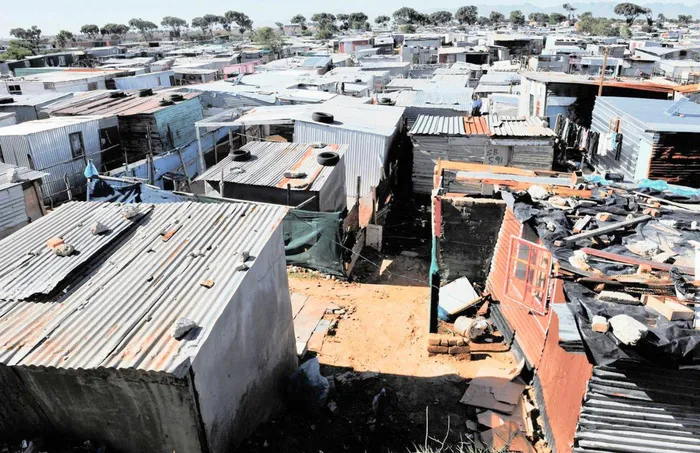
Statistics South Africa report shows that poverty in South Africa remains a significant and persistent challenge despite efforts to fight it.
Image: African News Agency (ANA
Poverty in South Africa remains a significant and persistent challenge despite efforts and progress in decreasing it over the last two decades.
This was revealed in the latest report by Statistics South Africa (Stats SA), “Poverty trends in South Africa”: An examination of absolute poverty between 2006 and 2023, which sheds new light on how poverty has evolved over nearly two decades.
The report was released on Thursday morning by Statistician-General Risenga Maluleke.
Drawing on data from the Income & Expenditure Survey (IES) 2022/23, the report analysed poverty levels among individuals and households, providing a detailed breakdown by various demographic, socio-economic, and geographic characteristics, including age.
South Africa faces a severe challenge with extremely high unemployment (32%) juxtaposed with sluggish economic growth (averaging 0.7% over the past decade), leading to rising poverty and inequality.
According to the report, in 2006, the poverty headcount using the Lower-Bound Poverty Line (LBPL) stood at 57.5% (approximately 27,3 million people), which declined to 37.9% (roughly 23,2 million people) by 2023. This 19.6 percentage point drop in the headcount over 17 years translates to an approximately 1.15 percentage point drop per annum. Overall, there are 4,1 million fewer people living below the LBPL in 2023 than there were in 2006.
KwaZulu-Natal, the Eastern Cape, North West and Limpopo are the poorest provinces in the country, reporting the highest poverty headcounts regardless of the line used, with poverty disproportionately affecting children, black Africans, females, and those living in rural areas.
Roughly 60% of all poor persons reside in one of those four provinces, with KZN alone home to approximately one out of every four poor persons in South Africa, according to Stats SA.
While Gauteng recorded the second-lowest headcount after Western Cape in 2023 and has seen its poverty levels drop moderately over time based on the LBPL and Upper-Bound Poverty Line (UBPL), the province’s poverty share has increased notably since 2015, with roughly one out of every five poor persons in South Africa residing there in 2023.
“People living in large households (those with 6 or more members) and those living in rural areas are also more likely to be poor compared to persons from smaller households or households living in urban areas. While rural areas accounted for a larger share of the poor population between 2006 and 2015, in 2023, there are now more poor persons living in urban areas compared to rural areas based on the LBPL.”
“However, this pattern changes depending on which line you use. Persons living in rural areas make up a larger share of the poor population based on the FPL (Food Poverty Line), but at the UBPL level, urban dwellers account for a greater share of the poor population,” read the report.
Although South Africa achieved meaningful progress in reducing poverty at the LBPL between 2006 and 2023, it remained disproportionately concentrated among black Africans and coloureds, while whites and Indians/Asians experienced considerably lower rates.
Despite national improvements, the period from 2015 to 2023 reveals persistent disparities among population groups, with black Africans continuing to carry the highest share of poverty.
Poverty headcount for black Africans decreased from 67.3% in 2006 to 43.8% in 2023, but despite the reduction, black Africans consistently had the highest poverty levels compared to the other population groups.
Coloureds experienced a steady and significant decline in poverty levels, dropping from 42.8% in 2006 to 24.6% in 2023. Indians/Asians consistently showed very low levels of poverty throughout the period, declining from 10.5% in 2006 to 2.8% in 2015, before rising to 5.8% in 2023.
The poverty headcount for whites remained the lowest among all population groups across the series; however, their poverty levels more than doubled by increasing from 0.6% in 2006 to 1.4% in 2023.
Throughout the period, females consistently exhibited higher poverty levels than their male counterparts. Both sexes reported a notable decline in poverty between 2006 and 2023. The poverty headcount for males decreased from 54.7% in 2006 to 36.0% in 2023, while that for females dropped from 60.3% to 39.7% over the same period.
The report also noted that children (0 to 17 years) remain one of the most vulnerable groups in the country, making up 43.1% of the poor population in 2023, while older persons (65 years and above) saw the largest improvement in their poverty status, with their headcount dropping by 54.8% (a 30.6 percentage point decline) between 2006 and 2023.
Meanwhile, the South African Human Rights Commission announced that it would convene a national investigative hearing into how food is produced in the country.
It stated that the country has the capacity to feed the entire population, but millions of people still go to bed hungry every night.
manyane.manyane@inl.co.za