

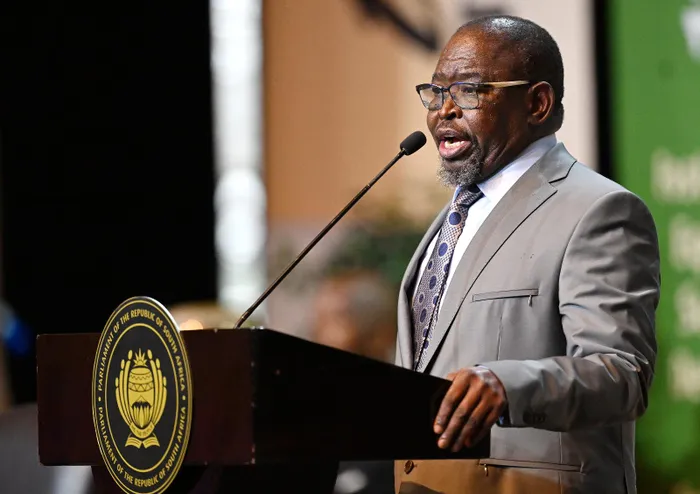
Civic organisations have urged Finance Minister Enoch Goodongwana to focus on poverty reduction, youth unemployment, and increase social grants.
Image: Phando Jikelo/ Parliament of SA
Rolling out an economic stimulus package targeting young unemployed graduates, putting policies in place to grow the economy, increasing the Child Support Grant, reducing taxes, and simplifying the tax review process are some of the budget tips that economists and civic organisations have suggested to Finance minister Enoch Godongwana.
This was after Godongwana issued an official call for ‘Budget Tips’ from the public, with the closing date of February 16, ahead of his February 25 speech.
Black Sash called for a budget that places poverty reduction and dignity at the centre of fiscal policy, highlighting that this requires increasing social grants in real terms so that they better reflect the actual cost of living faced by low-income households.
Thandi Henkeman, Western Cape regional manager at Black Sash, said that poverty reduction and dignity also means making the Social Relief of Distress (SRD) grant permanent and into a Basic Income Grant and raising it to at least the Food Poverty Line (FPL), so that it provides a meaningful level of protection rather than temporary relief.
“At the same time, dedicated funding must be allocated to resolve the ongoing SASSA and Postbank system failures that repeatedly interrupt access to grants, while social service budgets that support advice offices, monitoring, and community access to rights must be protected. A budget that neglects social protection simply shifts the crisis onto households already at breaking point, whereas a dignity-centred budget strengthens both social stability and longterm economic resilience,” Henkeman said.
She stated that grant values do not keep pace with the actual cost of living for low-income households, and the SRD remains far below what is required for basic living standards. As a result, millions remain trapped in an undignified standard of living, despite being within the social assistance system.
Henkeman stated that Black Sash’s position of advocating for social spending as an economic stimulant is grounded in both lived evidence and economic reasoning.
“Social grants are spent immediately in local economies, on food, transport, and services, supporting small businesses and sustaining demand in low-income communities. In a context of high unemployment, social protection functions as an automatic stabiliser, preventing deeper economic contraction. Framing debt levels as the sole threat to growth overlooks the risks of entrenched poverty and inequality. When households cannot meet basic needs, long-term human development, productivity, and social stability are undermined,” Henkeman said.
She added that social protection is therefore not consumption without return; it is an investment in human capability and economic resilience.
On the reduced inflation target of 3%, she said, Black Sash does not support further fiscal tightening in the current context of deep and widespread poverty.
“While macroeconomic stability is important, economic policy cannot be pursued in isolation from people’s lived realities. Millions already rely on inadequate social assistance to survive, while households face rising food, transport, and electricity costs. The social and human costs of short-term austerity, hunger, debt, school drop-out, and deepening inequality can also weaken long-term economic stability,” Henkeman stated.
Fiscal policy, she said, must balance inflation management with constitutional duties and the urgent need to protect people from falling deeper into poverty.
Mervyn Abrahams, a director at the Pietermaritzburg Economic Justice and Dignity Group (PMBEJD), called for a rollout of an economic stimulus package targeting young people, especially those who have acquired skills at tertiary institutions as artisans and technicians but remain inactive owing to unemployment.
“The package should aim at assisting established companies to expand so that they can absorb new entrants to the labour market. Equally, the package should also assist graduates to start their own businesses,” Abrahams said.
He highlighted that unemployment has been a challenge for many years in South Africa, even during the period of economic growth in the early 2000s, it has been widely recorded that, primarily, youth unemployment has been a challenge.
Abrahams also urged the Minister to increase Child Support Grant.
“It has been demonstrated for months now that low-income families continue to battle high food prices, despite suggestions of low food inflation in some commodities. In fact, even the interventions, such as grants, are not keeping up with inflation,” he said.
He added that at its current rate, the national minimum wage cannot be the anchor because there are other factors at play, such as high transport costs, water and electricity costs, which are in double digits.
“There is ample evidence that illustrates how these three items take more than two-thirds of workers’ earnings, leaving just about a quarter to provide nutritious food to their families. We have been consistent in saying that the current arrangement gives too much power to municipalities and Eskom, which leaves households more vulnerable,” he stated.
The minister ought to focus on local government, check whether there is spending on infrastructure grants as well as the conditional grants that should ensure that vulnerable households are protected from high utility bills and are able to access the basic needs as per the government commitment, Abrahams said.
Dawie Roodt, chief economist at Efficient Group, said that the minister must put policies in place to get the economy to grow, by getting rid of things like the Expropriation Act of 2024, and others.
Once the economy starts to grow, it will be much easier to afford all sorts of things, he said.
“The minister must simplify the tax review, because the tax review in South Africa is exceptionally complicated and expensive to administer. It should be dramatically simplified. Taxes must be lowered as well. Even without lowering the tax, the review can be simplified and the cost and redtape revoked,” Roodt said.
On the 3% inflation, he said, if it were higher, economic growth would have been even weaker, and that would have led to social unrest.
“There might have been a sacrifice in the short term in terms of economic growth, but we have what the Reserve Bank has done to get it down to 3%, and then the minister of Finance agreed to it. It is the best that could have been done under the circumstances. We need to reduce it even further,” he said.
The problem that we have in South Africa is that we do not have enough rich people. We have to create an environment that enables us to have more rich people, Roodt stated.
“The approach by the government is to reduce the number of rich people, which is the wrong approach. They want everybody to be poor. I want everybody to be rich, but you cannot keep on overtaxing the rich, who are the productive guys and the taxpayers,” he said.
Economist Gugulethu Xaba said that the 2026/27 budget speech should help support real economic growth in South Africa.
“The government must stop paying lip service to economic growth and help invest in high-impact sectors. He (Godongwana) must help stabilise and invest in state-owned entities and help these create large-scale jobs. Infrastructure investment must be prioritised across all nine provinces,” Xaba stated.
He added that a 3% inflation target remains a useful tool for the South African Reserve Bank even when inflation is driven by supply-side shocks such as global oil and local electricity prices.
Xaba stated that skepticism about the wealth tax on the top 1% to fund a Basic Income Grant is generally caused by a view that it is administratively inefficient and tends to generate lower revenue than projected.
“It further encourages tax avoidance and risks capital flight, which could ultimately harm long-term economic growth and job creation. High-net-worth individuals are generally very mobile with their capital, and they tend to flee to safe-haven countries and create sophisticated ways of hiding their money,” he said.
He added that once the 1% stops investing in the economy, the adverse effect of what was originally intended ensues, thus lowering economic growth and, consequently, resulting in fewer jobs for the poor, making the ‘medicine worse than the disease.’
gcwalisile.khanyile@inl.co.za