

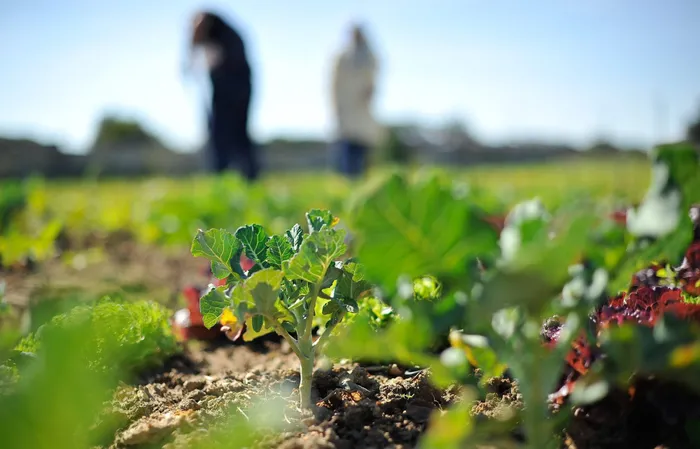
Experts say that small-scale farming could be the way to solve food insecurity and poverty.
Image: Henk Kruger / Independent Media
The current food system, built on the deliberate destruction of Black agriculture and extensive state support for white-owned large-scale commercial agriculture, is not working well for the majority of South Africans, and the challenges are visible in high levels of food insecurity and unemployment, experts say.
This was revealed during a recent webinar hosted by the Human Sciences Research Council (HSRC) under the theme Strengthening Small-scale Agri-food Systems to Enhance Household Food Security and Poverty Alleviation in South Africa.
Dr Marc Wegerif, a senior lecturer at the University of Pretoria and a principal investigator at the Department of Science, Technology, and Innovation and National Research Foundation (DSTI-NRF) Centre of Excellence in Food Security, said half the people in the country cannot afford a healthy diet.
The HSRC published a national food security survey, which identified 63.5% of households as being food insecure, to some extent, in South Africa, and over 28% of children as being stunted. At the same time, there is obesity, he said.
“The current food system in South Africa wasn’t just naturally created because it was the most effective way of running the economy or the food system; it was built on a history of land dispossession, the deliberate destruction of Black agriculture, and extensive state support for white-owned, large-scale commercial agriculture,” Wegerif said.
He added that this begs the question, “aren’t there small-scale actors that can show us and be the building blocks for a different kind of food system that could be more equitable, better at meeting food and nutrition security needs, better at alleviating poverty and unemployment?
Wegerif stated that there is a need to look at other food systems that can be more ecologically and socially regenerative, and address the country’s concerns of food security and poverty.
“What we saw after apartheid is an increasing concentration of ownership in the food system from farm through to processing, retailing, and so on. With financialisation increasing, ownership of the food, and parts of the food system, in the hands of international investment firms, we have seen the consolidation, with buyouts by companies like PepsiCo, increasing international investor and corporate ownership of the food system,” he said.
Wegerif added that inside the large-scale food system, there are high levels of computerisation, mechanisation, and increasing use of Artificial Intelligence for managing these supply chains.
“Now, the reality is that there are very few small-scale farmers, and very few black farmers, who can fit into this kind of value supply chain that is so increasingly concentrated. At every step, you’re seeing high levels of capital investment and a reduction of labour. And then at the retail end, we see, again, a similar scale,” he said.
Wegerif highlighted that in the dominant South African food system, this industrialised value-chain has an enormous concentration of wealth, power, and influence over the food system in the hands of the corporations that control and drive it towards things that are going to increase their profits and returns.
He argued for learning from and supporting small-scale actors like street traders and informal shops, who offer affordable, accessible food and create livelihoods, highlighting that these informal traders, while individually small-scale, collectively form a significant part of the food system and offer a practical alternative to the corporate-dominated food chain.
“In South Africa, we have a misfit between different parts of the food system. And it is very hard for a small-scale black farmer to be successful in making money selling into the corporate-dominated large-scale supply chains. So, we need a different kind of fit across the food system, from production to processing to selling and so on,” he said.
He added that the way they organise themselves is that multitudes of small-scale actors are socially embedded in relations, but also very individualistic.
“It is always their business, but they also work together, sharing transport, for example, buying together, and helping each other in their stalls. So, they manage this tension between collaboration and competition in a way that is very effective, and it works on a symbiotic sort of relations of interdependence,” Wegerif said.
He stated that low-income areas such as Alexandra, Diepsloot, and Ivory Park, in Gauteng, have found other brands in medium-scale maize supply operations, coming in and managing to be competitive in the maize system outside the dominant corporate actors.
He emphasised the need to support informal traders, saying they are contributing to achieving the right to food for all through accessible prices and creating livelihoods for themselves.
Professor Mjabuliseni Ngidi, a Food and Nutrition Security expert from the University of KwaZulu-Natal, said the small-scale food actors feed millions of urban and non-urban households, but they are systematically excluded by municipal regulations.
Ngidi said this is a governance issue, and not necessarily a marginal one. He said the problems facing small-scale food actors are created by how municipalities design their by-laws, plan their systems, and enforce the practices.
He said municipal red tapes exclude small food actors, with the first being that by-laws are designed for large, formal enterprises, not for the informal sector, not for smallholder farmers, and not for urban food producers.
“The zoning itself is very restrictive. It restricts people from participating in the food system, and that creates a problem. The assumption is that it is a one-size-fits-all kind of health and safety rules, where it is assumed that the regulations are the same for all actors, large and small, which should not be the case,” Ngidi said.
He argued that these regulations should be differentiated based on the scale of operation.
Ngidi added that there is limited access to infrastructure and services, such as water, for most small-scale food actors.
“Municipalities can act without having to wait for any national reforms, because they are in control of the by-laws. Municipalities must see them as part of the economy, rather than lawbreakers,” he stated.
It may help to review and amend informal trading and health by-laws, so that there is differentiation in nature, depending on the type of business one is involved in.
But also integrate these food systems into the Integrated Development Plan (IDP) and Spatial Development Frameworks, formally, Ngidi said.
He highlighted the need to protect the peri-urban agricultural lands so that it is not used for other things, but for urban agriculture that contributes to the food system, and invest in inclusive food infrastructure, and then industrialise the participation of food actors, because at the moment, food actors are excluded in terms of the participation when by-laws and certain frameworks are being developed.
Vandudzai Mbanda, a researcher at the Human Sciences Research Council, said that with the levels of food insecurity in the country and across the African continent, more studies show that small-scale farming could be the way to solving several problems.
gcwalisile.khanyile@inl.co.za