

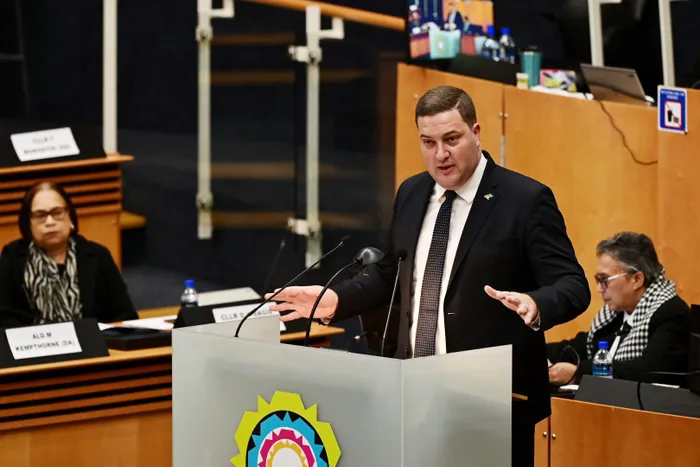
Mayor Geordin Hill-Lewis
Image: Supplied
While the City of Cape Town is proudly touting its proposal of lowering the property rates formula by 10,2% following General Valuation 2025 (GV2025), civic groups have shared their concerns of being hoodwinked by the City, and that they are just doing “very fancy footwork”.
The City announced in the week that it will propose a 10,2% lowering of the rate-in-rand for residential properties following the GV2025.
The City’s rate-in-rand refers to the formula used to calculate property rates, which it claims is the lowest in South Africa across all rate categories.
The municipality’s indicative residential rate-in-rand is 0,006428 (down from 0,007159) pending draft budget finalisation.
The City said that the lower rate-in-rand is among several proposed measures to help keep property rate increases to a minimum for most homeowners, despite strong asset value growth for property owners in Cape Town.
“Cape Town’s vastly lower rate-in-rand shows that it generally costs less to own a property asset here than it does anywhere else. This asset can also be expected to grow in value over time, increasing the net worth of families and personal wealth of ratepayers across the income and property value spectrum,” Mayor Geordin Hill-Lewis said.
Other proposed measures in the forthcoming draft Budget 2026/27 include raising the ‘rates-free benefit’ to the first R500,000 of property value (up from R450,000), and extending this benefit to all properties up to R8m (up from R7m).
Hill-Lewis said that the proposed 10,2% rate-in-rand decrease and extended rates benefits “will shield the large majority of ratepayers – over 60% of all homes - with very low rates increases despite their property asset showing strong value growth”.
The City said it will further deliver a balanced budget while keeping tariff increases to the minimum level needed to avoid severe service delivery cuts.
“Indigent relief thresholds will be raised, while property value bands for fixed charges will be altered to mitigate the number of properties moving between bands as far as possible.”
They said more details will follow when the 26/27 budget draft is tabled in City Council on 26 March and when the full public participation process commences. The GV2025 public inspection and objection period is prescribed in terms of the Municipal Property Rates Act and is scheduled for 20 February 2026 until 30 April 2026.
Property expert Storm MacLennan, from Jawitz Properties, previously said that the City's GV2025 uses Computer-Assisted Mass Appraisal (CAMA) to reset values on roughly 900,000 to 1,000,000 properties through statistical modelling rather than individual inspections.
MacLennan has warned that the automated CAMA system consistently overvalues properties by failing to capture developments, positioning and access issues, along with other factors that affect real market prices.
Real-world data from GV2022 shows successful objections reduced homeowners' rates by 20-30% on average, translating to monthly savings between R800 and R1,050.
"Where municipal valuations have been successfully challenged using market evidence, homeowners have typically reduced their rates exposure by 20% to 30%," MacLennan said.
The City of Cape Town announced in the week that it will propose a 10,2% lowering of the rate-in-rand for residential properties following the GV2025.
Image: File Picture
Advocate Rod Solomons from #SA1stForum said that dropping the rate-in-rand whilst there are immense increases in property values “seems mighty benevolent and we must then meekly be thankful to a benevolent #tonedeafDA and its 'property-selling' mayor”, he still has an uneasy feeling, especially amid the rates challenge in court.
“My immediate and gut feeling is that ‘we are being hoodwinked again’. I must tell you that my gut feeling is normally spot on. It does not make sense that if your property increases, then it follows that you will pay less rates and service fees,” Solomons said.
“As we argued in the past, and this confirms that we were correct when we said it is unfair that the CoCT also has arbitrary and sole control over the valuation of our properties.”
Stop CoCT’s Sandra Dickson said that some ratepayers have seen their new property valuation, and that fears over being unable to pay their municipal bill have started afresh.
“The mayor claims that 60% of ratepayers will not receive a rate increase, some rates will be lower, and others will remain unchanged. This means that 40% of ratepayers are hit hard with above the ‘average’ property value increase of 17.2%, the City reports for residential properties. This explains the increases of 20% and higher ratepayers' reports.
“The City boasts with its new rate-in-rand of 0.006428; however, this factor does not include the Fixed Charges for electricity, water, sanitation and cleaning, which were stripped out of rates in the 2025/26 Budget,” Dickson said.
“If these Fixed Charges are factored back into rates, the rate-in-rand is around 0.007680, which is pretty close to where we are now.
“It can be concluded that the City is doing very fancy footwork with its proposed measures. However, it remains clear that the trend of the 2025/26 Budget is continued, where the R3 million and upper tier of properties contribute the bulk of the City's coffers.”
theolin.tembo@inl.co.za