

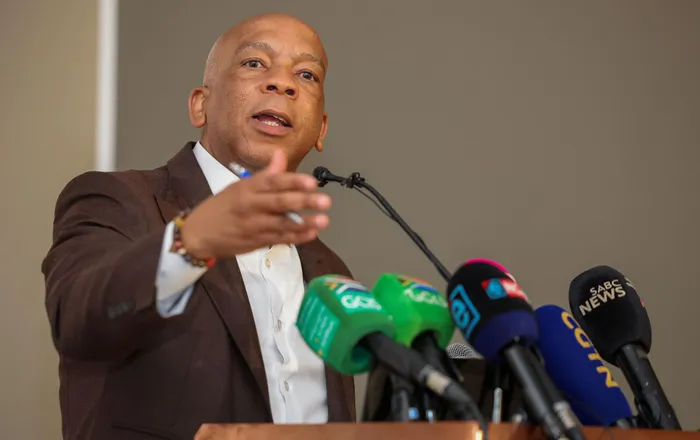
The Department of Electricity, led by Minister Kgosientsho Ramokgopa, says the current energy supply stability is not a temporary ‘sweet spot’, but the result of sustained operational improvements and better maintenance discipline.
Image: GCIS
Eskom has fully stabilised the national electricity system, and South Africa is no longer in an energy crisis, with the grid performing at a level not seen in five years, supported by an additional 4 400MW (megawatts) of available generation capacity compared to the same period in the previous year, the Electricity Department said.
This was after President Cyril Ramaphosa told the nation that ‘we have put load shedding behind us’.
Tsakane Khambane, spokesperson for the Department of Electricity, said the power utility has delivered approximately 98% electricity supply reliability in the current financial year, which is a significant improvement from the below ‑10% reliability recorded two years ago.
She added that this turnaround reflects sustained improvements in plant performance, maintenance discipline, and operational efficiency.
Khambane highlighted that the performance of the generation fleet has improved significantly over the past two years, with Energy Availability Factor (EAF) continuing to rise, and currently at 65.11% year to date and 68.56% month to date.
“In recent months, there have been extended periods where available supply has exceeded demand, meaning some units were available but not required to run. These units are placed in what is referred to as ‘cold reserve’. This reflects stronger system conditions. Importantly, these units remain available should demand increase or unexpected outages occur,” she explained.
She added that the current stability is not a temporary ‘sweet spot,’ but the result of sustained operational improvements and better maintenance discipline.
Khambane noted that although the national power system is stable and generation capacity continues to exceed demand, some communities, especially townships, continue to experience challenges stemming from illegal connections, meter tampering, and network overloading.
“These activities damage infrastructure and pose serious safety risks. As a protective measure, Eskom continues to implement load reduction only in high‑risk areas to safeguard both communities and the electricity network. To address these challenges sustainably, Eskom has initiated a phased programme to eliminate load reduction by 2027,” Khambane said.
She stated that Eskom’s planned investment in comprehensive distribution infrastructure upgrades, using modern technology to enhance efficiency, resilience, and network reliability, accounts for approximately 14% of Eskom’s total R320 billion infrastructure investment over the next five years.
A significant portion of this funding is dedicated to supporting the accelerated rollout of smart meters, she said.
In Eskom’s Medium-Term System Adequacy Outlook (MTSAO), which shows that some older coal stations are scheduled to retire by 2030, she said the outlook for 2026 to 2030 identifies a planned transition period around 2029 to 2030, when approximately 9.5 GW of baseload or dispatchable capacity is scheduled to retire.
“These retirements are known and have been incorporated into long-term planning, like the Integrated Resource Plan (IRP) 2025, which plans for the replacement capacity. As older coal stations are decommissioned, it is essential that new capacity is introduced in a coordinated manner to meet future demand and support economic growth. The MTSAO highlights the importance of maintaining plant performance and aligning new dispatchable capacity with planned retirements to ensure continued system adequacy,” Khambane said.
On wealthy households and businesses moving to private energy supply, she said, Eskom recognises that the growth of private solar is reshaping the electricity market, and the utility is actively adapting its business model to remain sustainable while supporting South Africa’s energy transition.
“Through the Just Energy Transition (JET), Eskom is evolving from a traditional electricity supplier into a modern energy and grid platform. This includes investing in transmission expansion, cleaner generation, and repurposing existing assets, ensuring the national grid remains the backbone of the country’s energy future.”
Khambane added that the power utility’s strategy is to integrate private generation, not compete with it, while strengthening the grid and ensuring an enabling electricity supply for all South Africans.
“The distributed energy and rooftop solar still depend on the grid for balancing, wheeling, and back-up supply. Eskom is, therefore, growing new revenue streams by enabling energy trading and market participation, which supports renewable energy aggregation and trading,” she stated.
With diesel spend down by R5 billion, Khambane said, Eskom is utilising the cash savings from open-cycle gas turbines (OCGTs) to cross-fund various requirements, including various elements of the capital programme.
Daphne Mokoena, Eskom spokesperson, said Eskom is implementing coordinated, multi-pronged intervention across all affected feeders to eliminate load reduction as a practice by March 2027.
She said more than 151,000 customers are no longer affected by load reduction since the launch of the programme, which has a rollout focused on high-loss areas affected by illegal connections, energy theft, and constrained networks.
She said extensive community and stakeholder engagement through ward councillors, public meetings, radio platforms, and social media to support the implementation of the programme has been undertaken.
“Despite these efforts, installation teams continue to face persistent resistance, including intimidation, violent incidents, and repeated work stoppages. These disruptions have led to deployment delays, the redeployment of teams, and heightened safety risks for Eskom employees and contractors. As a result, approximately 122,000 planned meter conversions have been delayed, undermining the stability and predictability of the rollout programme,” Mokoena said.
She said the current feeders under load reduction will either be fully stabilised through smart metering and network interventions or removed from load reduction through alternative technical solutions by March 2027.
Lisa Makaula, The Green Connection’s Programmes and Advocacy lead, said that while ‘we’ note the successes of ending load shedding, the reality is that vulnerable communities cannot afford electricity due to the 2026/27/28 approved tariff hikes.
“For a transition to be just, communities should benefit through socially owned renewable energy technologies such as rooftop solar and be able to sell a portion of their units to the grid. Innovative solutions like these could build resilience and local development. Moreover, the International Energy Agency (IEA) reports that renewables and battery storage will become cheaper over the years,” Makaula said.
She highlighted that since 2008, Eskom’s tariffs have been raised over five times, in real terms, which could continue to impact communities.
As of 2024, around 13.2 million people in South Africa were living in extreme poverty, with a poverty threshold of $2.15 daily, which equated to about R34.35, according to today’s exchange rate. This means that close to 140,000 more people were pushed into poverty, compared to 2023, Makaula stated.
She warned that unless the Minister of Electricity and Energy rectifies these issues by reviewing the Electricity Pricing Policy, energy poverty will only exacerbate because the power utility’s unprecedented electricity price increases are unsustainable.
gcwalisile.khanyile@inl.co.za