

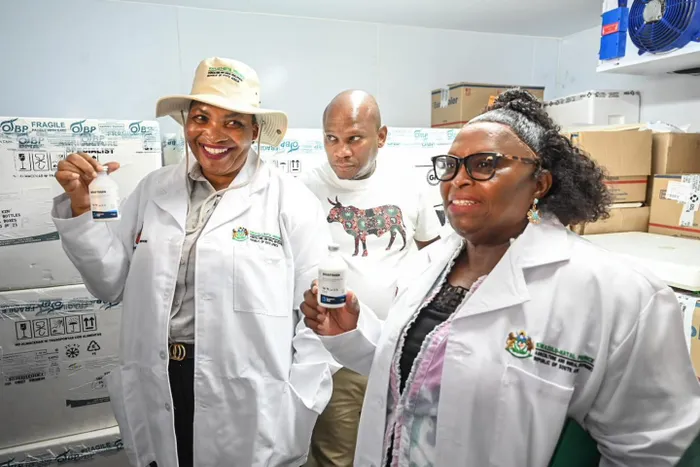
KZN Agriculture and Rural development MEC Thembeni kaMadlopha‑Mthethwa warns against illegal cattle movement as 200 000 vaccines are rolled out in uGu, aiming to protect 2.4 million cattle from foot and mouth disease.
Image: Supplied
KwaZulu‑Natal MEC for Agriculture and Rural Development Thembeni kaMadlopha‑Mthethwa has issued a stern warning to anyone involved in the illegal movement of livestock as the province battles a severe outbreak of foot and mouth disease (FMD).
She addressed the media at the provincial veterinary laboratory in Allerton, Pietermaritzburg, on Wednesday, where she oversaw 200 000 FMD vaccine doses earmarked for mass vaccination in the uGu district.
The MEC said the warning applied even to cattle moved for traditional purposes such as ilobolo
“We urge the public who continue to engage in the cattle movement to stop doing that. This instruction applies to even those who use cattle for ilobolo As an alternative, online platforms may be used for dowry exchanges.
She said she has also requested traditional leaders to advise their subjects against the illegal movement of animals in their communal lands.
''We have to be harsh now so that people will see how serious we are in dealing with this. This disease is serious; we have to adhere to the animal control measures that have been put in place,” said
According to the MEC, the mass vaccination drive is set to begin on Thursday, February 26, 2026, with veterinary services having selected the uGu and Harry Gwala districts for the first phase of inoculations using BioGenesis Bago vaccines.
KaMadlopha‑Mthethwa explained that these areas were chosen because they had not reported cases of the SAT 3 FMD virus, and the vaccines specifically target and neutralise the SAT 1 and SAT 2 viruses present in the cattle population there.
She said expanding the campaign into northern KwaZulu‑Natal would not be effective, as the vaccines may fail to deal with the SAT 3 strain.
Dr Kolisa Amanda Nokoyo, Deputy Director of Veterinary Diagnostics Services in KwaZulu‑Natal, said the Allerton Laboratory facility, where the vaccines are being stored under monitored cold‑chain conditions, would soon be upgraded to enable testing of all blood samples, including those from suspicious FMD cases.
She said, “Once fully upgraded, it will address the backlog of FMD results.”
The MEC said the first batch of 1,000,000 FMD vaccine doses supplied to KwaZulu‑Natal yielded 200,000 doses, now at Allerton, with both state‑employed and registered private veterinarians authorised to administer them to speed up the campaign.
Private veterinarians have been encouraged to register with the Department of Agriculture to assist in expanding the available workforce, she said.
According to the rollout plan, vaccination teams will cover 2 286 dip tanks over four to six months, targeting both communal and commercial cattle across the province’s estimated population of 2.4 million animals.
The plan prioritises districts bordering other provinces and countries before moving inward.
KaMadlopha‑Mthethwa said deployment of 45 teams per day is expected, with the capacity to vaccinate between 45 000 and 90 000 animals daily once recruitment is complete.
Details of livestock owners and animals will be captured in the Livestock Identification and Traceability System (LITS), with each vaccination team comprising three animal health technicians and four data capturers working alongside livestock associations, she said.
For commercial farms and feedlots, the department said it is working with private veterinarians and industry bodies such as Kwanalu and the Red Meat Producers’ Organisation to monitor and facilitate the rollout, while the state will oversee vaccination on commercial properties.
hope.ntanzi@iol.co.za
IOL News