

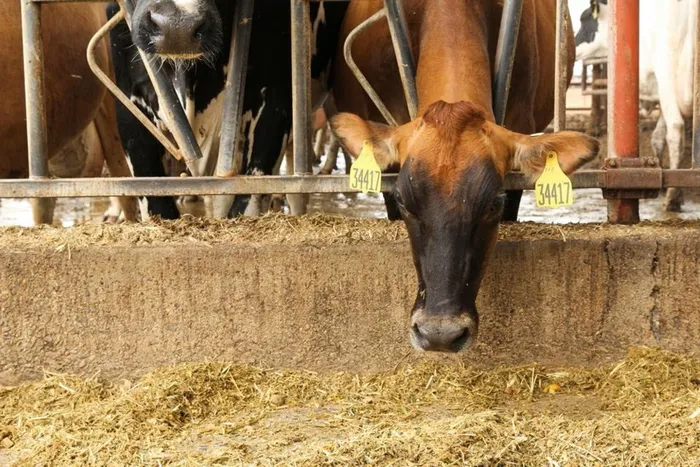
Farmers across KwaZulu-Natal participate in mass foot-and-mouth vaccinations, supporting government efforts to reduce infections, safeguard jobs, and secure the country’s FMD-Free Status with Vaccination.
Image: Supplied
KwaZulu-Natal has been at the epicentre of South Africa’s foot-and-mouth disease outbreak, prompting an intensified national vaccination campaign aimed at protecting the country’s 14 million cattle and stabilising the agricultural economy.
Agriculture Minister John Steenhuisen said the province was the “primary risk epicentre”, describing it as “ground zero” as he launched the department’s national mass vaccination strategy during a visit to Colbourne dairy farm near Mooi River on Friday .
He said the most virulent and widespread outbreaks had taken place in the province, which houses more than 1.6 million cattle in high-priority zones.
The campaign forms part of the Department of Agriculture’s 10-Year Eradication Strategy, which seeks to secure what Steenhuisen described as “FMD-Free Status with Vaccination” and reopen export markets.
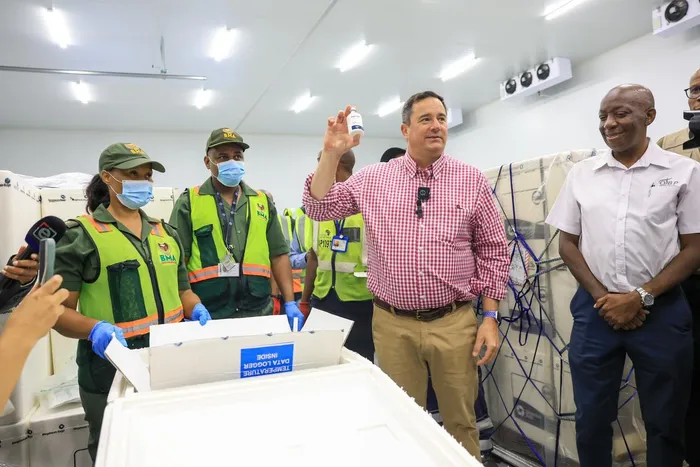
Agriculture minister received the first batch of 1 million Foot-and-Mouth Disease vaccines at OR Tambo International Airport on Saturday.
Image: John Steenhuisen/X
The intensified rollout follows President Cyril Ramaphosa’s declaration of foot-and-mouth disease as a national disaster during his State of the Nation Address.
“We have decided to vaccinate the entire national herd of 14 million cattle. This requires 28 million vaccines over the next few months,” Ramaphosa said.
The first shipment of one million high-potency vaccines arrived at OR Tambo International Airport on February 21.
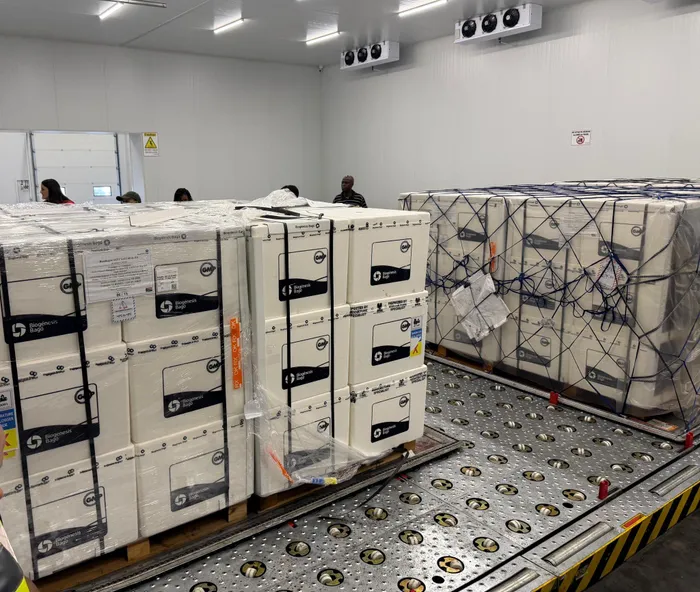
Agriculture Minister John Steenhuisen received 1 million vaccines from BioGenesis Bago last weekend.
Image: X
More than 13.5 million doses are expected to be in the country by the end of March, with 28 million required for initial and booster vaccinations.
The target is to vaccinate 80% of the national herd by December and reduce disease incidence by 70%.
The initial allocation of vaccines was distributed across provinces based on risk and herd size.
KwaZulu-Natal and the Free State each received 200,000 doses, while the Eastern Cape was allocated 150,000. Mpumalanga, North West and Limpopo each received 100,000 doses. Gauteng received 70,000, the Northern Cape 50,000 and the Western Cape 30,000 doses.
Steenhuisen said the country has also secured Dollvet vaccine from Turkey with the first consignment of 1,5million doses arriving Saturday, 28 February 2026 in South Africa, with millions more to arrive from Argentina shortly after.
Locally, the Agricultural Research Council has committed to producing 20,000 vaccines per week and scaling production to 200,000 per week by 2027.
Government policy adjustments were also announced to ease restrictions on the dairy sector. Effective 24 February 2026, milk from vaccinated, uninfected farms or farms not suspected of FMD infection may move without restrictions.
For milk from quarantined farms, only a single pasteurisation process will be required for local consumption, said Steenhuisen.
However, milk originating from properties under FMD restriction may not be processed for the export market unless the importing country explicitly agrees.
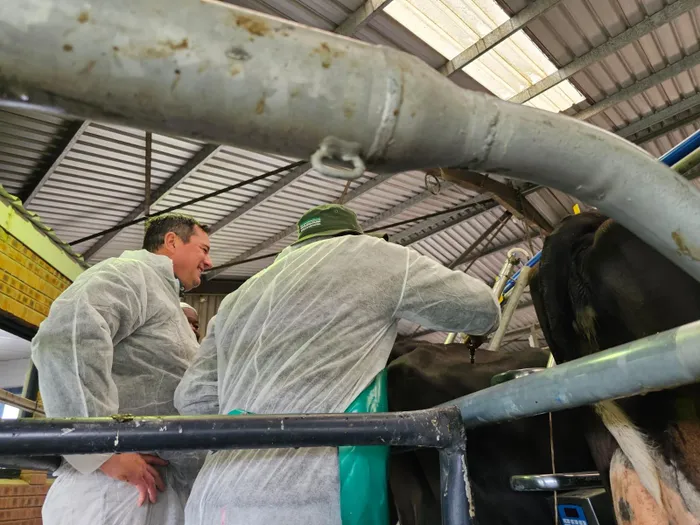
Agriculture Minister John Steenhuisen near Mooi River, KwaZulu-Natal, during the launch of the Department of Agriculture’s national mass vaccination strategy to combat foot-and-mouth disease outbreaks across South Africa.
Image: X / John Steenhuisen
“We are moving away from treating high-risk farms as: guilty until proven innocent,” Steenhuisen said.
Only farms with confirmed or clinical signs of infection will be quarantined.
He reaffirmed the government’s commitment to eradicating the disease and restoring export confidence.
“We will not stop until FMD is eradicated, and South Africa receives its ‘FMD free with vaccination’ status.
“This is our promise to our farmers: We are doing everything in our power to keep your milk moving and your herds safe.
The minister also welcomed Cabinet’s approval of the national mass vaccination programme and National Treasury’s reallocation of approximately R400 million underspent agriculture funds toward the war on FMD.
In KwaZulu-Natal, the vaccination drive began in the Ugu District, where 11,000 cattle were vaccinated on the first day at dip tanks under the Ray Nkonyeni Local Municipality.
The programme continued in uMuziwabantu Local Municipality on Friday,February 26 with 11,000 cattle also vaccinated.
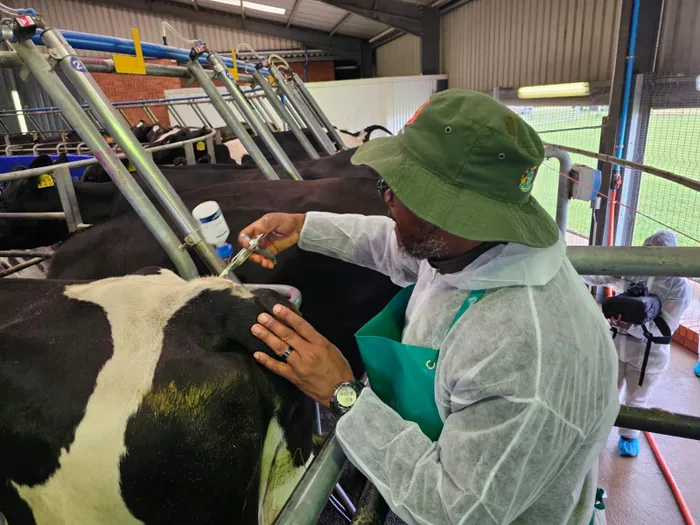
Cattle vaccination underway at the Colbourne Diary farm near Mooi River.
Image: X
KwaZulu-Natal Agriculture MEC Thembeni kaMadlopha-Mthethwa said the uMuziwabantu areas is excepted to draw about 12,000 to 15,000 cattle to dip tanks.
Commercial farmers have been advised to apply for veterinary visits for vaccinations scheduled for Monday and Tuesday, March 2 and 3, as the rollout expands beyond communal dip tanks to private farms.
The national rollout is set to continue in the Free State on Monday, where Steenhuisen will be joined by Elizabeth Cornelia Rockman, the province’s MEC for Agriculture, Rural Development and Environmental Affairs, as part of oversight of the nationwide campaign.
kaMadlopha-Mthethwa praised livestock owners for their cooperation.
“It is pleasing to have a significant number of livestock farmers participating in the vaccination drive,” she said.
Steenhuisen said more than two million doses had already been administered nationwide, with 45 teams deployed daily in KwaZulu-Natal, capable of vaccinating up to 90,000 animals per day to cover the province’s 2.4 million cattle herd.
.IOL News