

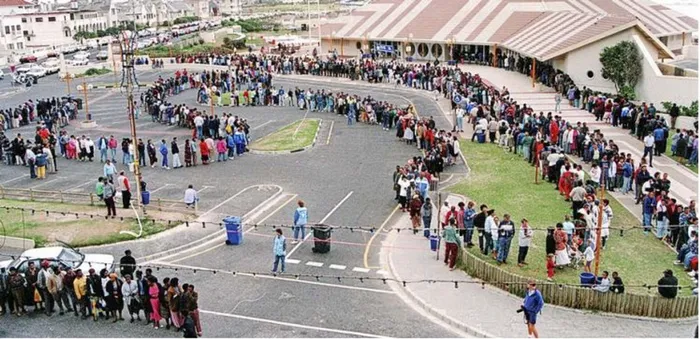
There were snaking queues of South Africans eager to vote in a new government during the first democratic election in 1994.
Image: Independent Newspapers Archives
Parliament and local political parties have commemorated Freedom Day, marking 32 years of freedom and democracy since millions of South Africans cast their votes in the country’s first democratic elections in 1994.
Parliament’s Presiding Officers, led by the Speaker of the National Assembly, Thoko Didiza, and the Chairperson of the National Council of Provinces, Refilwe Mtshweni-Tsipane, joined all South Africans in commemorating this historic occasion.
They said that the first democratic elections ushered in a new era, marking the end of apartheid and institutionalised racial oppression.
“This year holds added significance as South Africa marks 30 years since the adoption of the Constitution in 1996. More than a legal framework, the Constitution embodies the democratic values of human dignity, equality and freedom, and affirms the rights of all who live in the Republic.
“For three decades, it has served as the foundation of South Africa’s constitutional democracy—guiding governance, safeguarding fundamental rights, and providing a framework for transformation and social justice,” they said.
“As the nation reflects on these milestones, Parliament pays tribute to the countless South Africans who sacrificed for freedom and for the establishment of a democratic constitutional order. Their legacy continues to inspire the ongoing pursuit of a just, inclusive and equitable society.”
They emphasised that freedom extends beyond the right to vote, and it requires active citizenry, accountability, and a collective commitment to upholding constitutional values.
“As we commemorate Freedom Day and mark 30 years since the adoption of the Constitution, we must as a nation renew our commitment to the values of human dignity, equality and freedom.”
The ANC said that in celebrating the 32 years, this herculean feat “painfully reminds us of the arduous path travelled many years since the formation of the ANC and the major events that changed, and the course of the liberation history shaping the strategies and tactics struggle to defeat apartheid, ushering in a free, democratic dispensation”.
“This day was not a miracle, but a history written in sacrifice, death, blood, pain yet also human perseverance and hope. In a sense of proud nostalgia, the snaking queues to the ballot box were destined to usher a new destiny where we lost our chains and reclaimed our humanity and dignity based on a universal suffrage of one-man-one vote,” the ANC said.
“The 27th April 1994 was not a gesture of magnanimity but a product of sacrifices and human resilience, the well orchestrated destructive violence that gripped the country, the systematic and brutal apartheid killings, the death penalty, detentions without trial, the banning of the liberation movement, women and youth struggles, the Sharpeville, June 16, Langa, Boipatong and other massacres under the apartheid security forces.”
The ANC said the 27th April 2026 is a continuation of a chapter that infuses more determination and vigour in its commitment to build a peaceful country.
Democratic Alliance Federal leader, Geordin Hill-Lewis, said that today millions of South Africans live without the most basic condition of freedom: safety.
“Freedom is not only the right to vote. It is the freedom of a child to walk to school safely. It is the freedom of a mother to wait at a taxi rank without fear. It is the freedom of a shopkeeper to open for business without paying extortionists. It is the freedom of a family to sleep through the night without the terror of violent intrusion.
“For far too many South Africans, that freedom has been stolen by criminals, and too often it has been surrendered by a state that has become weak, compromised and slow,” Hill-Lewis said.
ActionSA President, Herman Mashaba, said that while it has been 32 years since the triumphant fall of apartheid, South Africans are facing a myriad of challenges, such as “the highest sustainable unemployment in the world, we are the murder and rape capital of the world”.
“This state of affairs continues while the majority of South Africans are experiencing abject poverty, living in squalor in squatter camps (called informal settlements). Our education system produces, to a large extent, a youth that is not ready for the new world economy. We have thousands of doctors and engineers who face unemployment. These critical skills are now leading to brain drain and migration to countries such as Australia and the UAE.
“International drug syndicates have found and identified South Africa as their playground, destroying the lives of the vulnerable and unemployed youth. We are still the most unequal society in the world, a country of the haves and the have-nots,” he said.
GOOD Party questioned how South Africa can truly claim to be free when the Cape Flats remains a battlefield.
“The relentless gang violence and the sight of bodies scattered across our communities are a stark reminder that for many, safety is a luxury they cannot afford. This is not freedom. The ongoing shootings strip residents of their fundamental rights, freedom of movement, safety and security, and human dignity… True freedom cannot exist in a state of fear and neglect.
We will not stop calling for the safety, justice, and dignity our citizens deserve,” the party said.
theolin.tembo@inl.co.za