

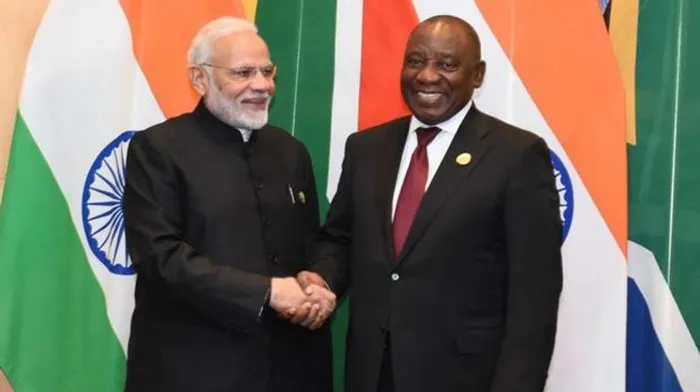
President Cyril Ramaphosa with Indian Prime Minister Narendra Modi.
Image: Independent Media Archives.
The fourth India-Africa Forum Summit (IAFS), which was set to take place in New Delhi this coming week, has been postponed due to concerns about the evolving health situation in parts of Africa, such as the Ebola outbreak in the Democratic Republic of the Congo (DRC) and Uganda.
The IAFS is the apex institutional mechanism for India’s engagement with Africa. It was established in 2008 and covers the entire gamut of inter-State partnerships in political, security, economic, trade, developmental partnership, cultural and people-to-people relationships.
On Friday, the Government of the Republic of India and the African Union (AU) announced the postponement of the summit.
In a statement, the AU said: “The two sides exchanged views on the evolving health situation in parts of Africa and reaffirmed the importance of continued cooperation in strengthening public health preparedness and response capacities across the continent, including through support to Africa CDC and relevant national institutions.
“India reaffirmed its solidarity with the peoples and Governments of Africa and expressed its readiness to contribute to Africa CDC-led efforts aimed at addressing the evolving health situation, in line with the shared commitment to an Africa-led response."
Earlier this month, President Cyril Ramaphosa, who is also the African Union Champion on Pandemic Prevention, Preparedness and Response, commended the DRC and Ugandan governments for their swift leadership and transparency in declaring the Ebola Virus Disease outbreaks of the Bundibugyo strain in Ituri Province in the Democratic Republic of the Congo and in Kampala, Uganda, following laboratory confirmation.
He called on them to sustain strong political leadership and continue working closely with frontline responders and communities to stop these outbreaks at their source and prevent further spread.
“Ebola does not respect borders. In a region marked by high population mobility, insecurity and humanitarian movement, the risk of regional spread is significant and demands urgent, coordinated action.”
The World Health Organisation (WHO) assesses the risk of the epidemic as high at the national and regional levels, and low at the global level.
“So far, 51 cases have been confirmed in the DRC, in the northern provinces of Ituri and North Kivu, including in the cities of Bunia and Goma – although we know the scale of the epidemic in DRC is much larger.
“Uganda has also informed WHO of two confirmed cases in the capital Kampala, including one death, among two individuals who travelled from DRC to Uganda,” WHO said.
After consultations were held between the Government of India, the Chairperson of the African Union, and the African Union Commission, about the health situation, it was agreed that it would be advisable to convene the IAFS at a later date.
“New dates for the summit and its associated meetings will be finalised through mutual consultations and communicated in due course. India and Africa reaffirmed their longstanding partnership founded on solidarity, mutual respect, South–South cooperation, and a shared commitment to peace, development, prosperity, and the well-being of their people,” the AU said.
SA High Commissioner to India, Professor Anil Sooklal, said it was decided that it is best not to put people's health at risk, given that the virus spreads fast, and with delegates from 75 countries registered to participate in the summit.
“It was a collective decision taken in order to ensure the safety and well-being of all. The IAFS is an established partnership forum between India and the African continent. It is taking place after a while because of circumstances that prevented the earlier staging of this conference,” Sooklal said.
Sooklal said that the AU commission, supported by the Africa group of ambassadors in Delhi, has been in negotiations with the colleagues from the Ministry of External Affairs to work on the draft declaration and the draft programme of action.
“That was more or less completed, given that the summit is supposed to have taken place this week. They have been in several rounds of negotiations, so this is a joint document crafted by both parties.
“The declaration, of course, is a political document, but what is important is the program of action. Now, it builds on the previous summits in terms of the cooperation existing between India and the African continent.”
Sooklal said that India has 46 embassies throughout Africa, and there are 46 African countries with embassies in Delhi.
“The coming together of the political leadership was again going to emphasise the importance both sides attached to this relationship, and as I pointed out, apart from the political significance, the economic significance, there was also an extensive cultural program.
“Focusing on both African culture and Indian culture with artists from the African continent and the Indian side. That was lined up,” Sooklal said.
He said there was an academic forum planned to bring together universities and academics on a focused programme.
“It was multifold in its focus in looking at strengthening, already existing collaboration, but more importantly, solidifying and institutionalising some of these partnerships. This was going to be actually a very important partnership in terms of setting a new paradigm of partnership between India and the African countries,” he said.
theolin.tembo@inl.co.za