

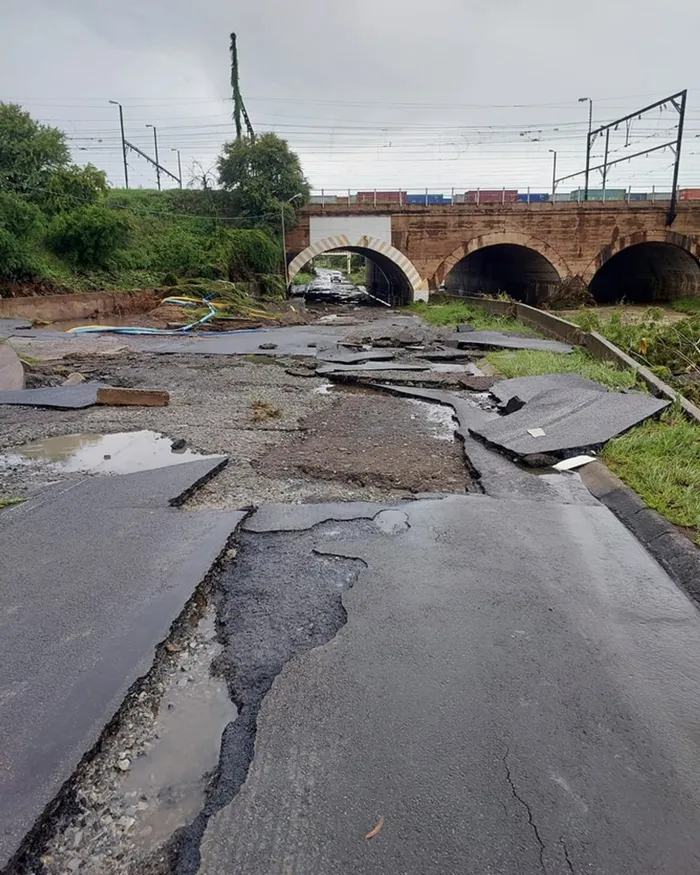
The revised eThekwini Disaster Management Policy Framework was discussed at a council meeting on Thursday.
Image: File
The revised eThekwini Disaster Management Policy Framework appears largely reactive rather than proactive, and stronger inter-departmental coordination is needed to address underlying issues.
This was the view of Dr Jonathan Annipen, IFP councillor in eThekwini, at a council meeting on Thursday, when the revised framework, in accordance with the Disaster Management Act, was approved.
The updated framework provides a strategic foundation to strengthen disaster risk reduction and enhance resilience across the municipality. It emphasises the integration of disaster risk management into all aspects of municipal planning, service delivery, and operations, ensuring a proactive, coordinated approach to risk management.
According to the report tabled at the council, the previous disaster management framework, adopted in September 2009, had been in place for over a decade. Since then, the disaster management environment has evolved considerably, necessitating a comprehensive review to align with current risks, best practices, and legislative requirements.
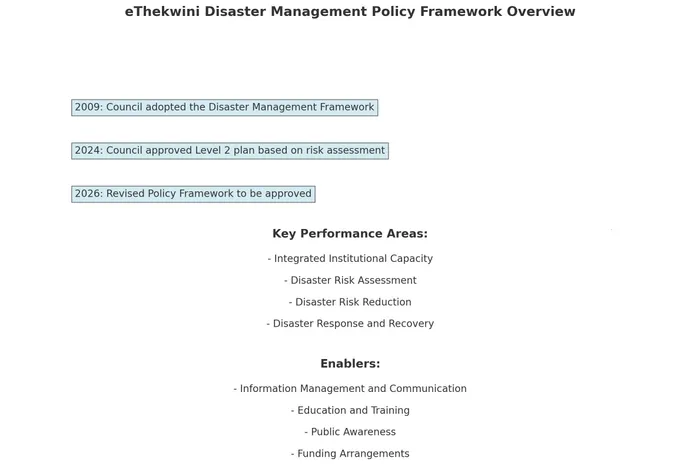
The revised eThekwini Disaster Management Policy Framework was discussed at a council meeting in April 2026
Image: RON-AI
In August 2024, the council adopted the eThekwini Disaster Risk and Response Management Level 2 Plan. It was developed following a city-wide risk and vulnerability assessment. Building on this foundation, the revised policy framework was developed by the eThekwini Disaster Management Directorate in close collaboration with Provincial and National Disaster Management Centres, ensuring alignment with national guidelines and frameworks.
Annipen said that on paper, the policy is comprehensive, well-structured, and aligned with the principles of disaster risk management.
“The concern is that this policy appears largely reactionary rather than proactive. It reads as a response to crises we have already experienced, rather than a strategy to prevent future disasters. Good governance is not measured by how we respond after devastation, but by how effectively we prevent it,” Annipen said.
He told the council that there is a clear gap between policy and practical implementation, and that what is required is not only a document but a physical and tangible approach on the ground.
“Our communities need to see visible interventions, not just plans. This is particularly critical when we consider residents in informal settlements, who remain the most vulnerable to floods, fires, and other disasters. Year after year, we see the same communities affected. This tells us that prevention is not being prioritised,” he said.
Annipen explained that the policy must go further in outlining clear strategies for relocation, where necessary, and infrastructure interventions in high-risk areas such as floodplains, riverbanks, and unstable land. He called for stronger inter-departmental coordination to address housing backlogs, poor spatial planning, drainage systems, and service delivery failures.
“These are the root causes of many disasters we see today. Disasters arising from accidents and unforeseen incidents must be included,” he said.
Zandile Myeni, eThekwini deputy mayor, said the municipality will strengthen partnerships with non-government organisations that are assisting in some areas.
She added that the revised framework is structured into key performance areas (KPAs) and three enablers, with roles and responsibilities assigned to various municipal directorates and entities
zainul.dawood@inl.co.za

Dr Jonathan Annipen, an IFP councillor in eThekwini, commented on the eThekwini Disaster Management Policy Framework at a council meeting on Thursday.
Image: File