

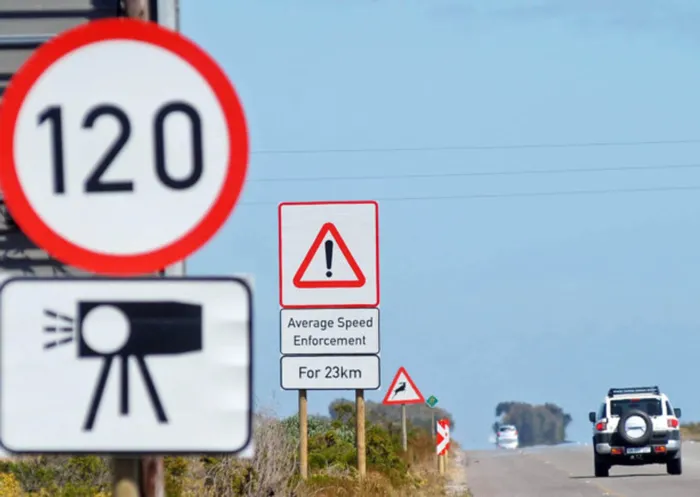
Cape Town - 131020 - Transport and Public Works Minister, Robin Carlisle, launched the third phase of the Average Speed Over Distance (ASOD) camera network system, now being extended to the R27 along the West Coast. Reporter: Chelsea Geach Picture: David Ritchie Cape Town - 131020 - Transport and Public Works Minister, Robin Carlisle, launched the third phase of the Average Speed Over Distance (ASOD) camera network system, now being extended to the R27 along the West Coast. Reporter: Chelsea Geach Picture: David Ritchie
The Western Cape provincial department of transport and public works has begun began nabbing drivers on the R27 up the West Coast using a camera system that has already saved lives on roads elsewhere in the province.
The Average Speed Over Distance camera system has so far reduced road deaths on the R61 and N1 near Beaufort West over the past two years, and is now set to monitor 54km of open road between Cape Town and Langebaan.
Transport MEC Robin Carlisle said road fatalities on the monitored N1 stretch fell from 86 in 2011 to 38 in 2012 and 21 so far for this year.
“It’s incredibly successful and very cheap,” Carlisle said. The new R27 monitoring zones cost R6.5 million.
The cameras work in pairs, measuring a driver’s average speed over the distance between them.
Camera A snaps a picture of the licence plate as a vehicle enters the monitored zone. Camera B takes a photo as the vehicle exits the zone.
The system matches up the pictures by licence plate recognition, and works out how long it took for the vehicle to get from point A to point B. If the driver arrived faster than the speed limits allows for, he or she can expect a detour through a road block within the next three kilometres.
The cameras don’t only spy on speedsters.
Every licence plate number scanned by the cameras is instantly cross-referenced with the National Traffic Information System database. If the vehicle is unroadworthy, unlicensed or stolen, the camera system will notify traffic police to pull the driver over.
Yasir Ahmed, chief director of transport regulation, said: “Once a car is stolen, all cameras look out for that numberplate.”
You won’t find these cameras sneakily stashed in a bush. They come with a warning sign – “Average Speed Enforcement” – and hang conspicuously over the road.
“We’re not trying to catch people out.”
Carlisle said: “We want people to slow down and observe the speed limits our road engineers judge to be safe.”
Alerting drivers that their speed will be monitored over a stretch of road has the added benefit of jolting them awake.
Ahmed said: “The combination of speed and fatigue is a killer.”
The first speeding driver to be pulled over on Sunday afternoon was doing an average of 131km/h on his way to Langebaan for the day. He and his passenger were admonished by Carlisle for driving unsafely.
“It’s a wake-up call.”
The next speedster was off to see a client in Vredenburg when he was pulled over. He hadn’t realised he was driving through a speed trap.
“When I come down this road again I will definitely be more careful,” he said.
The man, who refused to give his name, was then breathalysed, found to be over the limit and arrested.
Carlisle plans to use the camera system to cover more of the N1 and N2 next.
“We’ll have a nice nanny state,” he said. “It’s going to be a pleasure to drive in the Western Cape once we’ve got these roads covered.” - Cape Argus