

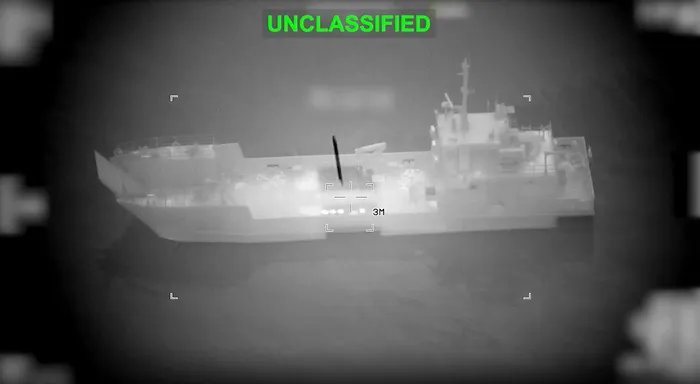
This screen grab obtained from video released by the US Central Command shows what they say is an Iranian naval vessel as it is struck by a projectile "near the Strait of Hormuz" as part of "Operation Epic Fury" on March 10.
Image: US Central Command / AFP
US Central Command said on Tuesday that it had struck 16 Iranian mine-laying vessels near the Strait of Hormuz, part of ongoing tensions in the region. The command said in a post on X that “US forces eliminated multiple Iranian naval vessels, March 10, including 16 minelayers near the Strait of Hormuz.”
A video included in the post showed munitions hitting nine of the vessels, most of which appeared to be moored at the time of the attack. It was not immediately clear whether Iran had deployed naval mines in the water following the massive US-Israeli strikes on February 28.
Iran’s Islamic Revolutionary Guard Corps Navy Commander, Alireza Tangsiri, said in a post on X on Tuesday that Iran would use missiles and submarines to prevent the movement of the US and allied fleet through the Strait of Hormuz. He also dismissed previous US claims that its navy had been escorting oil tankers through the strategic waterway.
Recent disruptions to maritime traffic in the Strait of Hormuz have raised concerns about ripple effects on energy markets, maritime transport, and global supply chains, the United Nations Conference on Trade and Development (UNCTAD) said on Tuesday.
In an analysis report, UNCTAD noted that military escalation in the region has disrupted shipping flows through the strait, a vital passage that carries roughly one-quarter of global seaborne oil trade, along with significant volumes of liquefied natural gas and fertilisers.
More than 1,300 Iranian civilians have been killed, and 9,669 civilian sites destroyed in military strikes launched by the United States and Israel since February 28, Amir Saeid Iravani, Iran’s ambassador and permanent representative to the United Nations, said on Tuesday.
The civilian sites included 7,943 residential homes, 1,617 commercial and service centres, 32 medical and pharmaceutical facilities, 65 schools and educational institutions, 13 Red Crescent buildings, and several energy supply facilities, Iravani told the press.
“They are deliberately and indiscriminately targeting civilians and civilian infrastructure across my country,” he said. “They show no respect for international law and no restraint in committing these crimes. Densely populated residential areas and critical civilian infrastructure are deliberately targeted.”
Iravani cited heavy strikes on fuel storage facilities in Tehran and other cities on Saturday night, which released large quantities of hazardous and toxic pollutants into the atmosphere. “The explosions caused severe air pollution and serious health risks for civilians, especially children, women, the elderly, and those with critical health conditions,” he said, citing the Iranian Red Crescent Society.
“These heinous attacks also violate international environmental obligations, including those under the United Nations Framework Convention on Climate Change and the Convention on Biological Diversity,” he added.
He also listed other targets, including attacks on Mehrabad Airport in Tehran early Saturday morning, which destroyed or severely damaged several civilian aircraft and airport facilities, and an attack on a freshwater desalination plant on Qeshm Island in Hormozgan province, disrupting water supplies to 30 villages.
In addition, Iravani said that early Sunday, Israel carried out “a deliberate terrorist attack” against the Ramada Hotel in Beirut, Lebanon, killing four Iranian diplomats. “The targeted killing of diplomats on the territory of another sovereign state is a grave terrorist act, a war crime, and a flagrant violation of international law,” he said.
“The international community must act now to stop this bloody war against the Iranian people. We will take all necessary measures to defend our people, our territory, and our independence,” Iravani added.
Xinhua