

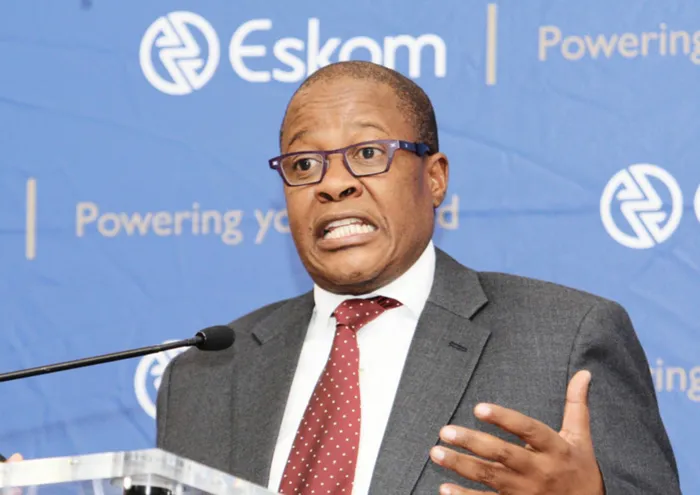
Eskom's acting chief executive Brian Molefe. The writer says well-run parastatals that put efficiency first can have a greater leveraging impact in driving job creation and empowerment. Picture: Simphiwe Mbokazi Eskom's acting chief executive Brian Molefe. The writer says well-run parastatals that put efficiency first can have a greater leveraging impact in driving job creation and empowerment. Picture: Simphiwe Mbokazi
There is a continual gloom in South Africa about the impact of mismanagement within the parastatal sector on growth and investment. The truth, however, is that such a pessimistic hunt as undertaken by the media is entirely misplaced – the narrative is not changing and has not gotten worse.
Put simply, the long-run risks that have often been discussed associated with South Africa and have played into investors’ decision-making processes over a long period are finally playing out – but have always been there. This sense of a set narrative materialising is probably not the most exciting one to talk about, but examining the building blocks of the view is important to consider.
Capacity
First, the lack of capacity in the public sector has long been known about. There have been some good managers in very large and complex organisations at the top, but a lack of depth, or indeed policy oversight and capacity in government.
Indeed, one of the key lessons over the past year has probably been that we had previously been overestimating, or oversimplifying, the level of capacity at the central government level, especially within the Department of Public Enterprises.
However, what we are seeing now is parastatals’ capacity being continually shipped around the sector – the chief financial officer of Transnet is joining Brian Molefe at Eskom, for example. Put simply, there is too much good management talent spread too thinly.
We have seen with the case of Sars, how a sound, well managed state institution with large capacity can be shifted suddenly off course through management changes, politicisation and scandals. This is the ultimate downside risk behind the often trumpeted ‘sound institutions’ barrier to further downgrades of South Africa’s sovereign rating.
PetroSA and Passenger Rail Agency of South Africa (Prasa) are different examples – the two companies’ investors would normally be unconcerned with, but are suffering from, a suspected chronic case of over fiddling by politicians – crumbling under the weight of inappropriate cadre deployment. This leaves a more negative impression than probably the size and importance of these organisations justifies, yet events in such entities are seen as symptomatic of wider public sector risks and issues.
Job creating foreign direct investment is not flowing into South Africa because of various different, interlocking and overlapping reasons – of which parastatals and energy security are only one part. Even if parastatals were perfectly run and functioning efficiently, you might get a jump higher in growth (of the order of 0.6pp) as private sector investment rebounds with a recovery in domestic sentiment. However, foreign investment is a different beast and other limiting factors would come into play, such as education and skills, regulatory certainty in many industries, cost issues (on wages, unionisation and labour market regulations), including higher long-run costs.
Put a different way – a key driver of the drain of direct investments in the balance of payments is that South African’s are investing abroad, particularly in the rest of Africa. So many countries on the continent have energy security issues that clearly the direction of investment cannot be solely explained by, or solved with, parastatals. Other factors are at play – most fundamentally, summing up the variety of factors above, that risk adjusted returns are higher on the rest of the continent than in South Africa.
As is so often the case in South Africa the solutions to parastatals are simple, and indeed known to the government and the ANC. What stands in the way is the internal politics of the ANC and its vested interests. Setting aside the strong case for a massive privatisation of parastatals – there is much the government could achieve within the public sector.
First, senior appointments should be taken away from the ‘shareholder’ and placed into an independent institution structured and safeguarded in a similar way to chapter 9 institutions. Senior appointments should be open to international competition.
BEE targets
Second, local content, black economic empowerment (BEE) targets and empowerment hiring and promotion practices should be rewritten to prioritise service delivery and efficiency first, the empowerment second. South Africa needs to ask which is more important – the degree of empowerment within parastatals or the proper and cost effective functioning to prompt wider growth and job creation in the economy. Put simply well-run parastatals that put efficiency first can have a greater leveraging impact in driving job creation and empowerment than if they are on their own.
Third, ‘nested contracting’ should be banned. This is a more specific point around BEE. Parastatals should contract directly with service and labour providers and not work through a multitude of intermediaries who add no value, increase costs and the duration of projects and decrease efficiency. Eskom has learnt this the hard way in coal procurement, investment goods and strike-prone labour.
Fourth, all new investment projects should be conducted through a transparent open tender in some form of public-private partnership. They should be handled by the Treasury’s new procurement office under tender documents decided by the parastatal, not the government. All parastatal tenders over R10 million should be conducted through the Treasury with external auditor oversight.
Parastatals
There are some that say the government, “would never agree to that”.
Parastatals should be boring and dependable, issuing debt that investors see little need to yield more than the government’s own. They should not be actively driving development, but allowing development to occur naturally from doing their jobs well. The first stop on a trip to South Africa should be to visit some exciting new industry or business.
A topic that I am thinking a lot about is how the next generation of young millennial South Africans view government institutions and structures in the long run.
A generation that wants instant solutions to problems, is prepared to be entrepreneurial enough in looking to build and import solutions, and is going to look at the government’s stance in relation to parastatals as profoundly at odds with the problem and possible solutions available.
As this generational shift feeds through into the body politic, so the sprawling mass of state entities will look out of date and change will likely come. At that point privatisation and efficiency may be options. This may well be a long way off, however, assuming a status quo candidate is successful in 2017.
The path to get there is uncertain and at some point will require some political capital to be spent and difficult decisions to be taken. The solutions are already known, but for now the political and ideological roadblocks to reform seem too great.
* Peter Attard Montalto is an executive director and senior emerging markets economist and strategist at Nomura
** The views expressed here are not necessarily those of Independent Media.
BUSINESS REPORT