

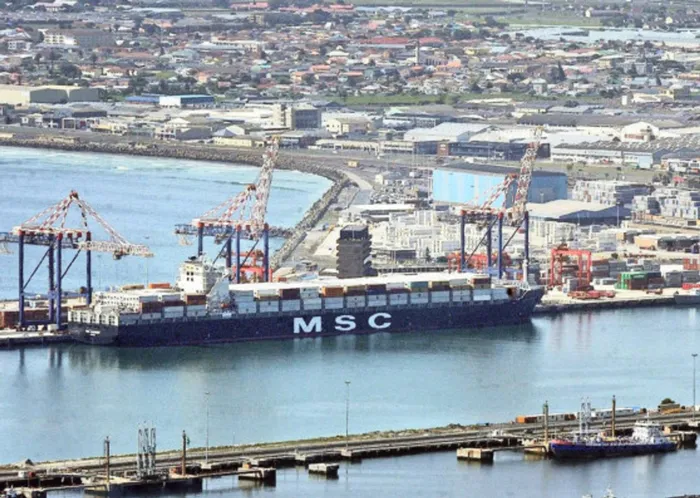
Transnet Port Terminals in Cape Town. The writer says exporters should be taking better advantage of the weak rand. Picture: David Ritchie, Independent Media Transnet Port Terminals in Cape Town. The writer says exporters should be taking better advantage of the weak rand. Picture: David Ritchie, Independent Media
Upon his return from a four-year stint in Brussels as South Africa’s trade diplomat to the EU in 2011, Department of Trade and Industry director-general Lionel October held high hopes for our country attaining economic prosperity on the back of growing industrial exports.
During his posting, October had witnessed first-hand the carnage brought by the 2008 global economic recession in Europe and elsewhere, which also resulted in the destruction of 1 million jobs in South Africa. He had been dispatched in 2007 by the then trade and industry minister, Mandisi Mpahlwa, to facilitate trade and investment between South Africa and the EU, one of our major trading partners.
When he came back to South Africa to take over the reins at the Department of Trade and Industry, October was convinced that South Africa could leapfrog to prosperity through boosting its industrial exports in much the same way as manufacturing giants like Germany, South Korea and China had done.
October had also discovered that these powerful industrial exporters were able to weather the recessionary storm much better than countries such as Ireland and Iceland, which prior to the recession had built thriving financial services industries instead of focusing on being exporters of manufactured goods.
South Africa is still a heavy exporter of raw minerals and has struggled to grow its industrial exports despite the rand depreciating sharply against the dollar over the past five years. In theory, a weaker currency is supposed to be good for local exporters by making their goods cheaper to foreign buyers. No country in recent memory has industrialised on the back of a strong currency, and this occurring without protecting its key infant industries from foreign competition.
For example, China deliberately keeps its currency, the yuan renminbi, softer against the dollar to give its industrial exporters a competitive edge against manufacturers from the rest of the world.
This policy, along with its cheap labour, has propelled China to overtake Germany as the world’s biggest exporter, knocking off Japan from its long-held spot as the second-largest economy in the world.
Growth in SA exports
Growth in South African exports has ranged mostly from stagnant to sluggish between 2011 and 2014.
This trend is unlikely to reverse even though Reserve Bank governor Lesetja Kganyago pointed out in a monetary policy committee statement in September that there appeared to be some evidence that exports were responding to the weak rand.
To illustrate how stagnant our export growth is, we sold $126.6 billion (R1.99 trillion at current rates) worth of exports in 2011, roughly 30.4 percent of our gross domestic product (GDP) , $118bn (29.7 percent of GDP) in 2012, $113.5bn (31 percent of GDP) in 2013, and $109.5bn (31.3 percent of GDP) in 2014.
Not even a 50.2 percent drop in the value of the rand against the US dollar since 2011 has acted as a stimulant that gives local industrial exporters a competitive advantage.
This year, in the wake of President Jacob Zuma’s bizarre axing of Nhlanhla Nene as finance minister in December, the rand has been volatile, even falling to a record low of R18 against the dollar in January before strengthening to trade inside the range between R16 and R17 against the greenback.
Many reasons have been advanced by economists as to why South African exporters are unable to capitalise on a hugely depreciated rand. Economists cite labour strikes, the high cost of labour, weak global economy, power cuts, infrastructure bottlenecks, and rising electricity tariffs as possible factors that hamstrung local manufacturers from flooding the international markets with their lowly-priced goods.
State intervention
There is no doubt that these factors hold back our exporters from reaching their potential, but Chris Malikane, an associate professor of economics at the University of Witwatersrand, advanced an interesting theory that explained the inability of our local manufacturers to win a respectable share of the global trade.
Malikane has publicly argued that the private and foreign ownership of strategic industries such as mining, which supply raw materials to the manufacturing sector, was responsible for stifling the growth and the competitiveness of the local manufacturing industry.
Malikane adds that South Africa’s strategic minerals are being exported raw and those supplied locally are sold to downstream consumers at hugely inflated prices, going against the policy of encouraging beneficiation.
He proposes that the government remedy this by nationalising companies that mine key strategic minerals and supply these minerals to downstream consumers at prices equal to the cost of mining them. This strategy could make South African manufacturers globally competitive and avoid the controversial import-parity pricing (IPP) imposed by monopolies, oligopolies and cartels on downstream manufacturers.
At one point, the government famously clashed with steel producer ArcelorMittal and petrochemicals giant Sasol after downstream customers of the two corporate giants complained about the imposition of IPP, arguing its pricing was exorbitant, amounted to market abuse and substantially increased their cost of production, which left them globally uncompetitive.
The critics of the IPP pushed unsuccessfully for the pricing model to be scrapped because goods produced on South African shores were charged as if they were imported, meaning that import duties and shipping costs were added to the overall price that was ultimately paid by the downstream consumers.
Chinese model
The government threatened to turn the heat on IPP practitioners by bringing foreign competition to South Africa to break the shackles impeding local manufacturers. As usual, the government still has to make good on its threats.
Malikane argues that South Africa needs to follow the Chinese model, where state-owned companies source key resources in Africa and elsewhere and then supply them to Chinese companies at affordable prices to fuel its industrialisation and infrastructure boom.
So where is the state-owned mining company? Proponents of bigger state economic involvement or ownership of the economy were in a victorious mood when the government launched the state-owned mining company, known as the African Exploration Mining and Finance Corporation (AEMFC), in February 2011.
AEMFC was meant to supply Eskom with cheap coal to fire its power stations and to secure key minerals needed to drive mineral beneficiation in partnership with downstream manufacturers.
Nothing much has come of the AEMFC since its much-vaunted launch. From the beginning, the state-owned company was viewed as an attempt to pacify the youth wing of the ruling ANC, then under Julius Malema, who lobbied strongly for the nationalisation of mines before he was expelled by party elders.
To its credit, the government has expanded its industrial development zone programme and introduced incentives to boost local manufacturing. However, there have been few successes, particularly in the automotive industry. But attempts to revive the clothing and textile industry have not yielded positive results after it was decimated by cheap Chinese imports.
Until South Africa boosts its export competitiveness and starts attracting foreign direct investment, we will struggle to register decent economic growth higher than 5 percent, instead of the less than 1 percent growth expected this year.
*
Andile Ntingi is the chief executive and co-founder of GetBiz, an e-procurement and tender notification service.
** The views expressed here do not necessarily reflect those of Independent Media.
BUSINESS REPORT