

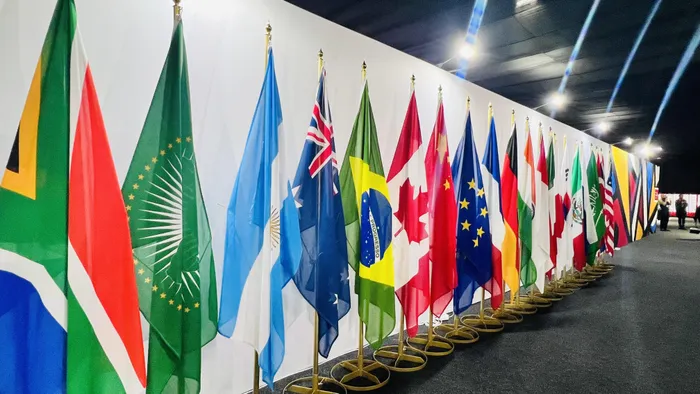
The G20 Leaders’ Summit was held in Johannesburg.
Image: Thabo Makwakwa / IOL News
South Africa once again occupied the global stage, not as a country in crisis but as host of one of the most complex diplomatic gatherings on earth. For two days, the G20 Leaders Summit unfolded on African soil forthe first time in history and the world watched a nation that has often been defined by its fractures reveal a different face: composed, disciplined, coherent and globally respected. This was more than logistics or protocol. It was a rare glimpse into the South Africa we are capable of being.
Globally, the summit took place during deep geopolitical division. Major powers entered into disagreement on fundamental issues, yet South Africa delivered unity where paralysis had become the norm. Domestically, we continue to wrestle with unemployment, inequality, uneven service delivery and institutional fatigue. Yet for two days, South Africa offered the world stability anchored in dignity, leadership in restraint and diplomacy in maturity. It showed a version of itself that many citizens have not experienced in years.
That capability was visible in the quality of our security arrangements, the movement of delegations, coordination across departments and the firmness with which we negotiated positions inside the summit.
South Africa, at its lowest institutional moment in decades, still managed to produce a G20 performance that reflected dignity, statesmanship, coherence and capability even while the country itself is fractured.
The South African state is fragile, but South African statecraft is still formidable. Our domestic reality is fractured, but our global posture remains dignified, coherent and principled. This contradiction, that we can rise in the moment even when things are broken at home, is one of the most powerful and dangerous truths about our democracy.
This is the mirror the G20 holds up to us. It tells us that excellence is not foreign to South Africa. It is simply not yet our daily habit. It tells us that discipline is not beyond reach, but not always part of our administrative culture. It tells us that the state is not incompetent; it is inconsistent. South Africans live with a deep psychological fatigue from navigating failing infrastructure and slow services.Yet that same nation just delivered a summit in which global leaders acknowledged our ability to convene, mediate and negotiate at a level many larger nations struggle to achieve. This is not a coincidence nor an anomaly. It is a national signal. For all our internal fractures, South Africa still carries something rare: a moral authority and diplomatic maturity that emerge precisely when global tensions are at their highest. Countries do not host such summits by accident. They succeed because beneath strain, their institutional muscle memory remains intact. And the world felt it.0
South Africa secured a G20 declaration reflecting the needs of the Global South. Debt relief, climate resilience, sustainable industrialisation, mineral value chains and youth inclusion sat at the centre of the final text. Even with selective non-endorsements, the core held because South Africa understood how to balance interests and soften rigid positions. In a year defined by geopolitical paralysis, South Africa proved that middle-power diplomacy still matters.
This was leadership from an administration navigating one of the most difficult domestic periods since democracy. Many South Africans do not experience the state as reliable in daily life. Yet the G20 showed that when leadership aligns with clarity and urgency, South Africa can deliver with coherence and authority.
This is why the G20 is not merely an event. It is a diagnostic tool. It exposes the distance between who we are in our lowest moments and who we become when the world is watching. The sharper truth is that it is not incapacity that threatens us, it is the normalisation of inconsistency. Our crisis is not one of intelligence or skill but one of discipline and follow-through.The G20 proves excellence is alive. The question is why it only surfaces under global pressure.
Why can we deliver security for global leaders but not always for our own citizens? Why can we coordinate nations but not departments? Why can we prepare world-class venues but not maintain local infrastructure? Why do we show urgency to the world yet move slowly for our own people?These questions are not indictments. They are invitations.South Africa’s problem is not capacity. South Africa’s problem is consistency.
This inconsistency has economic implications. When excellence becomes episodic instead of predictable, investor confidence becomes unstable and long-term planning becomes nearly impossible. If South Africa lacked the ability to rise to global standards, the G20 would have exposed that. Instead, it revealed the opposite. Beneath exhaustion and frustration, the country still knows how to unify in moments of consequence. It still has a diplomatic centre even when governance falters. It still commands respect abroad even when trust is fragile at home.
But a nation cannot rebuild on adrenaline. It must rebuild on discipline. South Africans do not need fantasy.They need a function. They need the competence shown at the G20 to become the competence they feel in their clinics, schools, municipalities and daily interactions with the state.
We need G20-standard governance, not as performance but as practice. It means urgency for a leaking pipe is equal to urgency for an international arrival terminal. It means preparing municipal budgets with the samediscipline as diplomatic communiqués. It means demanding coordination between departments in the same way we coordinated for global leaders. It means treating everyday South Africans as if the world were watching.
Because the world is no longer our judge. Our people are.
The next decade will test whether South Africa can convert moments of excellence into a culture of competence.If we are to build a country worthy of its potential, we must stop rising only under the spotlight and start rising in the shadows where most national life unfolds.
The G20 has ended. The convoys have departed. The microphones have been switched off. But the mirror remains. It reflects a nation with extraordinary potential living below its capabilities. A state that can be world-class but is not yet world-class for its own. A people who still believe in possibilities even when trust is fragile.
Institutions that can rise under pressure but must now rise under obligation. If there is one question South Africa must confront as we close this chapter, it is this: Will we continue to rise only when the world is watching, or will we finally rise for ourselves?

Nomvula Zeldah Mabuza is a Risk Governance and Compliance Specialist.
Image: Supplied
Nomvula Zeldah Mabuza is a Risk Governance and Compliance Specialist with extensive experience in strategic risk and industrial operations. She holds a Diploma in Business Management (Accounting) from Brunel University, UK, and is an MBA candidate at Henley Business School, South Africa.
*** The views expressed here do not necessarily represent those of Independent Media or IOL.
BUSINESS REPORT