

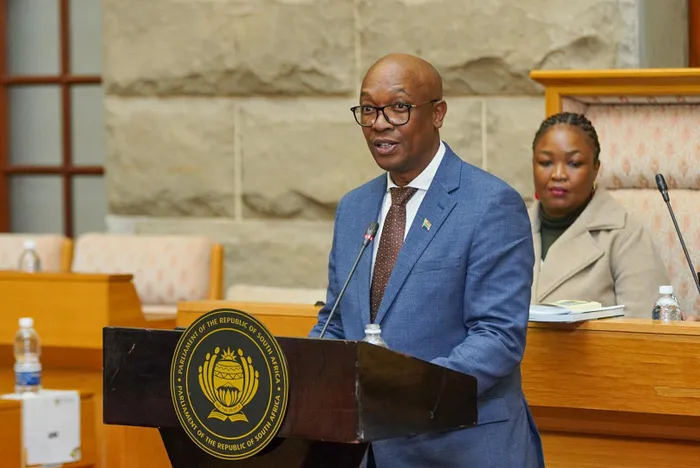
Trade, Industry and Competition Minister Parks Tau.
Image: GCIS
The successes and challenges of Broad-Based Black Economic Empowerment (BBBEE) have been the subject of much debate recently in Parliament and across society, including the Minister for Trade, Industry and Competition, Parks Tau, indicating a two staged review of the current BBBEE model.
That’s natural. South Africa is a constitutional democracy, something that the Congress of South African Trade Unions (Cosatu) and generations of workers fought and died for.
We expect Parliament to interrogate government policies and legislation, to hold the state accountable for their implementation, and where there are challenges, to find solutions. Cosatu as a Federation anchored amongst workers, will always welcome debate but these must lead to solutions that take the working class forward not backwards.
It is important to remember that South Africa’s 1994 democratic breakthrough did not arrive with a clean slate. We inherited 350 years of the world’s most brutal forms of colonial and apartheid dispossession, disempowerment and discrimination leaving South Africa the world’s most unequal society.
Despite tangible progress since 1994 under government led by the African National Congress, we remain a nation where the colour of one’s skin largely determines your economic fate. Similarly, one’s gender or disability too play an important determining factor.
No sober government could afford to ignore such ticking-time bombs. No sane society would tolerate a state that did not seek to tackle such structural discrimination.
The principles and objectives of BBBEE remain valid and they will continue to be as long as we have such stark levels of inequality, poverty and where access to the economy is not linked to one’s entrepreneurial talent, but rather race, gender or disability.
It does not help when politicians and noise hustlers demonise BBBEE as the enrichment of a few. This desperation for social media links dangerously polarises a necessary debate. The objectives of BBBEE and the empowerment of the poor and the working class are sacrosanct and cannot be abandoned in pursuit of votes at the ballot box.
The less said about the race-baiting and fear mongering juvenile antics of AfriForum the better.
The government and Parliament routinely review policies and legislation. It would be strange if they didn’t as the economy is not static and conditions evolve.
BBBEE has gone through previous reviews and adjustments, expanding from Black to Broad-Based Black Economic Empowerment and to introduce worker ownership. This is exactly what workers expect from government, an ability to listen to society’s concerns, undertake thoughtful self-introspection and produce progressive solutions.
What must guide this debate, in addition to our fundamental task of addressing unemployment, poverty and inequality; are our stark economic indicators of an economy struggling to move beyond 1% economic growth since 2008 and a dangerously high 42.4% unemployment rate.
We must tackle the stifling bureaucracy and red tape that greet investors, domestic and foreign. An economy in desperate need of stimulus should not be drowning and losing potential investors to paperwork.
The former Minister for Trade, Industry and Competition, Ebrahim Patel, initiated the establishment of a one stop online portal for companies to register for the CIPC, the UIF, SARS etc. This kind of innovation that makes it easier for investors to comply with our statutory requirements is key to attract the investment needed to create jobs for our 12 million unemployed.
The detractors of BBBEE routinely claim that it is a vehicle for the enrichment of a politically connected few. This is simply not true. BBBEE has three paths.
One is the 30% shareholder option to help historically disadvantaged persons, be it race, gender or disability, enter the economy as shareholders. This has helped empower millions, including White women, and created a growing Black middle class. It has helped chip away at the apartheid edifice of African, Coloured and Indian South Africans being confined to manual labour.
A major success has been the Employee Shareholder Ownership Programme (ESOPs), which has enabled more than half a million workers, Black and White, to become shareholders in their workplaces. This has meant money in their pocket boosting their living standards, giving them a stake in the success of their company and thus boosting workplace productivity, and laying the foundations for generational empowerment.
Equity Equivalents have been particularly important for investors not able to undertake the shareholder options. These have seen these investors hire local workers, support local businesses, buy locally produced goods and invest in local communities. These have helped nurture value chains and SMMEs. Many investors have followed this path with great success.
Cosatu welcomes a debate, but it must be anchored upon progressive principles. It must advance and not abandon transformation and the empowerment of the dispossessed. It must stimulate economic growth, create decent jobs and support local procurement.
Already some important proposals have been raised.
Should someone who is already empowered continue to be eligible under BBBEE or should BBBEE focus on those in need of upliftment?
Can the spouses and children of public representatives be prohibited from doing business with the state or disclosed in a publicly available register?
Should the United Nations’ Sustainable Development Goals about investing in critical economic infrastructure, community development etc. be included as additional options under the Equity Equivalent path?
Already progressive and creative discussions have taken place between DTIC, business and labour on the proposed Transformation Fund and how a voluntary 3% tax on companies could be utilised to support SMMEs could be introduced as a fourth option for BBBEE compliance.
These are important debates, but they must be held in a manner that unites ordinary South Africans. They must be done to advance transformation and to ensure that empowerment reaches those who most need it, be it the homebased sewing production in Mitchell’s Plain, the emerging farmer in Cofimvaba or the Afrikaans mine worker in Orkney.
It requires a level of maturity and commitment to building an inclusive South Africa as envisaged by the Freedom Charter’s call of a South Africa that belongs to all who live in it, Black and White.

Solly Phetoe is general secretary of Cosatu.
Image: Doctor Ngcobo / Independent Newspapers.
Cosatu General Secretary Solly Phetoe
*** The views expressed here do not necessarily represent those of Independent Media or IOL.
BUSINESS REPORT