

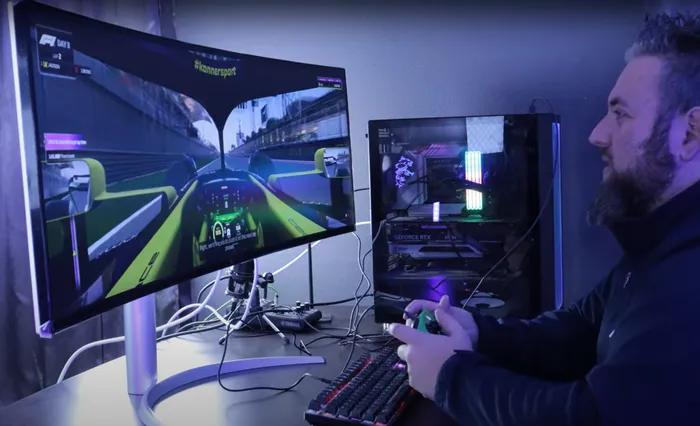
Across Africa, the gaming ecosystem is evolving rapidly, says the author.
Image: Ben Liebenberg / IOL
Gamers know that every millisecond counts. Whether you’re in the final circle of a battle royale, climbing the ranks in an FPS, or streaming your gameplay to the world, your monitor can make or break the experience. With the global PC gaming population having hit 907.5 million players in 2024, up from 873.5 million the year before, one piece of gear is taking centre stage: the gaming monitor.
Across Africa, the gaming ecosystem is evolving rapidly. From the rise of eSports tournaments and gaming cafés to the growth of digital content creation, African gamers are demanding performance that rivals global standards. In South Africa, where the gaming market is now worth over $1 billion and growing at more than 9% annually, the monitor is fast becoming the competitive edge. And for Lenovo, innovation in display technology sits at the heart of that evolution.
Smart Ergonomics for Smarter Play
At CES 2025 earlier this year, Lenovo unveiled its groundbreaking AI Display Proof of Concept, demonstrating the company’s commitment to pushing display innovation beyond traditional specs. This concept uses artificial intelligence to automatically adjust key visual settings, including brightness, contrast, colour temperature, and refresh rate, based on real-time ambient conditions and the user’s posture.
The result is a more immersive experience and healthier for the user. Eye strain and fatigue are common among gamers and streamers who spend long hours in front of screens. The AI-driven ergonomics address this by learning from the user’s environment and behaviour, creating a smarter, more adaptive viewing experience. It’s an approach that aligns perfectly with how gaming itself has evolved, more fluid and deeply personalised.
This is particularly relevant for African gamers, many of whom play or create content in varied lighting conditions and spaces. By prioritising comfort and intelligent adjustment, Lenovo’s display technology ensures consistent performance and visual clarity, regardless of the environment.
What Are Today’s Gamers Really Looking for
While 4K resolution and HDR visuals often dominate marketing conversations, gamers today are far more discerning. Speed and immersion now define the modern gaming experience. Monitors that deliver ultra-fast refresh rates and low input lag provide a measurable competitive advantage, which is a critical factor in eSports and high-stakes online play.
According to IDC’s 2024 gaming hardware report, global gaming monitor shipments grew by over 20% in 2023 and are projected to rise another 13.6% in 2024, with most of the demand concentrated in displays offering 144Hz and higher refresh rates. In South Africa, MyBroadband reported that 27-inch QHD (2 560 × 1 440) monitors with 100–165Hz refresh rates are now the sweet spot for serious gamers.
This shift underlines an important point, that gamers are chasing performance. The milliseconds between input and on-screen action define immersion. The Legion monitor range, including the R25i-30, R27i-30, and R34w-30 curved monitors, delivers that precision. These monitors combine response times as low as 0.5ms with up to 180Hz refresh rates and exceptional colour accuracy, catering to the growing demands of both casual and competitive players.
The Intersection of Gaming, Streaming, and Content Creation
Thanks to the digital era, modern gamers are also content creators. Platforms like YouTube and TikTok have blurred the lines between gaming, content production, and digital entrepreneurship. In Africa, this creator economy is flourishing, with local gamers and streamers reaching global audiences and building communities around their content.
This convergence of play and production has reshaped what a monitor needs to do. Displays must now deliver fluid motion and accurate colour reproduction for both gameplay and editing workflows. According to Future Market Insights, more than 40% of gamers worldwide also use their monitors for streaming or creative tasks; a number expected to rise as social platforms continue integrating live gaming content.
Legion monitors are designed for exactly this dual purpose. The same high-refresh displays that make gaming seamless also offer factory-calibrated colour accuracy, multiple input ports, and ergonomic flexibility, making them ideal for creators who edit, design, or broadcast between matches. In markets like South Africa, Kenya, and Nigeria, where the creator economy is booming, this adaptability is fast becoming a major purchasing driver.
The Next Wave of Gaming Tech: What’s Shaping the Future
The future of gaming technology, in Africa and globally, will be defined by convergence and intelligence. The global gaming monitor market, valued at $10.65 billion in 2024, is projected to more than double by 2034, reaching $21.8 billion. This growth is being fuelled by new technologies such as OLED and Mini-LED panels, AI-powered visual optimisation, and the integration of adaptive sync and variable refresh technologies for even smoother gameplay.
The opportunity lies in combining these global innovations with local insight. African gamers are value-conscious but increasingly sophisticated in their expectations. They want premium performance at accessible price points; monitors that are both aspirational and attainable. Lenovo’s leadership in R&D and manufacturing scale allows it to deliver exactly that: high-performance, high-refresh, ergonomically smart displays that meet the needs of a rapidly expanding market.
As eSports continues to rise across the continent and gaming communities evolve into full-fledged creative ecosystems, the technology company’s vision goes beyond hardware. It enables African gamers to play and connect at the same level as their global peers.
Yugen Naidoo, General Manager at Lenovo Southern Africa
*** The views expressed here do not necessarily represent those of Independent Media or IOL.
BUSINESS REPORT