

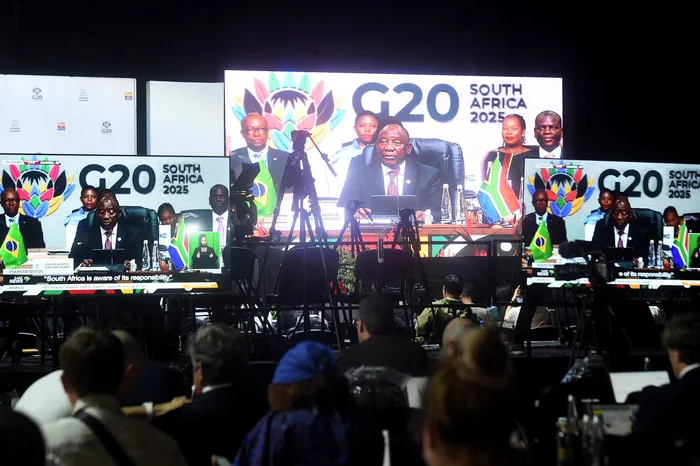
South Africa’s leadership managed to push agriculture higher up the G20 agenda than it has been in years, says the author.
Image: Itumeleng English/ Independent Newspapers
South Africa has now concluded its tenure as Chair of the G20, an extraordinary opportunity for a country that often sits at the intersection of global economic ambition and the lived realities of a developing agricultural sector.
As the chairship winds down, one thing is clear: South Africa did not simply occupy the position; it shaped it. At a time when global food systems are strained by climate pressures, geopolitical conflict, erratic markets, and the lingering aftershocks of economic instability, South Africa’s leadership managed to push agriculture higher up the G20 agenda than it has been in years. And it did so with a deliberate focus on the Global South, reframing long-standing questions around food security, climate-smart farming, and inclusive growth.
As we reflect on what this means for the sector as we advance, three outcomes stand out.
A Rebalanced Global Conversation on Agriculture
First, South Africa successfully widened the lens through which the G20 views agriculture. For far too long, global agricultural conversations have been dominated by the priorities of industrialised economies — emissions reduction, biosecurity, standards harmonisation, and advanced technologies. These priorities matter, but they are only part of the story. South Africa used its chairship to elevate the concerns of regions where the majority of farmers are smallholders, where climate change is not a future risk but a daily reality, and where food security remains one drought or one cyclone away from collapse. The 2025 G20 Ministerial Declaration reflects this shift. It places stronger emphasis on climate adaptation, resilience, and targeted support for developing countries. It acknowledges the centrality of Africa in future global food security. And it situates climate-smart agriculture not as a luxury but as an imperative. This reframing is a quiet but meaningful victory.
A Concrete Push for Climate-Smart Agriculture
Second, the chairship unlocked new momentum on climate-smart agriculture (CSA). South Africa’s message was simple: global food systems cannot survive without protecting the farmers who feed them. And those farmers — especially in the developing world — require tools, technology, and finance that they currently do not have access to. Under South Africa’s leadership, the G20 committed to expanding investments in:
These commitments matter because they address the structural vulnerabilities that repeatedly undermine agricultural production worldwide. They also align directly with South Africa’s own Agriculture and Agro-processing Masterplan (AAMP), which places climate resilience and productivity gains at the heart of the sector’s renewal and future trajectory.
Technology Transfer and Innovation for the Next Generation
Third, South Africa ensured that the conversation on agricultural innovation became more inclusive. In many developing countries, including South Africa, there remains a growing divide between the possibilities of modern precision agriculture and the realities faced by farmers who lack reliable connectivity, mechanisation, or finance.
As Chair, South Africa pushed the G20 to confront this inequality head-on. The result is a much stronger G20 commitment to:
These outcomes are especially relevant for South Africa, where the emergence of a new generation of tech-enabled farmers is one of the most promising shifts in recent years.
What South Africa Can Expect to Gain
While the G20 does not issue binding agreements, it does shape global financing flows, investment priorities, and policy direction. For South Africa, several benefits are now within reach:
1. Greater Access to Climate Finance for Farmers
This includes concessional loans, blended finance, micro-insurance for climate risks, and green credit facilities. Smallholders and emerging commercial farmers stand to benefit the most.
2. Expanded Investment in Digital Agriculture
South Africa’s growing AgTech landscape—spanning weather tools to artificial intelligence for crop monitoring—will find greater opportunities for collaboration and commercialisation.
3. Enhanced Support for Export-oriented Value Chains
With global partners now more attuned to Africa’s role in food security, South Africa’s fruit,beef, wool, and horticulture sectors are positioned to gain stronger footholds in global markets.
4. Reinforced Political Space for the AAMP
The alignment between G20 priorities and South Africa’s transformation agenda strengthens the case for domestic implementation, particularly around smallholder integration, agro-processing, and market access.
What the G20 Cannot Deliver
But even with these gains, we must be sober about the limitations. The G20 cannot resolve South Africa’s domestic constraints:
It cannot rewrite global trade rules overnight, nor can it dismantle entrenched agricultural subsidies in wealthy economies. And it cannot, on its own, transform the lived reality of South African farmers. What it can do—what it has done—is create space. Space for new partnerships, for new financing models, and for renewed global recognition that Africa’s agricultural future is central to the world’s food system.
The Work Ahead
Now that the chairship has ended, South Africa has a unique window to turn global commitments into local action. The onus shifts to domestic policymakers, financiers,agribusiness leaders, and farmer organisations to convert these opportunities into meaningful progress. If South Africa can harness the momentum generated by its leadership, agriculture could become one of the country’s most transformative economic sectors over the next decade—driving rural jobs, boosting exports, and ensuring greater food security. South Africa’s G20 chairship may be over, but its impact is only beginning. The question now is whether we will seize the opportunity we helped create.

Dr Thulasizwe Mkhabela is an Honorary Research Fellow with the African Centre for Food Security and the University of KwaZulu-Natal
Image: LinkedIn
Dr Thulasizwe Mkhabela is a director and Senior Researcher at Outcome Mapping (thula@outcomemapping.co.za; thulasizwe.mkhabela@gmail.com). He is also an Honorary Research Fellow with the African Centre for Food Security at the University of KwaZulu-Natal (MkhabelaT1@ukzn.ac.za) and an independent agricultura lresearcher and policy analyst with extensive experience in South African and African agricultural & development issues.
*** The views expressed here do not necessarily represent those of Independent Media or IOL.
BUSINESS REPORT