

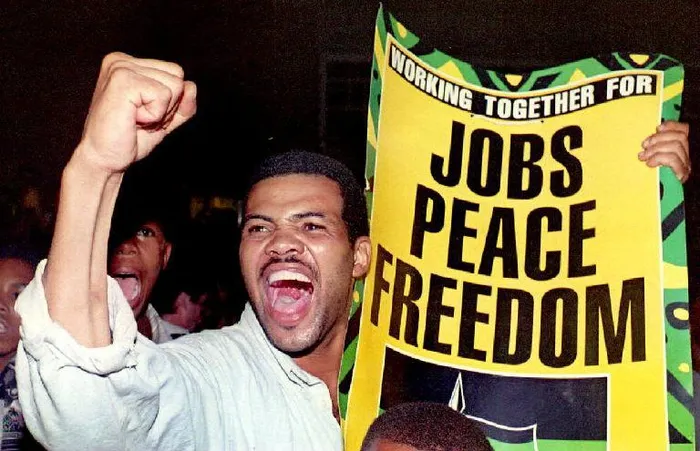
AN ANC supporter at the party's election campaign meeting in this file photo.
Image: AFP
The African National Congress (ANC), will be holding its National General Council (NGC) from the 8th to the 11th December.
Whilst it is natural for a political party to spend time engaging upon politics, it is critical that this NGC of the ANC, gear its attention to the daily struggles that millions of workers experience, to give hope to the unemployed and to tackle the obstacles facing inclusive and rapid economic growth.
Society wants to hear from the leading party in government frank self-introspection and most importantly for the ANC to emerge with concrete proposals on what needs to be done to ensure the state can fulfill its constitutional mandate to provide public and municipal services, to utilise public resources in the most effective way possible to stimulate economic growth and tackle unemployment, poverty, inequality, crime and corruption.
That is the message that the Congress of South African Trade Unions will be bringing to its ally, the ANC’s NGC.
The 40% result that the ANC received in the 2024 elections must serve as a wake-up call. It is a stark reminder to the NGC delegates that society, correctly, expects more.
If the economy is to reach the 3% annual growth rate fundamental to reducing our staggering 42.4% unemployment rate, then the NGC must focus on urgent high impact interventions to get the economy moving.
An ANC that is occupied by palace politics helps no one. It distracts the leaders of government from focusing on the bread-and-butter issues that matter to workers and the economy.
To highlight how important it is to have a coherent, disciplined and focused ANC, one needs look no further than many important achievements put in place since 1994, from providing 27 million impoverished South Africans with social grants, to rolling out free schooling with meals across poor communities, to enabling millions to access tertiary education through NSFAS amongst other important interventions designed to put in place the foundations for long term inclusive growth and a skilled workforce able to compete in a globalised economy.
One need look no further than some municipalities to the dangers of leaders focused more on what positions they can occupy, than what needs to be done to provide communities and businesses with the services needed to survive and thrive.
It is natural, though unhelpful, to allow the negative headlines to dominate.
We have seen in the recent past, important green shoots emerging after the devastating decade of state capture and corruption. Key amongst these is the massive work done by workers to stabilise Eskom and defeat loadshedding, to resolve challenges at Transnet Freight Rail and Ports, reopen Metro Rail lines, rebuild the South African Revenue Service, exit grey listing and improve investment ratings, and the creation of 248 000 jobs in the last quarter.
The ANC NGC needs to spend its time deliberating on how to consolidate and build upon these gains.
What are the key matters that workers and the economy need to see come out of the NGC?
First is to ensure that as government prepares the 2026 Budget to be tabled at Parliament in two months, that it responds decisively to the economic conditions facing the nation.
The Budget needs to be bold and aggressive. It needs to ensure that economic growth is raised from 1% to the 3% necessary to reduce unemployment. It needs to ensure that frontline public and municipal services as well as State-Owned Enterprises have the resources and other support necessary to lay the foundations for rapid economic growth and job creation.
The NGC should not take a business-as-usual approach, when the economy has been wallowing at 1% growth since 2008. Bold and new approaches are needed.
Key amongst these is a new mass industrial and small, medium and micro enterprises financing package, coordinating resources and interventions from the fiscus, the developmental finance institutions and the private banks and investment funds. This was a matter discussed at length in the ANC’s National Executive Committee January Lekgotla. It needs to be actioned.
A similar collective approach between the fiscus, the development finance institutions and the private sector is needed to provide a pathway to permanent, decent employment for 12 million unemployed. This needs to include a massive expansion of the Presidential Employment Stimulus and the filling of frontline vacancies across the state. The private sector must come to the party by tapping into the funding available for skills training for workers and hiring young people through artisans and internship programmes to give them their first job experience.
The government has put in place a progressive R1 trillion investment for critical economic infrastructure over the next three years with 25% of it already underway. Key to ensuring it is spent correctly and timeously and thus having the intended impact upon the economy, is to expedite the necessary interventions to stabilise and capacitate struggling municipalities and State-Owned Enterprises.
One of the major deterrents to attracting the domestic and foreign investment needed to create jobs and economic growth are our high levels of crime and corruption. A revamped anti-crime strategy and a well-resourced South African Police Service, National Prosecuting and Judiciary are critical to turning the tide in this war. The days of townships and informal settlements being crime hot spots must come to an end.
The South African Revenue Service deserves special attention and to be provided with the resources needed to collect taxes and custom duties needed to fund public services.
The NGC must build upon the Nedlac social compacts between government, business and labour that saw spectacular successes to defeat Covid-19, saving the lives and livelihoods of millions of workers.
The NGC needs to build upon the green shoots painstakingly put in place to ensure an ANC in touch with the needs of workers and the economy, to rebuild public and municipal services, to stimulate inclusive economic growth and create jobs. It needs to provide hope to a society and send a signal that the foundations for a better future are being laid step by step.

Solly Phetoe is general secretary of Cosatu.
Image: Doctor Ngcobo / Independent Newspapers.
Cosatu General Secretary Solly Phetoe
*** The views expressed here do not necessarily represent those of Independent Media or IOL.
BUSINESS REPORT