

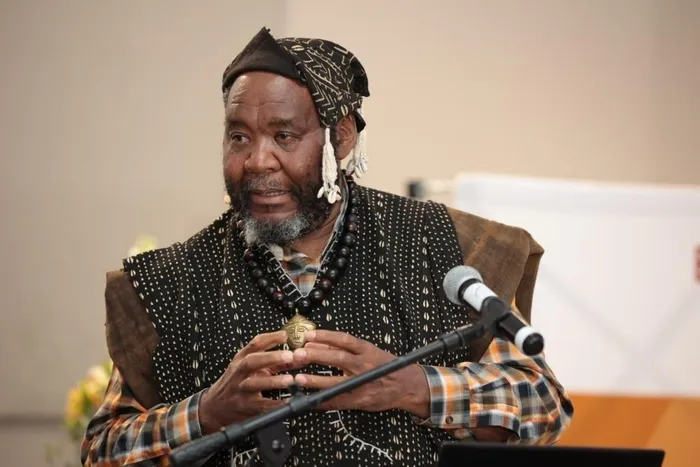
Dr Pali Lehohla is a Professor of Practice at the University of Johannesburg, among other hats.
Image: Supplied
I delivered a keynote address to the 5th SAIGA conference held at the Emperors Palace and asked the question, “Whither governance when Moses has broken the tablets at the foothills of Mount Sinai?”. When we stood before the nations in 1994, newly liberated but materially poor, we did not anticipate that the riches of the state would eventually afflict us, paralysing our human agency. That agency was once epitomised by the poor who triumphed over a labyrinth of apartheid laws and prisons. Yet today, we face a tragic inversion: the liberators have become the predators.
Hani, Mandela, Biko, Sobukwe, Maxeke, Sisulu, and Tambo cannot sleep in peace, despite our songs wishing them eternal rest. They cannot rest because the "Covenant of Truth"—the tablet of governance—has been broken.
We have mutated into what the Indlulamithi Scenarios define as a "Gwara-Gwara" nation, further devolving into a "Vulture Culture." In this culture, proceeds of crime lubricate political favour, and leadership becomes an uncontested association in crime. We are dancing and singing while development is dololo.
But the cost of this Vulture Culture is not just economic; it is measured in blood. Lawrence Moepi, Babita Deokaran, Cloete Murray, and Mpho Mafole—the shield of the nation—paid the ultimate price. Their blood has watered the proceeds of crime, martyring its way into the sealed envelopes of political contestation and now into the Government of National Unity.
The Moral Hazard of the PAAA
In response to this crisis, South Africa made a profound, structural mistake. We attempted to solve a political crisis with an auditing tool.
My central contention is this: You cannot fix a paralyzed state by arming the accountant.
The original design of the state rests on a fundamental separation of powers. The Statistician and Auditor-General (AG) (Moses) hold the Tablets (The Truth/The Numbers). Their power is epistemic—based on knowledge. The Executive (The King/Pharaoh) holds the Sword (The Police/Justice). Their power is coercive—based on action.
When the executive refused to use the sword to punish thieves, our late brother, Kimi Makwetu, attempted to solve the problem with the Public Audit Amendment Act (PAAA). While born of necessity, this amendment effectively handed a small, clumsy knife to Moses.
This created a massive moral hazard. The Executive now effectively says, "I don't need to punish the corrupt officials. The AG has the power to issue a debt certificate. Let him do it."
By giving the Auditor General the power to "punish," we inadvertently gave the executive permission to sleep. We institutionalised executive failure.
The Subsidy of Silence
This failure to govern is compounded by what I call the "Subsidy of Silence." The PAAA allows Ministers to hide behind the process. When a material irregularity is identified, it triggers months or years of remedial actions, appeals, and debt certificate processing.
During this "back and forth," the corrupt official stays in office, continues looting, and the Minister says, "We must wait for the AG's process to conclude." The government is formally kicking the can down the road, outsourcing political will to a Chapter 9 institution.
The assassins know this. They are trying to make the state "Blind." When you kill the auditor, you remove the eyes of the public so the looting can continue in the dark. This is the "Terminal Breaking" of the tablets.
The Contradiction of Proximity
I contrast this with the culture of accountability we once strove for. In 2003, when I was probed for graft regarding Census 2001 tenders, I did not attack the auditor. I requested the forensic investigation myself. I told them, "Dig. If you find dirt, I will resign before you can print the report." I was cleared because I submitted to the audit. The system worked because the roles were respected.
Today, we see the opposite. It reminds me of a vernacular story about an octogenarian mother of a priest. Irritated by children playing, she used profanity but prefaced it with sanctity: "Ke ‘ma ea fatere – ke tla u nyelisa" ("I am the priest’s mother, I will make you sh** yourself").
Our public administrators do the same. They claim proximity to the sanctity of the Auditor-General to hide their systemic theft, using the AG’s credibility as a shield for their inaction.
Restoring the Covenant: The Sixth Element
What is the remedy? We do not need a "Super-AG." We need a functional State.
We must return to the constitutional design where the auditor audits (holds the mirror) and the executive executes (wields the sword). If an audit shows theft, the Minister must act, or the Minister must fall.
To achieve this, we need to establish the "Sixth Element" of statehood—the START Mandates (Statistics for Transparency, Accountability, Results and Transformation). We must elevate Science, Statistics, and independent Fact-finding to a constitutional mandate, co-equal with the Judiciary. This creates a "Utilisation Framework" where the executive is forced to act on the evidence provided by the AG, without hiding behind debt certificates.
The Mohlomi Code
Finally, we must look to our own history for the definition of leadership. Morena Mohlomi, the mentor of King Moshoeshoe, taught that leadership is not the display of power through violence, but the exercise of responsibility.
Perhaps we need a "Mohlomi Code" for our public service—one that pursues peaceful, productive alliances and uses power to create intergenerational value.
We must reject the institutionalisation of executive failure. When Moses broke the tablets at Sinai, he did not pick up the shards to stab the Golden Calf. He ground the idol to dust and went back up the mountain to get the Law again.
It is time to reset the Covenant. Stop kicking the can down the road. Pick up the tablets. And read the law.
In recognition of his patriotism and bravery, SAIGA at its 5th Annual Conference recognised Lt General Nhlahla Mkhwanazi, Police Commissioner of the KZN Province.
Dr Pali Lehohla is a Professor of Practice at the University of Johannesburg, a Research Associate at Oxford University, a board member of Institute for Economic Justice at Wits and a distinguished Alumni of the University of Ghana. He is the former Statistician-General of South Africa.
*** The views expressed here do not necessarily represent those of Independent Media or IOL.
BUSINESS REPORT