

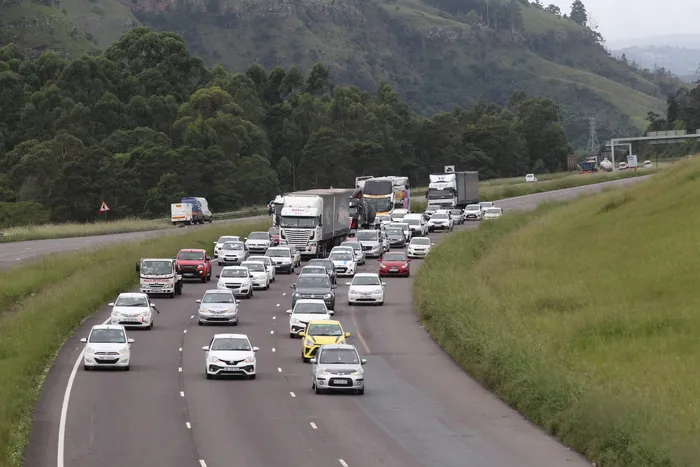
South African transport sector stands at a crossroads. It is the country’s third largest emitting sector, but also one of the areas where climate action can most directly improve lives, says the author.
Image: Doctor Ngcobo / Independent Newspapers
The great migration has begun. South Africans and many of our country’s migrant workers will begin the great trek, as holiday makers head to the coast, the berg, the bush, and the rural hinterlands of places they call home. It is also the last-minute rush to move goods and cargo on time for the festive shopping and to stock up warehouses for the demand of a new year, when all economic and social beings and systems yawn out of the end of year festivities back to making South Africa work.
With the attention it so deserves, the narrative around transportation and mobility at this time of the year, becomes about road safety due to the hundreds of lives lost due to road fatalities. The other focus becomes our congested land ports struggling to process outbound migrant workers and last-minute shipments. To its relief, rail is spared from the spotlight, and the airline industry only gets mentioned in case of some newsworthy mid-flight incident.
In simply terms – we are not talking about transport and development as we should be, yet the transformation of our society and general of evolution of “civilisation” has hinged on how it adapted to its environment to enable ease and safety in the movement of people and goods.
The urgency of alignment is clear - transport challenges stretch far beyond cost, efficiency, and safety.
South African transport sector stands at a crossroads. It is the country’s third largest emitting sector, but also one of the areas where climate action can most directly improve lives.
Long commutes, unsafe roads, congestion, and pollution from ageing diesel fleets all affect public health. Climate change adds further pressure: flooding, heatwaves and storms increasingly disrupt mobility, especially for low-income households living far from job centres.
Decades of poor spatial planning have created travel patterns that are costly, inefficient and environmentally damaging. More than 61% of school learners walk to school, often over long and unsafe distances. Around 22% of working adults walk to work, not by choice but because affordable alternatives do not exist.
This is where the intersection of climate action transportation is more than about than climate, but about improving the quality of life. The Presidential Climate Committee’s recommendations on South Africa’s Nationally Determined Contribution (NDC) highlight several priorities that can align mitigation, adaptation efforts with our development imperatives.
The first is revitalising rail. Few measures offer as many benefits as possible at once: lower emissions, reduced congestion, safer travel and shorter commutes. Rail is the backbone of any modern transport system. Encouragingly, the Department of Transport has made progress, reopening corridors and refurbishing stations to bring commuters back to trains. Although much is still required, this work shows what is possible.
South Africa must accelerate the shift to cleaner vehicles with a clear pathway for electric mobility, supported by standards, charging infrastructure and incentives that enable adoption. Electrification is not only a climate response; it is also essential for the competitiveness of the automotive sector, which employs thousands of people. With the right policy signals, South Africa can position itself as a hub for electric vehicle manufacturing and charging technologies.
Public transport systems must be strengthened. Integrated rail, buses, minibuses and safe last-mile connections are essential for households with the greatest mobility burdens. Investment in public transport is both a development imperative and a mitigation priority. Reliable, affordable and safe public transport underpins inclusive economic growth.
Urban planning must also change. The PCC stresses the need for spatial transformation and climate-resilient infrastructure. This includes creating walkable, connected neighbourhoods; improving stormwater systems; designing safer streets; and shortening travel distances through better land-use planning. These interventions reduce emissions while improving daily mobility for women, children, older persons and people with disabilities.
Furthermore, the lack of freight efficiency must also be addressed. South Africa’s freight system remains heavily road-based, contributing significantly to emissions, congestion, and road damage. Shifting heavy freight to rail supported by logistics upgrades and intermodal hubs is one of the most impactful transport mitigation opportunities. A more efficient freight system strengthens competitiveness and lowers transport costs for the economy.
At its heart, the transport recommendations in the NDC rest on a simple principle: mobility must empower people. When rail is revitalised, it expands access to work and education. When public transport is strengthened, the economy becomes more inclusive.
When cities invest in walking and cycling, they become safer, healthier and more resilient.
As we travel, let us remind ourselves for the need for a just, people-centred transition in sectors that most directly shape daily life—transport being foremost among them. Particular emphasis on resilient infrastructure, equitable mobility, and the transformation of high-emitting sectors in ways that protect communities from climate risks while improving access and affordability. South Africa’s transport transition must be human-centred and seize the opportunity to build a mobility system that is modern, affordable, resilient, and climate-compatible.

Bridgette Setshedi, Manager Climate Mitigation, Presidential Climate Commission.
Image: Supplied
Bridgette Setshedi, Manager Climate Mitigation, Presidential Climate Commission.
*** The views expressed here do not necessarily represent those of Independent Media or IOL.
BUSINESS REPORT