

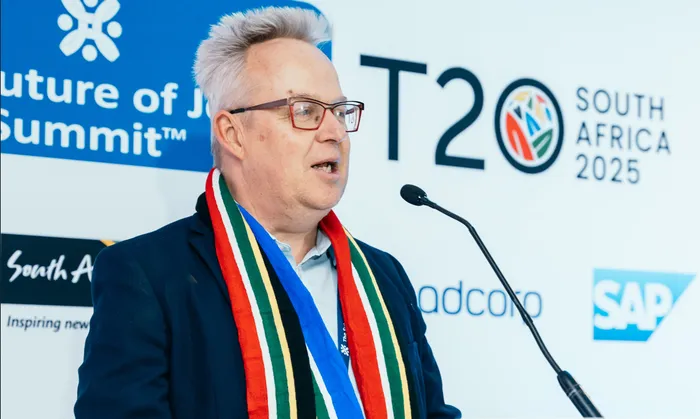
Dr Nik Eberl is the Founder & Executive Chair: The Future of Jobs Summit™ (Official T20 Side Event) .He will be writing a regular column in Business Report.
Image: Supplied
Ever since 2010, I have been haunted by a question that refuses to let go: How do we bottle the magic our visitors experience when they come to South Africa — and how do we turn that magic into a permanent national asset?
During the FIFA World Cup, I had the privilege of leading South Africa’s national brand ambassador programme. Our mandate was ambitious: train 500 000 service employees – from hotel staff and airport officials to taxi drivers, police officers and volunteers – in one unifying discipline: how to make every visitor feel seen, safe and welcomed.
What surprised me most was not how much people had to learn, but how little they needed to change. The warmth was already there. The generosity of spirit was already embedded. Our job wasn’t to manufacture hospitality — it was to unlock confidence. We taught one simple principle: You are not just doing a job. You are representing a country.
The results were extraordinary. Post-event research recorded a 92% net promoter score, one of the highest visitor satisfaction levels ever achieved by a host nation. Visitors didn’t talk only about stadiums or matches. They talked about taxi drivers who became tour guides. Police officers who handed out directions with pride. Waiters who learned foreign greetings just to make guests feel at home.
Fifteen years later, I watched the same story unfold again during the G20 visitor experience. In my recent LinkedIn article (which was quoted extensively by President Ramaphosa in his G20 Address to the Nation), I captured what G20 visitors had to say.
A German delegate told me, "I've attended summits on six continents. I've never experienced warmth like this." A Japanese delegate had this to say: "Your security guards smile while being vigilant. Your drivers share stories while navigating. Everyone — from the protocol officers to the coffee vendors — treats us like welcomed family, not foreign dignitaries." And a French delegate shared something profound: "We came to discuss economic frameworks. But what we'll remember is how your people made us feel. That's not soft power — that's real power."
Our People Are Not the Soft Side of Strategy – They Are the Strategy
There is a dangerous myth in nation-building: that infrastructure is strategy, and people are a bonus. My experience from 2010 taught me the opposite. Stadiums impress people. Human beings transform them.
I remember standing in a crowded training hall with several hundred frontline workers in the final weeks before the World Cup. A young hotel porter raised his hand. He said, “Sir, people fly for hours to come here. What if they don’t like us?” The room went silent. I answered him with words I still carry: “They will love you if you let them see who you are.”
That shift — from fear to pride — changed everything. The G20 visitor experience proved that this mindset still exists. South Africans still know how to carry guests, not just host them. But here is the uncomfortable truth: we have never institutionalised this capability.
How Do We Bottle the Magic?
You cannot bottle magic by trying to contain it. You bottle it by designing systems that release it consistently. From my experience leading the brand ambassador programme, three lessons stand out:
First, behaviour is strategy: We didn’t teach scripts. We taught states of mind: dignity, responsiveness, generosity and accountability. The goal was never perfection — it was presence.
Second, pride outperforms compliance: People don’t deliver world-class experiences because they are told to. They do it when they feel part of something bigger than themselves.
Third, consistency wins over brilliance: You don’t need every interaction to be heroic. You need every interaction to be human. These same principles showed up again during G20. Visitors weren’t dazzled by luxury. They were disarmed by authenticity.
Multiplying the Brand Essence of South Africa
For too long, we have treated national image as a communications problem. It isn’t. It’s a behavioural leadership problem. If we truly want to multiply the South Africa brand, we must do three things:
We must professionalise citizen ambassadorship again — not only for mega-events, but as a permanent national capability.
We must train for emotional outcomes, not just technical service. People don’t remember what you do. They remember how they felt.
And we must align tourism, trade, diplomacy and investment around a single truth: every citizen is a touchpoint of the national brand. This is not sentimental thinking. This is economic strategy.
G20 Was Not an Anomaly. It Was a Reminder
The world is moving toward an era where trust, warmth and authenticity are strategic currencies. In that world, South Africa is not disadvantaged. We are under-activated.
When we hosted the World Cup, we proved that a nation could shift global perception in 30 days by activating its people. When the G20 visitors walked through our cities, they experienced the same shift, again.
Magic is not rare. Magic is rehearsed. Magic is trained. Magic is systemised. And South Africa has done it before. The question is not whether we can bottle it. The question is whether we are finally ready to make it permanent.
Dr Nik Eberl is the founder and executive chair: The Future of Jobs Summit™ (Official T20 Side Event). He is author: Nation of Champions: How South Africa won the World Cup of Destination Branding.
*** The views expressed here do not necessarily represent those of Independent Media or IOL.
BUSINESS REPORT